

 Image 1 of 1
Details
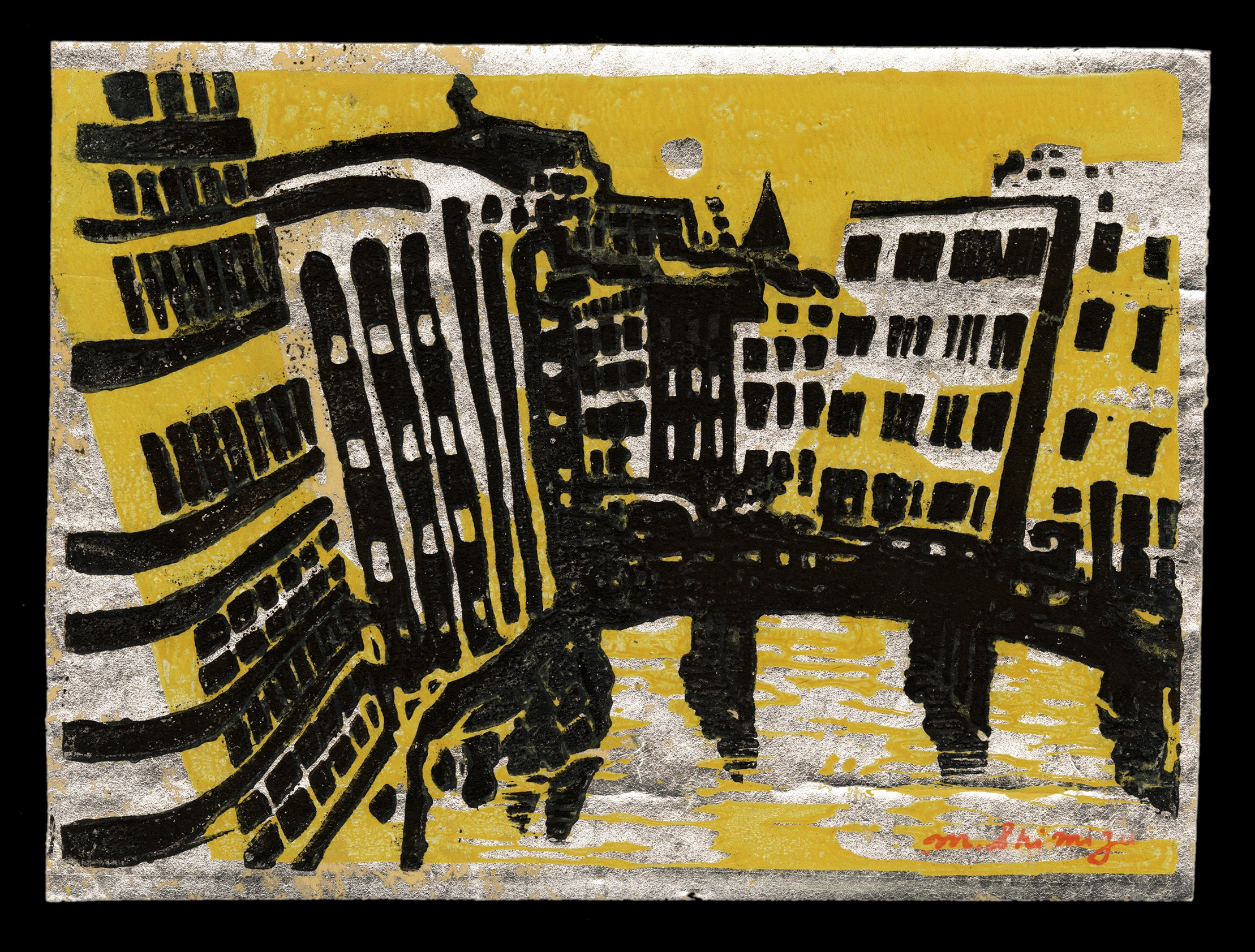
In From Sukiyabashi Bridge, Masahiro Shimizu captures Tokyo as a living field of movement and compressed urban energy. Buildings bend and press inward around the canal while the bridge itself arcs dramatically across the center of the composition, creating a sense of visual momentum that mirrors the restless dynamism of the modern capital. Rather than offering topographical precision, the artist presents the city through expressive distortion, allowing architecture to pulse with psychological intensity.
The district of Sukiyabashi occupied a symbolic position within interwar Tokyo. Situated near Ginza and the rapidly modernizing commercial heart of the city, the area represented cosmopolitan urban life, illuminated nightlife, department stores, cafés, theaters, and modern circulation through bridges, canals, automobiles, and electric infrastructure. Shimizu’s print condenses this atmosphere into a strikingly graphic vision that feels both immediate and dreamlike.
The composition is remarkable for its daring use of color. A radiant field of yellow floods the image like electric light or industrial haze, while thick black forms define the city’s structures with near-abstract intensity. Reflections ripple across the water below, breaking the geometry into fragmented bands of light. The result evokes not a stable cityscape, but a metropolis constantly in flux — shimmering, crowded, and alive.
Shimizu’s approach reflects the experimental ambitions of younger Sosaku Hanga artists during the 1930s, many of whom embraced modern graphic design, abstraction, and expressive carving techniques. Unlike more atmospheric Shin Hanga city views, this work emphasizes structure, rhythm, and emotional immediacy. The compressed perspective and forceful contrasts suggest the influence of European Expressionism while remaining deeply rooted in the tactile language of Japanese woodblock printing.
The print also reveals how waterways continued to shape Tokyo’s modern identity even as the city industrialized. Bridges such as Sukiyabashi connected not only neighborhoods but social worlds — linking commercial districts, entertainment quarters, and the growing culture of urban leisure that defined early Shōwa metropolitan life.
Connoisseur's Note
From Sukiyabashi Bridge stands among the most visually arresting examples of urban Sosaku Hanga from the early 1930s. Shimizu reduces the city to essential forms — bridge, canal, towers, reflected light — producing an image that feels simultaneously architectural and improvisational. The vigorous carving and flattened composition create extraordinary visual tension, revealing the artist’s confidence in pushing woodblock printing toward modernist abstraction.
This impression is particularly notable as a rare variant printed on silver leaf paper. The metallic surface remains exposed in areas intentionally left unprinted by the artist, causing portions of the composition to shimmer beneath changing light. This unusual effect transforms the canal and sky into luminous, reflective spaces, heightening the print’s sense of nocturnal atmosphere and urban radiance. Such experimental printing choices align closely with the exploratory spirit of Sosaku Hanga during this period.
Collectors especially value impressions such as this for their material complexity and rarity. The interaction between matte pigment and exposed silver leaf creates a constantly shifting visual experience, allowing the image to appear alternately atmospheric, industrial, and almost cinematic depending upon the surrounding light.
More prints by Masahiro Shimizu:
1984
$1,500
Street Scene
Masahiro Shimizu (b. 1914)
EDITION: 3/5
DATE: 1984
MEDIUM: Woodblock Print
DIMENSIONS: 24 × 18 inches
CONDITION: Excellent impression and color; small spots of pigment splatter in image from the time of production, as is often the case with the work of this artist
$1,500.00
Contact us to purchase