

 Image 1 of 1
Details
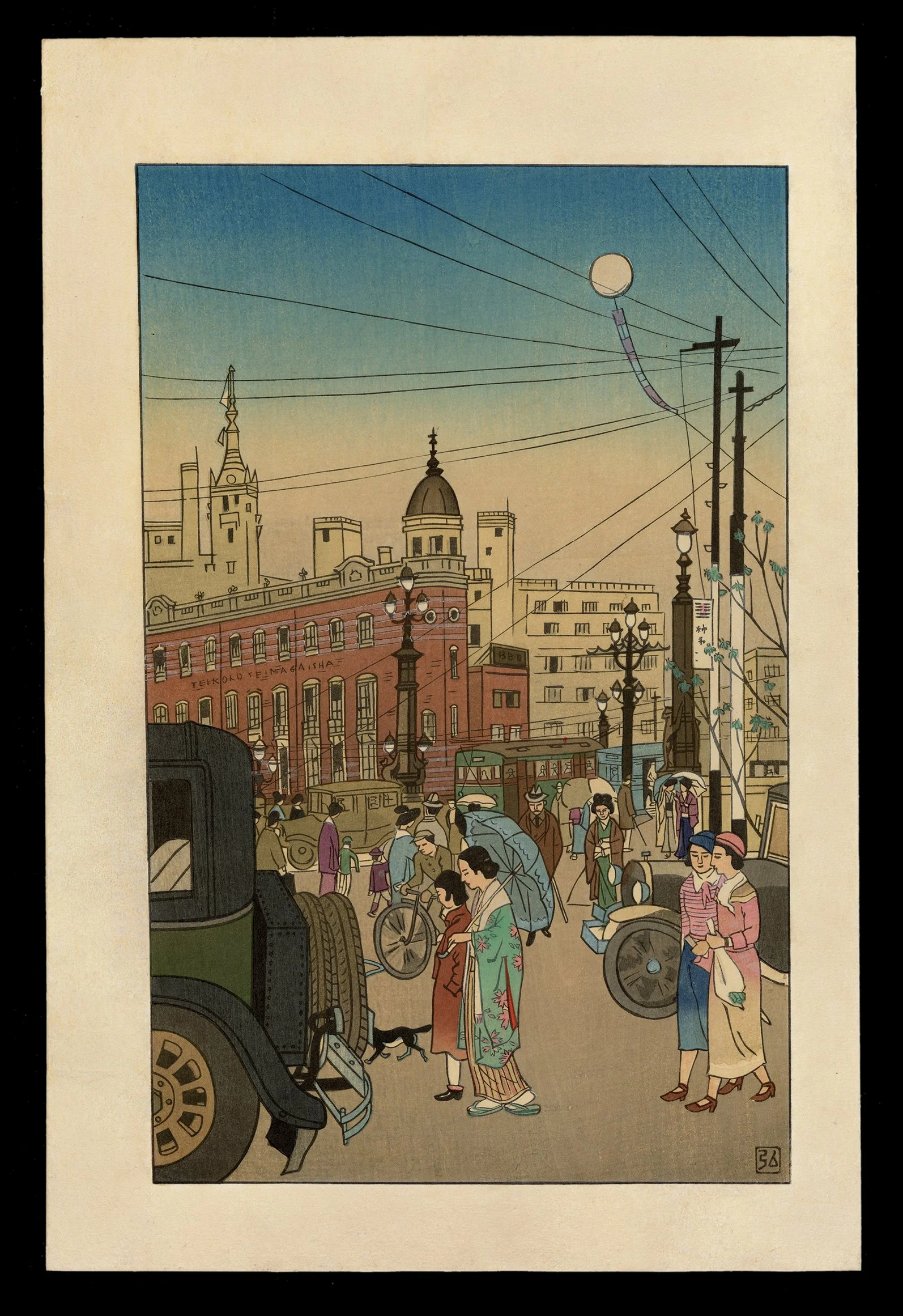
In Nihonbashi in Early Spring, Nakagawa Hiromitsu offers a sophisticated portrait of Tokyo at the height of its interwar transformation. The famous Nihonbashi district, long considered the commercial heart of Edo and later Tokyo, appears here as a fully modern metropolis alive with movement and social exchange. Automobiles crowd the foreground beside bicycles and pedestrians, while overhead utility wires stretch dramatically across the open sky like drawn lines of energy connecting the rebuilt city.
The composition is animated by its remarkable variety of figures. Young women in Western hats and fitted coats walk confidently beside women dressed in kimono, visually embodying the coexistence of tradition and modernity that defined urban Japan during the early Shōwa period. A fashionable modern girl appears comfortably integrated into the same streetscape as more traditionally dressed pedestrians, reflecting the fluid social atmosphere of Tokyo during these years of rapid cultural transformation.
Nakagawa carefully situates the viewer within a city experiencing technological acceleration. Streetcars move through the crowded intersection while telegraph poles and electric lines dominate the upper register of the print. Yet despite these signs of modernization, the artist maintains a graceful compositional harmony characteristic of Shin Hanga aesthetics. The architecture rises with measured elegance rather than overwhelming monumentality, and the soft gradation of the sky lends the scene a gentle seasonal atmosphere that tempers the urban density below.
Particularly notable is Nakagawa’s treatment of early spring light. The pale blue sky and muted warmth of the buildings suggest the first softness following winter, while the crisp clarity of line preserves the freshness of the season. The small balloon floating overhead introduces an almost whimsical note, reinforcing the sense of optimism associated with Tokyo’s reconstruction and modernization during the 1930s.
Unlike many Sosaku Hanga artists who emphasized the immediacy and rough vitality of urban life, Nakagawa approaches the city with the polished sensibility of Shin Hanga. His Tokyo is neither nostalgic nor aggressively modernist; instead, it becomes a carefully balanced urban spectacle where beauty emerges from the coexistence of old and new forms.
Connoisseur's Note
Nihonbashi in Early Spring stands as an especially compelling example of how Shin Hanga artists adapted traditional landscape sensibilities to the realities of modern Tokyo. While earlier ukiyo-e masters such as Hiroshige had depicted Nihonbashi as a center of mercantile Edo culture, Nakagawa transforms the location into a contemporary crossroads of automobiles, department stores, electrical infrastructure, and shifting social identities.
The print is particularly successful in its depiction of transitional urban culture. Rather than isolating modern fashion as novelty, Nakagawa integrates contemporary dress naturally into the rhythm of city life. The juxtaposition of kimono-clad women and stylishly dressed modern girls captures a society negotiating multiple identities simultaneously. Such imagery resonated strongly during the early Shōwa years, when cafés, cinemas, department stores, and new forms of leisure reshaped public life throughout Tokyo.
Collectors have long admired Nakagawa’s refined draftsmanship and atmospheric handling of urban subjects. His use of delicate color harmonies softens what might otherwise become a purely documentary cityscape. Here, the subtle tonal transitions of the sky and the carefully modulated architectural surfaces create a mood of calm observation rather than spectacle.
Fine impressions preserve the elegant balance between crisp linear detail and luminous color gradation that defines the work. The print remains an evocative image of Tokyo poised between memory and reinvention, where the rhythms of modern metropolitan life unfold beneath the fragile light of early spring.
More prints by Nakazawa Hiromitsu: