

 Image 1 of 1
Details
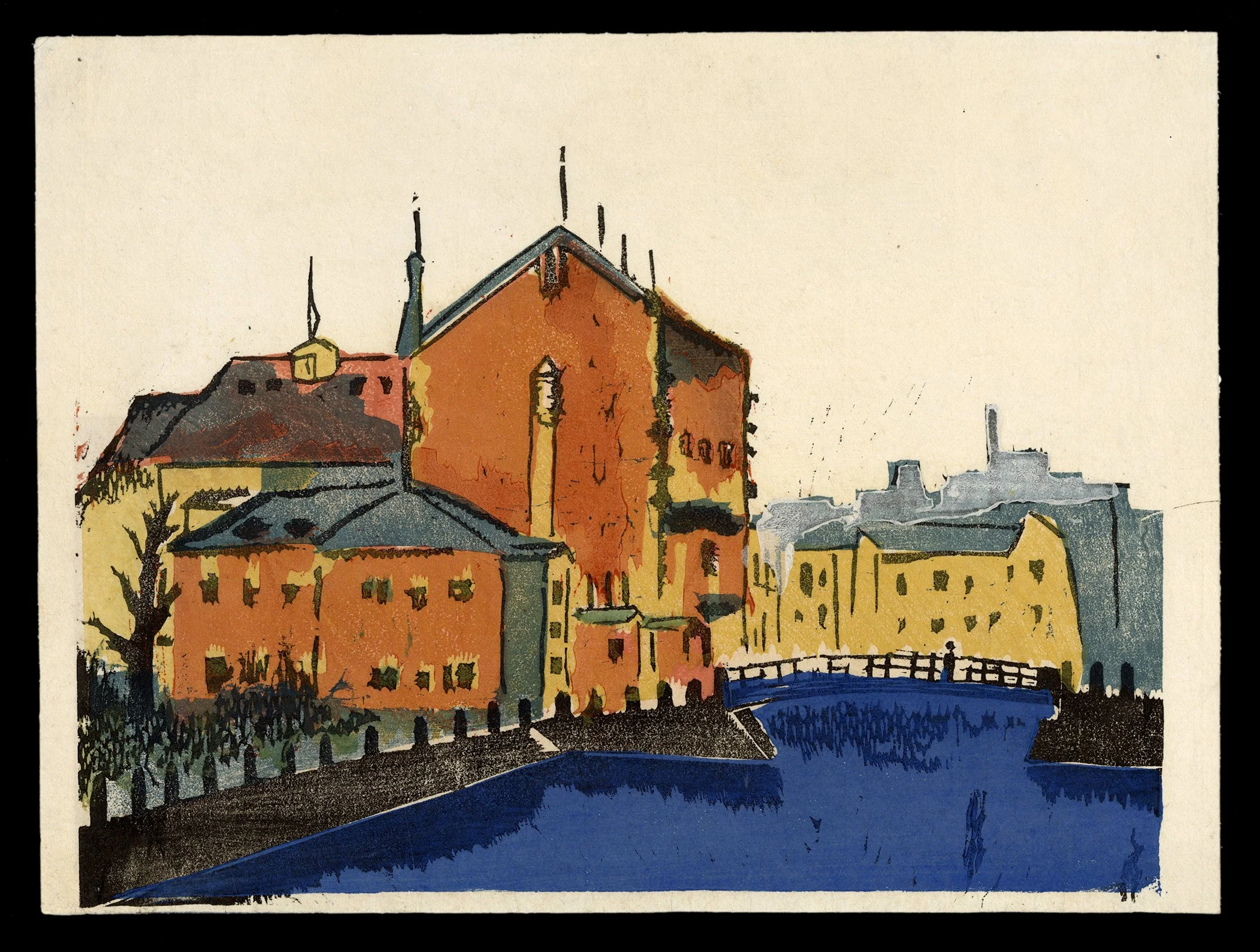
In Shinbashi Bridge, Rokuro Muto offers a quiet and unexpectedly lyrical interpretation of one of Tokyo’s most modern districts. A small bridge arches gently across a vivid blue canal, guiding the eye toward a cluster of warm ochre and rose-colored buildings whose softened silhouettes rise against a pale, open sky. Unlike many urban compositions of the early Shōwa era that emphasize congestion, signage, or electric spectacle, Muto instead presents Shinbashi as calm, spacious, and contemplative. The district appears suspended in a moment of stillness, removed from the hurried energy commonly associated with Tokyo’s entertainment and transportation corridors.
The composition is remarkable for its restraint. Architectural details are reduced to broad planes of color and abbreviated linear accents, allowing atmosphere and spatial rhythm to dominate the image. The bridge itself functions less as a monumental structure than as a modest connective form linking districts, waterways, and patterns of daily movement. The canal occupies nearly the entire foreground, its saturated blue surface creating a broad field of visual quiet that contrasts with the warm density of the buildings beyond. Through this interplay of emptiness and structure, Muto transforms the modern city into a scene of reflective calm.
Shinbashi during the early 1930s stood at the center of Tokyo’s rapidly evolving urban culture. Closely associated with railway transit, cafés, restaurants, nightlife, and commercial activity, the district served as one of the gateways into the modern metropolis. Yet Muto deliberately avoids depicting crowds, illuminated signs, or fashionable urban spectacle. Instead, he isolates the architectural character of the neighborhood itself, revealing how waterways and bridges continued to shape the identity of Tokyo even amid modernization. The result is a cityscape where traces of older Edo-period spatial sensibilities persist beneath the surface of the rebuilt modern capital.
Executed within the Sosaku Hanga movement, the print demonstrates Muto’s sensitivity to balance, color reduction, and compositional clarity. The softened contours and carefully limited palette lend the work an understated elegance distinct from more aggressively modernist urban prints of the period. Though modern in subject, the composition retains a meditative quality that slows the viewer’s gaze and invites prolonged observation.
Connoisseur's Note
This print provides a fascinating counterpoint to other contemporary depictions of Shinbashi produced during the early Shōwa era, particularly those emphasizing nightlife, electric illumination, and metropolitan spectacle. Whereas artists such as Kazuma Oda often portrayed Shinbashi through the dazzling visual language of cafés, stations, and evening entertainment culture, Muto approaches the district through architectural quietude and compositional restraint. His Shinbashi is not a theater of neon modernity, but a carefully ordered urban environment shaped by water, masonry, and atmosphere.
The distinction reveals the remarkable diversity within modern Japanese printmaking during the interwar years. Artists associated with Sosaku Hanga frequently used the city not merely as subject matter, but as a means of expressing differing psychological responses to modernization itself. In Muto’s hands, Tokyo becomes less fragmented and overwhelming than introspective and spatially balanced. The broad canal, simplified buildings, and open sky create a mood of pause and contemplation rarely found in more dynamic representations of the capital.
The print is also notable for the subtle manner in which it negotiates the relationship between old and new Tokyo. Shinbashi had become emblematic of modern transportation networks and commercial expansion, yet Muto’s composition quietly recalls earlier Japanese bridge imagery in its emphasis on water, asymmetry, and gentle passage through space. Modern urbanism is present, though softened into something intimate and humane rather than monumental.
This impression carries the distinguished provenance of the Ono Tadashige Museum, adding further significance to an already uncommon work. Today, Shinbashi Bridge stands as an elegant and highly personal meditation on Tokyo’s evolving cityscape during a period when the metropolis balanced technological transformation with enduring spatial memory.
More prints by Rokuro Muto:
1932
RESERVED
Shinbashi Bridge
Rokuro Muto (1907-1995)
MEDIUM: Woodblock print
DATE: 1932
DIMENSIONS: 11 x 15 ½ inches
CONDITION: Excellent, no problems to note
PROVENANCE: Ono Tadashige Museum
$2,000.00 <RESERVED>