

 Image 1 of 1
Details
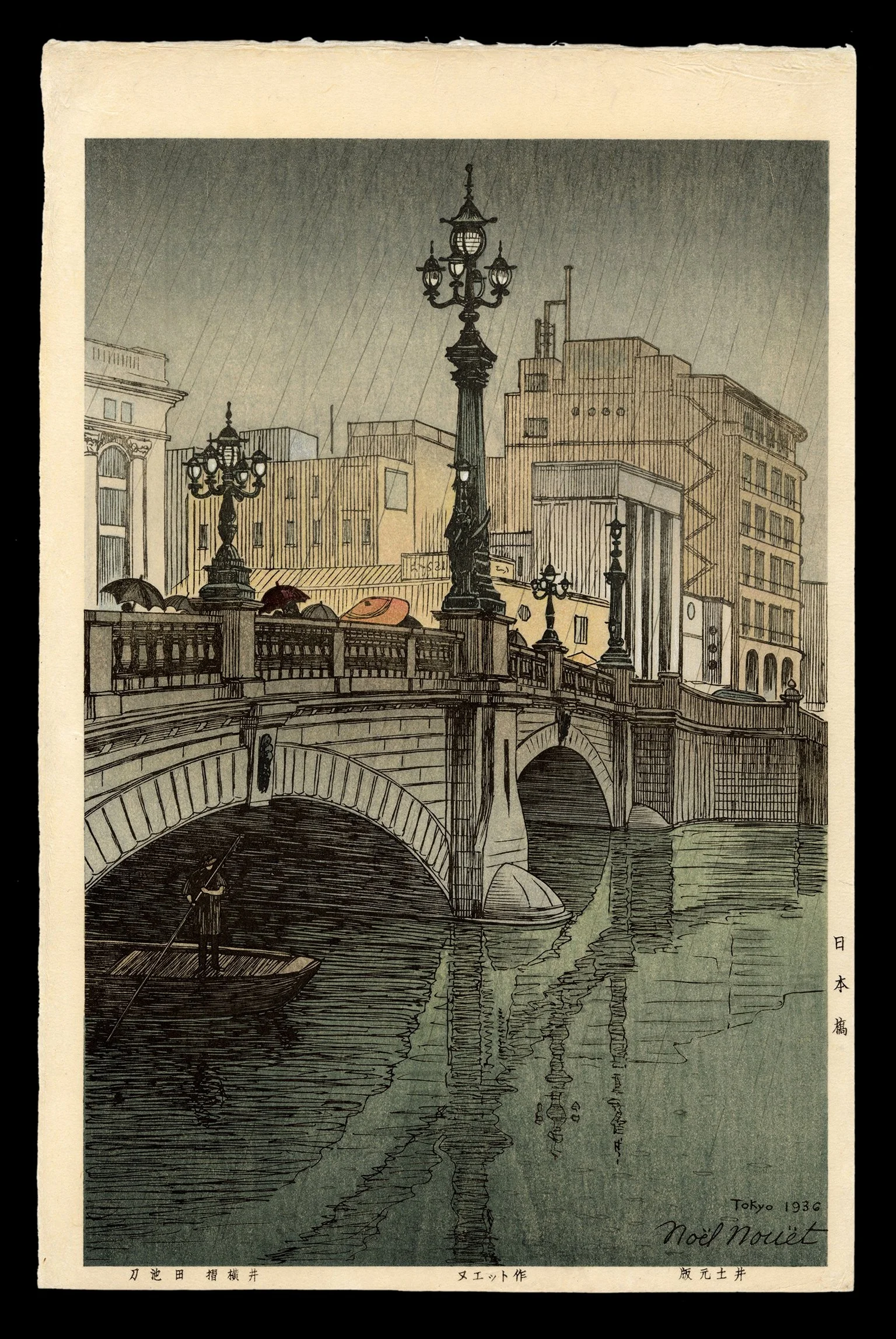
In this refined 1936 depiction of Nihonbashi, Noël Nouët transforms one of Tokyo’s most historically significant bridges into a vivid image of modern urban experience. For centuries, Nihonbashi had served as the symbolic center of Japan’s road network and commercial life, immortalized by Edo-period artists such as Hiroshige as a bustling artery of merchants, travelers, and river commerce. Nouët retains the bridge’s historic importance while presenting it entirely within the atmosphere of contemporary Shōwa Tokyo.
The composition is dominated by the elegant stone bridge arching across the foreground, its decorative lampposts rising rhythmically into a rainy gray sky. Umbrellas move steadily across the bridge in a procession of modern city dwellers, while beneath them a solitary boatman poles his craft through the reflective canal waters below. The contrast between the mechanized geometry of the surrounding architecture and the quiet persistence of older river traditions creates a subtle tension throughout the design. Modern office buildings and commercial facades rise behind the bridge with restrained Art Deco influence, their simplified forms and vertical accents suggesting the international architectural language increasingly visible throughout Tokyo during the interwar years.
Rain becomes one of the print’s most expressive elements. Fine diagonal lines sweep across the composition, softening the hard edges of the city and lending the urban landscape a contemplative atmosphere. Nouët demonstrates extraordinary control in balancing detail with openness: the dark reflections beneath the bridge anchor the composition, while the pale gray sky and water create an enveloping sense of stillness. The city appears active yet hushed, as though momentarily suspended beneath the rainfall.
Unlike nostalgic interpretations of Tokyo that sought to preserve a vanishing Edo, Nouët’s vision embraces the modern city directly. Modern architecture, electrical infrastructure, and contemporary fashion quietly inhabit the scene without spectacle. The bridge itself—rebuilt and monumental—stands as a symbol of Tokyo’s reconstructed identity after the Great Kantō Earthquake. In Japan during this period, modernity was often celebrated through infrastructural elegance rather than sheer vertical monumentality. Bridges such as Nihonbashi embodied the city’s new interconnectedness and engineering sophistication, linking districts, commerce, and people within the expanding urban landscape.
Nouët’s position as a foreign artist working in Japan gives the print particular richness. His work reveals profound admiration for Japanese woodblock traditions while simultaneously bringing a distinctly cosmopolitan sensitivity to composition and atmosphere. The result is neither wholly Japanese nor European, but a remarkably sophisticated fusion of both perspectives.
Connoisseur's Note
Nihonbashi stands among Noël Nouët’s most accomplished Tokyo views, capturing the layered identity of the city during the 1930s with exceptional restraint and elegance. The print succeeds not through dramatic spectacle, but through careful observation of atmosphere, architecture, and daily urban rhythm. Nouët’s ability to transform an ordinary rainy afternoon into a scene of quiet grandeur reflects the sophistication that distinguishes his finest works.
Particularly compelling is the artist’s treatment of historical continuity. Nihonbashi had long occupied an iconic place within Japanese visual culture, yet Nouët refuses sentimental reconstruction. Instead, he presents the bridge as fully integrated into modern metropolitan life—alive with umbrellas, traffic, commercial buildings, and reconstructed civic identity. The scene acknowledges the weight of history while embracing the realities of contemporary Tokyo.
This impression is especially important as a first-state printing published by the Doi publishing house. Later impressions bear Doi seals in the margins; the earliest state is distinguished by the absence of these seals, preserving the composition in its initial published form. The sheet retains the Doi watermark, confirming its early printing and publication history.
Collectors prize first-state impressions for their freshness and clarity, qualities beautifully preserved here. The delicate rain lines remain crisp and uninterrupted, while the tonal gradations within the water and sky possess remarkable subtlety. Particularly noteworthy is the balance between architectural precision and atmospheric softness—a hallmark of Nouët’s mature style.
More prints by Noel Nouët:
1936
$3,000
Ryogoku Bridge
Noël Nouët (1885-1969)
SERIES: Scenes of Tokyo, Twenty-four Views
MEDIUM: Woodblock print
DATE: 1936
DIMENSIONS: 15 1/2 x 10 1/2 inches
CONDITION: Excellent, no problems to note
NOTE: Published by Doi Eiichi
LITERATURE: Scenes of Tokyo, Twenty-four Views
$3,000.00