

 Image 1 of 1
Details
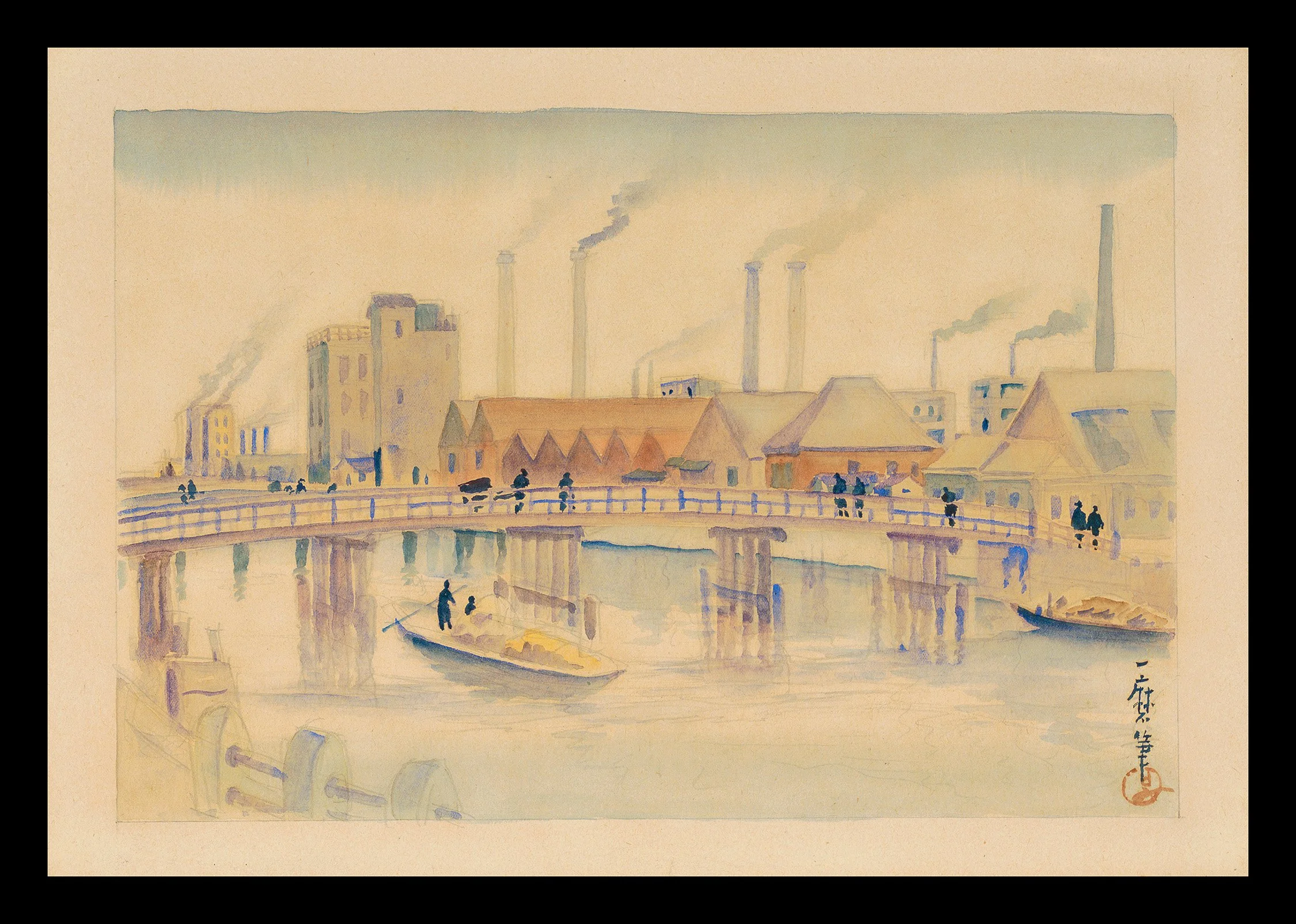
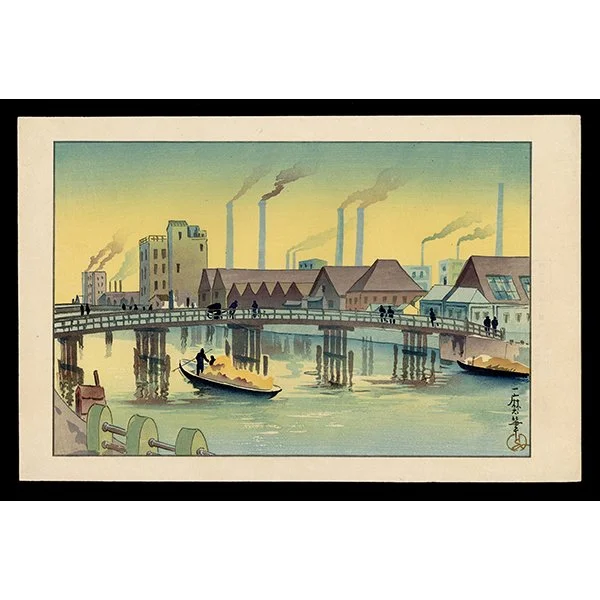
This rare watercolor is the original design from which Kazuma Oda’s woodblock print View of Yagishima was developed. As such, it offers an unusually intimate view of the image before its translation into carved blocks and successive impressions of color. The essential architecture of the finished composition is already fully conceived: the long bridge sweeps laterally across the canal, boats pass through the foreground, and the irregular silhouettes of warehouses and factory buildings are punctuated by a procession of tall smokestacks. Yet in watercolor the scene possesses a markedly different character. Forms remain fluid, edges dissolve, and the industrial landscape seems suspended within an envelope of pale light.
Oda works with remarkable economy. Broad, translucent washes establish the sky and water, while architecture is built from muted ochres, dusty violets, pale blues, and softened browns. Against this restrained field, small accents of deeper blue animate the bridge railings, figures, windows, and boats. Particularly compelling is the treatment of the smokestacks, which emerge almost spectrally through the atmosphere before their plumes disperse into the surrounding paper. The distinction between solid structure and vapor is deliberately unstable: buildings, reflections, smoke, and sky appear to belong to the same shifting tonal continuum.
The watercolor also reveals aspects of Oda’s working process that are necessarily subdued in the finished woodblock. Fine graphite lines remain visible in places beneath and beyond the washes, recording the initial construction of architectural forms and the placement of reflections upon the water. Elsewhere, color has been allowed to wander softly across these boundaries. The result is not simply a blueprint for another medium, but a work possessing the freshness of direct observation and the provisional freedom of an artist still determining the final balance of the image.
Comparison with the subsequent woodblock is especially revealing. In the print, the architecture acquires greater definition, the bridge becomes more emphatically articulated, and the contrasts between water, buildings, figures, and sky are strengthened through carving and controlled color printing. The watercolor, by contrast, depends upon permeability. Its bridge seems lighter, its distant factories less substantial, and its expansive cream-yellow atmosphere more enveloping. Even the reflections beneath the bridge are suggested through loose vertical strokes and transparent passages rather than the more organized patterns required by the printed medium. What would become a carefully resolved woodblock composition survives here at the more fugitive moment when observation, memory, and design were still closely intertwined.
Connoisseur’s Note
Preparatory works for modern Japanese prints occupy a particularly revealing position between the private act of artistic invention and the collaborative procedures of woodblock production. In the finished View of Yagishima, Oda’s design passed into the hands of carver Aoyagi Takeo and printer Mura Kumakichi, whose technical expertise transformed the artist’s image into the disciplined vocabulary of the color woodblock. The present watercolor precedes that transformation. It preserves Oda’s own hand before the image was interpreted through carving, registration, pigment, and repeated printing.
Its relationship to the published woodblock therefore gives the work significance beyond that of a related watercolor. Here one can study what Oda established at the outset and what was subsequently clarified in print: the placement of the principal architectural masses, the cadence of the smokestacks, the sweep of the bridge, the disposition of figures and boats, and, above all, the atmospheric conception upon which the finished image depends. The comparison demonstrates how successfully the later craftsmen retained the sensibility of Oda’s watercolor while translating its translucent washes into the fundamentally different language of carved line and superimposed color.
There is also a compelling reversal of emphasis between the two works. The limited-edition woodblock represents the culmination of a sophisticated collaborative process; this watercolor records its point of origin. Its visible pencil construction, delicate washes, passages of unresolved detail, and subtle variations of touch preserve decisions that disappear once the design assumes its reproducible form. The sheet consequently provides rare material evidence of the creative sequence behind one of Oda’s most evocative industrial landscapes.
For the collector, the survival of the original watercolor together with knowledge of its corresponding woodblock offers an exceptional opportunity to consider conception and realization side by side. Rather than functioning merely as a preliminary study, the watercolor stands as an independent work of considerable delicacy while simultaneously documenting the genesis of the published image. It brings the viewer closer to Oda himself—to the moment when View of Yagishima existed not yet as an edition of prints, but as pigment, pencil, water, and an artist’s first resolved vision on paper.
More prints by Kazuma Oda:

1929-30
RESERVED
Twilight at Ginza
Kazuma Oda (1882-1956)
SERIES: Print Collection of Great Tokyo
MEDIUM: Woodblock print
DATE: 1929-30
DIMENSIONS: 9 3/8 x 12 7/8 inches
CONDITION: Excellent, no problems to note
NOTE: This impression is a rare color variant with a lighter and brighter palate
LITERATURE: Machida City Museum of Graphic Arts, Kazuma Oda, pl.102
$4,500.00 <RESERVED>