

 Image 1 of 2
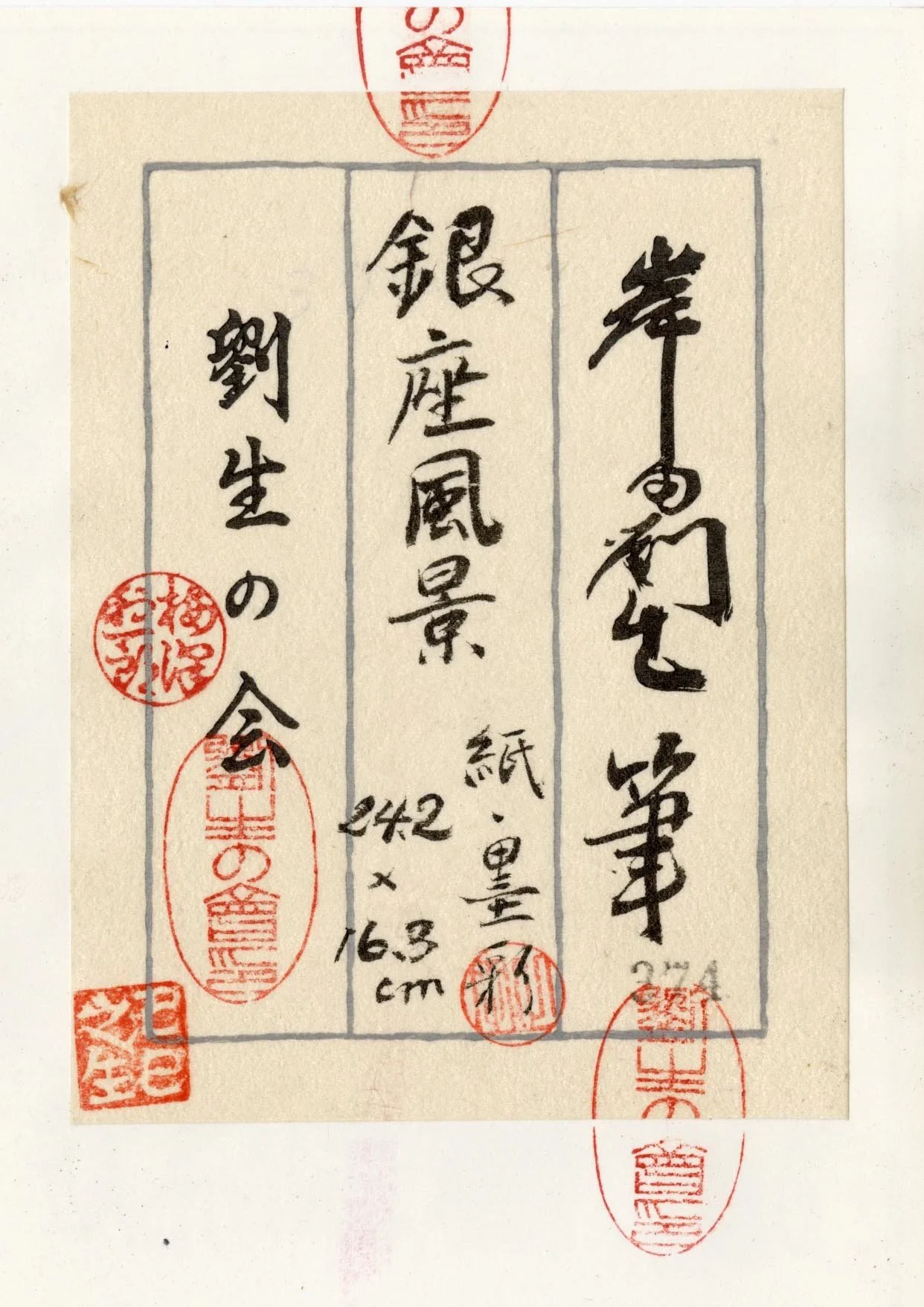 Image 2 of 2
Details
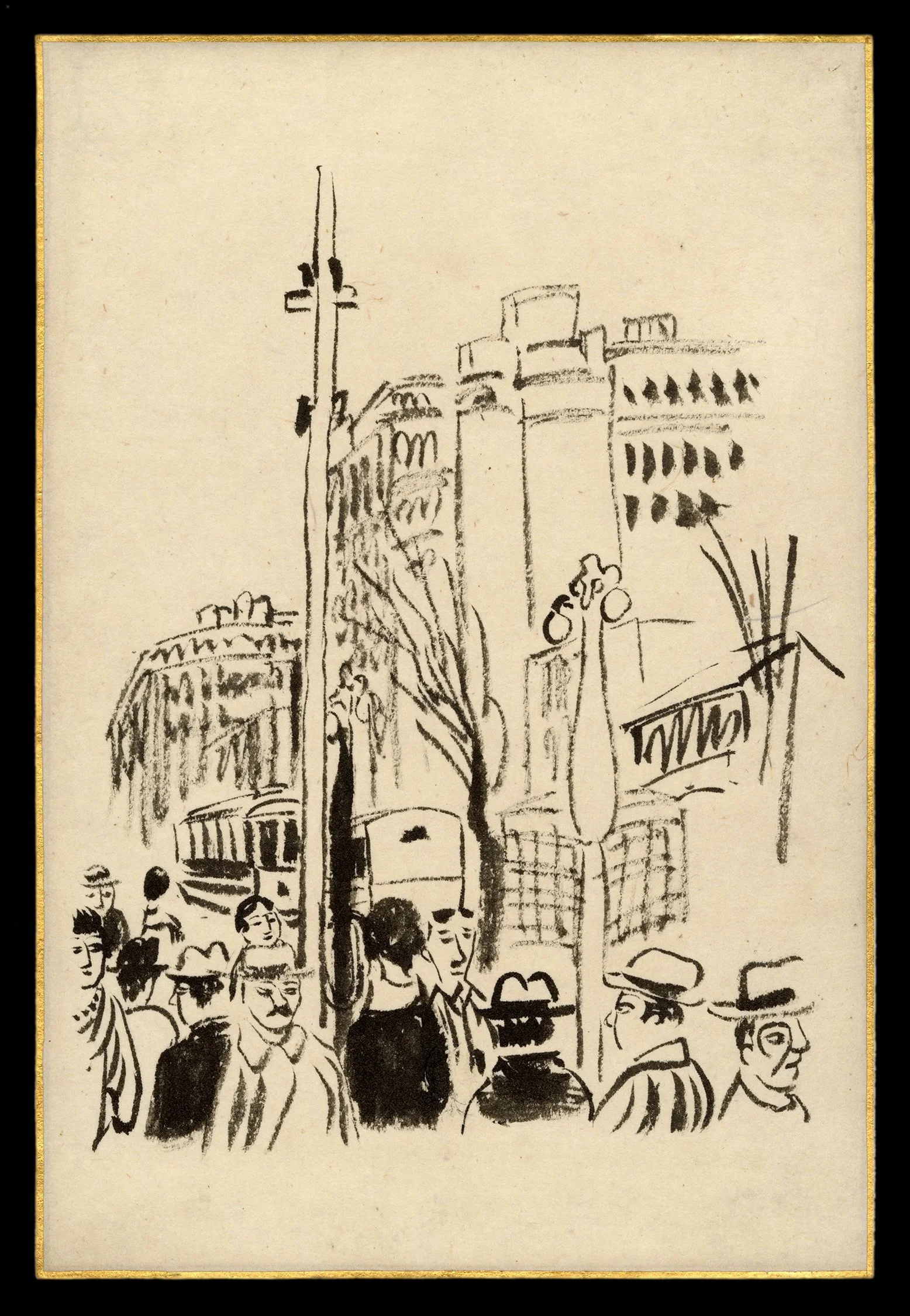
Executed in 1925, this lively ink drawing by Ryusei Kishida captures the dense visual rhythm of Ginza during one of the most transformative moments in modern Tokyo’s development. The composition presents a crowded urban street animated by pedestrians, automobiles, streetcars, utility poles, and rising commercial architecture, all rendered through an economy of line that conveys both immediacy and remarkable observational precision. Though modest in scale, the drawing possesses an expansive metropolitan energy, transforming an ordinary city intersection into a vivid portrait of modern urban experience.
The scene reflects Ginza’s emergence during the Taishō and early Shōwa years as the symbolic center of Tokyo modernity. By the mid-1920s, the district had become synonymous with cafés, department stores, cinemas, transportation networks, and fashionable pedestrian culture. Kishida’s drawing captures this atmosphere not through grand spectacle, but through accumulated fragments of everyday life: clustered hats moving through crowds, passing streetcars, telephone poles cutting vertically through the composition, and layered building facades receding into the city beyond. The artist’s loose but highly controlled brushwork allows the image to oscillate between architectural structure and fleeting human movement.
Particularly striking is the way Kishida organizes the urban space through vertical and horizontal rhythms. The central utility pole anchors the composition while simultaneously dividing and unifying the surrounding activity. Streetcar lines, rooftops, signage, and windows generate a lattice-like framework against which the pedestrians appear almost transient. This interplay between permanence and movement reflects the accelerating pace of metropolitan life during the interwar period, when technological infrastructure and human circulation increasingly defined the visual character of Tokyo.
Unlike more polished finished paintings, the drawing preserves the immediacy of direct observation. Rapid ink passages and abbreviated forms suggest the artist working quickly before a constantly shifting urban scene. Yet despite this spontaneity, the composition remains remarkably balanced, revealing Kishida’s sophisticated understanding of spatial compression and visual rhythm. The result is both documentary and atmospheric — a city not simply recorded, but experienced.
Connoisseur's Note
Although Ryusei Kishida is celebrated primarily for his psychologically intense portraiture and highly refined oil paintings, drawings such as the present work reveal a different but equally important dimension of his artistic practice. Urban sketches allowed the artist to engage directly with the changing visual environment of modern Tokyo, capturing transient impressions with a freedom often absent from more formally constructed studio compositions. These works provide invaluable insight into how Kishida observed and interpreted the rapidly modernizing city around him.
The work’s restrained monochromatic palette further heightens its modernity. Rather than relying upon coloristic effects, Kishida constructs the entire urban atmosphere through variations of ink density, calligraphic line, and open paper space. This reduction creates a visual immediacy remarkably close to journalistic illustration while simultaneously retaining the sensitivity and structural intelligence of fine draftsmanship. The balance between spontaneity and compositional control is particularly masterful.
Works of this nature remain highly desirable not only because of Kishida’s early death in 1929, but also because they preserve direct encounters with Tokyo before the radical transformations of the 1930s and wartime period. The accompanying Ryusei Kishida Society certificate further strengthens the work’s importance and authenticity. As both an intimate drawing and a rare historical vision of interwar Ginza, the present work stands as a compelling testament to Kishida’s ability to distill the energy of modern urban life into a few remarkably economical lines.
More prints by Ryusei Kishida: