

 Image 1 of 1
Details
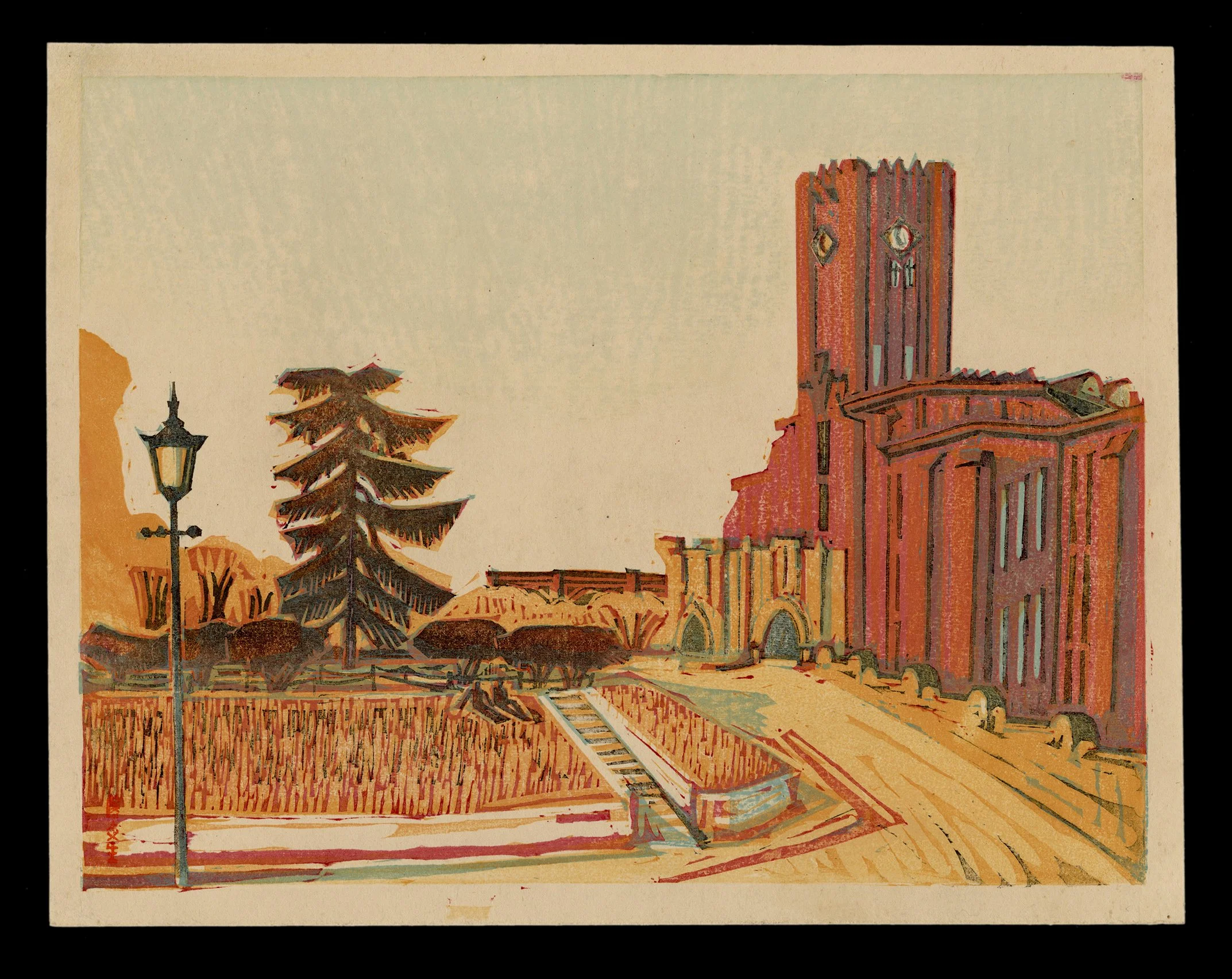
In Imperial University (Waseda University) in Autumn Light, Shizuo Fujimori constructs a luminous vision of modern Tokyo shaped through clarity, openness, and restrained elegance. Dominating the right side of the composition is the striking Art Deco-inspired university building, rendered in warm tones of rose, ochre, and muted violet. Its tower rises confidently into the pale sky, embodying the architectural modernity that increasingly defined Tokyo following the reconstruction efforts after the Great Kantō Earthquake.
Balancing the monumental geometry of the university structure is a large tree positioned prominently near the center of the composition. Its layered foliage and organic silhouette soften the rigidity of the surrounding architecture, creating a subtle dialogue between the natural world and the newly ordered urban environment. Fujimori’s treatment of the tree is particularly sensitive: rather than functioning merely as landscape detail, it becomes a stabilizing presence within the composition, grounding the modern cityscape in seasonal atmosphere and quiet contemplation.
The broad open spaces, carefully planned pathways, and orderly landscaping reflect the increasingly modernized civic planning of Tokyo during the 1930s. Yet despite the emphasis on urban progress, the print remains deeply atmospheric. The warm tonalities of the foreground and the soft diffusion of autumn light lend the scene a sense of stillness and reflection. The city appears neither crowded nor frenetic, but calm and aspirational—a place shaped by education, culture, and intellectual life.
Institutions such as Waseda University occupied an important symbolic role within modern Tokyo. They represented the emergence of a new urban generation shaped by literature, journalism, international thought, and rapidly changing social values. The print quietly evokes the world of students, writers, and modern young people moving through these spaces, participating in the expanding cosmopolitan identity of the capital.
Stylistically, Fujimori combines the flattening tendencies of Japanese woodblock design with the geometric simplifications of international modernism. Architectural forms are reduced into elegant planes of color and line, while the subtle layering of pigment preserves softness and depth. The result is a composition that feels simultaneously modern and contemplative, sophisticated yet restrained.
Connoisseur's Note
This print stands among the most refined urban landscapes produced within the Sosaku Hanga movement during the 1930s. Fujimori’s achievement lies in his ability to portray Tokyo not as a spectacle of industrial power alone, but as a carefully balanced cultural environment where architecture, public space, and seasonal atmosphere coexist harmoniously.
Particularly compelling is the relationship between the towering university building and the large tree beside it. Rather than allowing modern architecture to dominate entirely, Fujimori introduces an organic counterpoint that tempers the composition’s geometry with quiet humanity. The tree’s presence softens the cityscape and introduces a sense of continuity and calm within an otherwise rapidly modernizing environment.
The print also reflects the broader fascination among Sosaku Hanga artists with documenting Tokyo as it actually appeared during the interwar years—not as an idealized memory of Edo, but as a living contemporary metropolis shaped by new architecture, urban planning, and intellectual culture. Fujimori’s restrained palette and spacious composition distinguish the work from more dramatic city views, emphasizing instead the psychological atmosphere of the modern capital.
Impressions from Twelve Views of Greater Tokyo remain highly prized for their rarity and historical importance. In this example, the delicate coloration and openness of the design create a particularly evocative image of Tokyo during a moment of profound transformation, when the rebuilt city sought to define itself through culture, education, and modern civic identity.
More prints by Shizuo Fujimori:
1934
$1,500
Imperial University (Waseda University) in Autumn Light
Shizuo Fujimori (1891–1943)
SERIES: Twelve Views of Greater Tokyo
MEDIUM: Woodblock print
DATE: 1934
DIMENSIONS: 10 ¼ x 13 1/2 inches
CONDITION: Excellent, no problems to note
$1,500.00