

 Image 1 of 1
Details
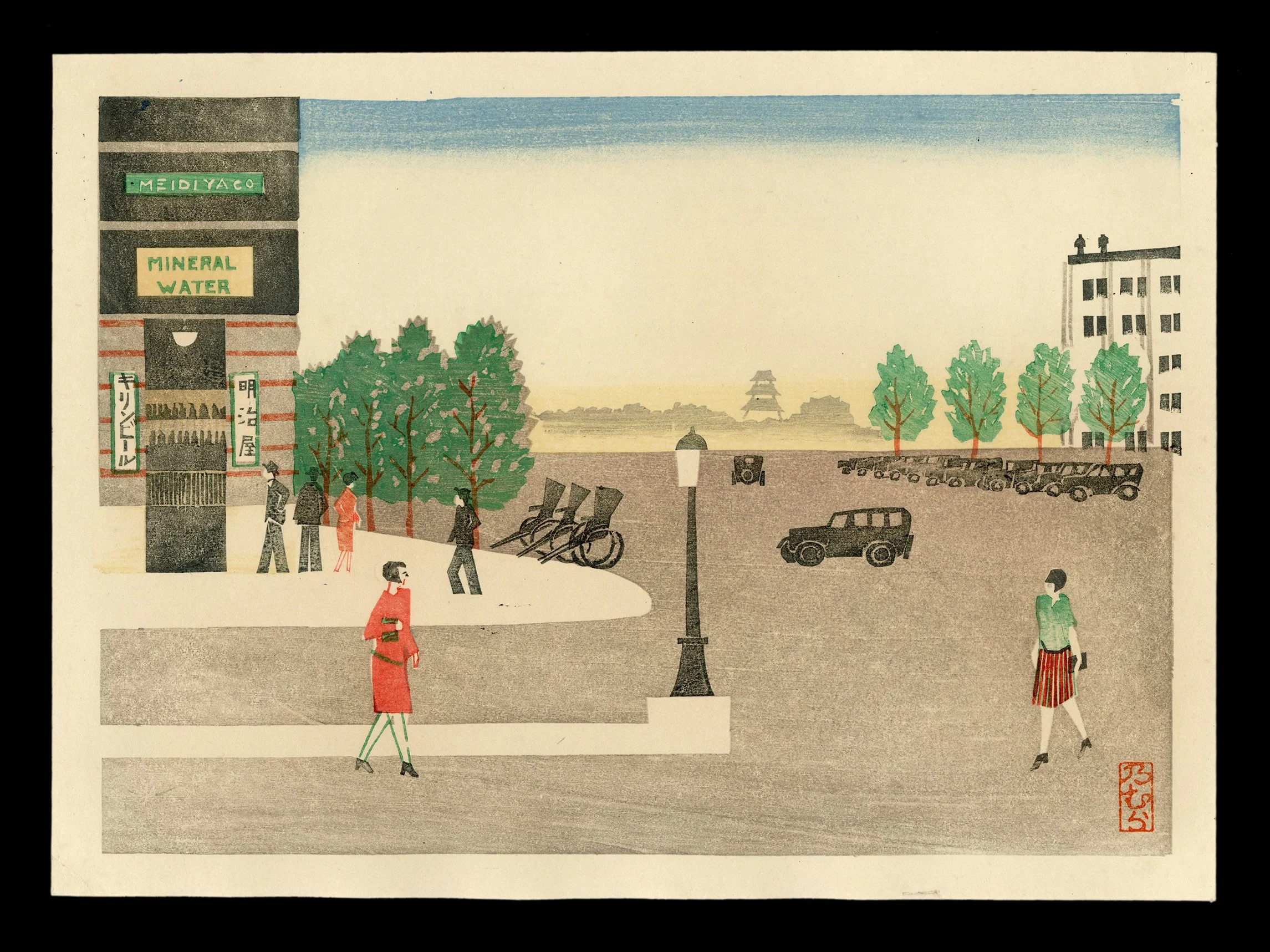
In this refined and quietly lyrical composition, Toshihiko Nomura presents Marunouchi not as a crowded commercial district, but as an ordered and spacious vision of Tokyo’s modern future. The broad avenue unfolds beneath an expansive pale sky while automobiles, pedestrians, and carefully planted rows of trees define a city rebuilt according to modern urban planning ideals. Fashionably dressed women cross the foreground with elegant restraint, their slim silhouettes embodying the sophistication of the early Shōwa metropolis. Beyond the open plaza, the distant outline of Edo Castle quietly lingers upon the horizon, creating a subtle dialogue between historical memory and contemporary transformation.
The print belongs to the celebrated Print Collection of Great Tokyo, a collaborative sōsaku hanga series devoted to documenting the reconstructed capital after the devastation of the Great Kantō Earthquake of 1923. During the late 1920s and early 1930s, Marunouchi emerged as one of Tokyo’s clearest symbols of modernization. Western-style office buildings, department stores, automobiles, cafés, and widened boulevards reshaped the district into a cosmopolitan urban center modeled partly upon European and American city planning while remaining distinctly Japanese in atmosphere and sensibility.
Nomura’s composition captures this balance with remarkable subtlety. The modern city is rendered through flattened geometric forms, restrained color harmonies, and broad areas of open space characteristic of progressive sōsaku hanga aesthetics. Rather than dramatizing urban energy through congestion or spectacle, the artist emphasizes calm order and visual clarity. The arrangement of streets, trees, signage, and moving figures creates a rhythm that feels simultaneously modern and contemplative. Even the commercial storefront advertising “Mineral Water” reflects the growing consumer culture of interwar Tokyo, where imported tastes and Western leisure habits increasingly shaped daily urban life.
Particularly striking is the presence of the modern women who animate the scene. Their fashionable attire, short hairstyles, and confident movement through public space evoke the emergence of the moga—the “modern girl” who became a defining cultural figure of late Taishō and early Shōwa Japan. Here, however, the moga is not presented provocatively, but as a natural participant within the modern city itself. Nomura treats these figures with understated elegance, integrating them seamlessly into the rhythm of the rebuilt capital.
Connoisseur's Note
View of Marunouchi stands as an eloquent example of how sōsaku hanga artists reimagined landscape printmaking for the modern age. Unlike earlier ukiyo-e traditions that celebrated Edo’s seasonal pleasures, or the nostalgic romanticism often associated with shin hanga, Nomura’s work addresses the lived reality of contemporary Tokyo. The rebuilt city itself becomes the subject of poetic reflection.
The composition reveals the influence of modern graphic design and Art Deco sensibilities that permeated Japanese visual culture during the late 1920s. Simplified architectural forms, delicate tonal restraint, and asymmetrical spatial balance give the print an unmistakably modern visual language. Yet despite these international influences, the work retains a distinctly Japanese sensitivity toward emptiness, atmosphere, and measured visual rhythm. The open spaces of the avenue and sky create a quiet interval within the composition, evoking a contemplative mood that softens the machinery of modern life.
Equally compelling is the tension between permanence and transformation embedded within the image. The distant silhouette of the old castle recalls the historical foundations of Tokyo even as automobiles and modern buildings define the foreground. This coexistence of past and present was central to the psychological landscape of interwar Japan, where rapid modernization unfolded alongside persistent awareness of cultural continuity.
Today, View of Marunouchi remains both a sophisticated urban landscape and an invaluable historical document of reconstruction-era Tokyo. Nomura captures a fleeting moment when the Japanese capital sought to redefine itself as one of the great modern cities of the world. Through its calm geometry, elegant figures, and restrained atmosphere, the print preserves the optimism and refinement of that transformative period with exceptional grace.
More prints by Toshihiko Nomura:
1929-30
$1,500
View of Marunouchi
Toshihiko Nomura (1904–1987)
SERIES: Print Collection of Great Tokyo
MEDIUM: Woodblock print
DATE: 1929-30
DIMENSIONS: 9 x 12 1/4 inches
CONDITION: Excellent, no problems to note
$1,500.00