

 Image 1 of 1
Details
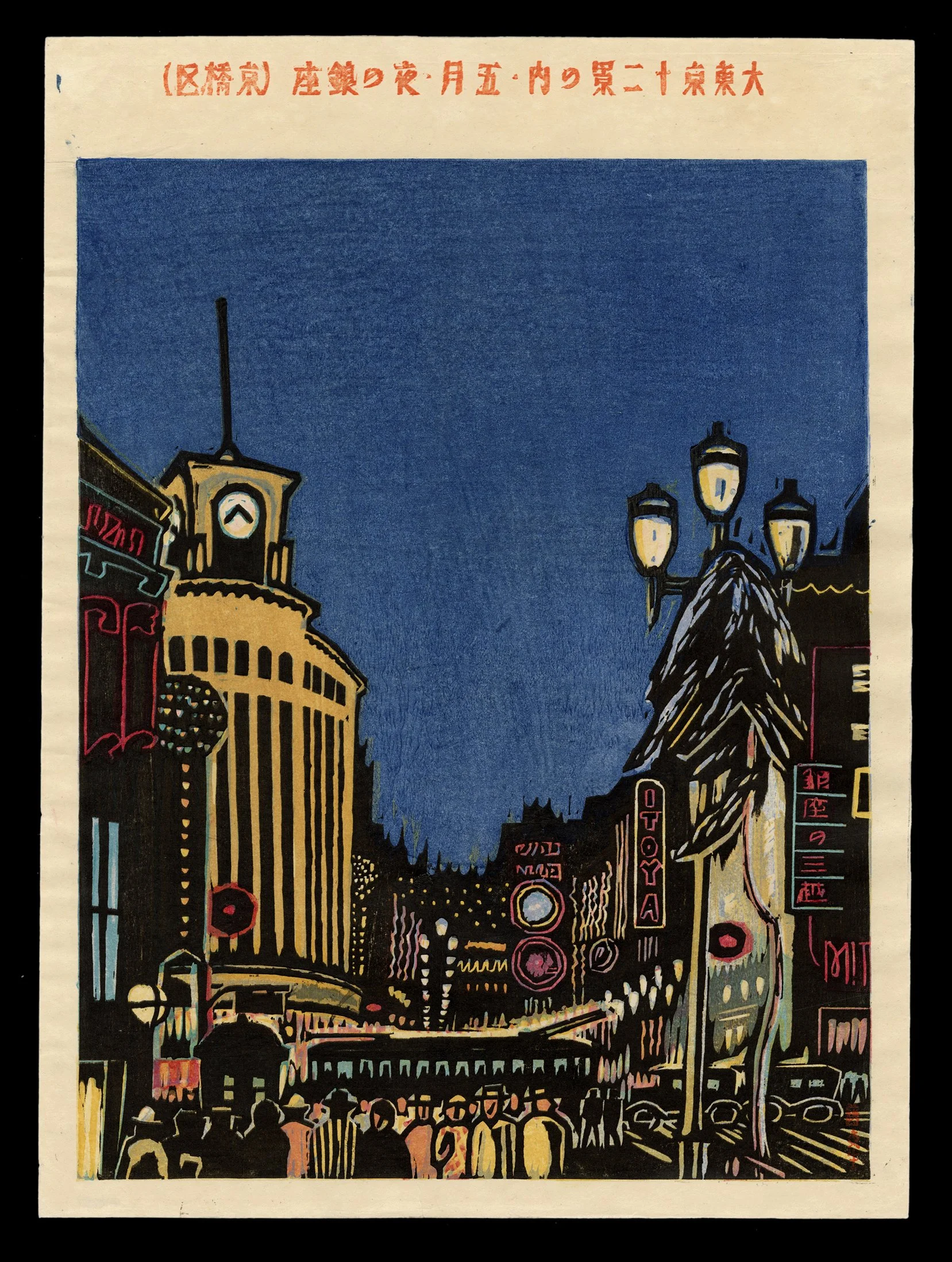
In May, Night View of Ginza, Shizuo Fujimori transforms Tokyo’s most cosmopolitan district into a luminous theater of electric modernity. Beneath an expansive cobalt evening sky, the streets of Ginza glow with neon signage, illuminated storefronts, and streams of urban life moving through the city after dark. The composition pulses with energy while remaining remarkably controlled, balancing architectural monumentality with the fleeting rhythms of nightlife.
At the left rises the iconic clock tower of the Wako department store, its curved façade and vertical lines asserting the district’s modern commercial identity. Across the composition, electric signs blaze against the darkness—advertisements for cafés, theaters, and businesses rendered in vivid pinks, reds, and whites. The signs themselves become graphic elements within the composition, reflecting the increasingly international visual culture that transformed Tokyo during the interwar years. Fujimori captures the excitement of a city embracing speed, spectacle, and illumination.
Crowds gather in the foreground beneath the glow of streetlamps and storefronts. The figures are simplified into silhouettes and rhythmic shapes, yet they convey the social vitality of Ginza as a center of evening leisure. Here one senses the presence of mobos and mogas (modern boys and modern girls) moving through cafés, cinemas, jazz halls, and department stores—participants in a rapidly changing urban culture shaped by fashion, mass media, and cosmopolitan aspiration.
Unlike nostalgic visions of Tokyo rooted in Edo-period memory, Fujimori’s Ginza exists wholly within the present moment. Automobiles, electric signage, and dense architectural forms define the scene. The city is not romanticized as timeless, but celebrated precisely for its modernity and international character. The print reflects the fascination many Sosaku Hanga artists held for Tokyo as a living contemporary metropolis, one transformed by reconstruction following the Great Kantō Earthquake and increasingly aligned with global urban culture.
Fujimori’s handling of color is especially sophisticated. The deep ultramarine sky acts as a vast stage against which the illuminated architecture and neon accents shimmer with extraordinary clarity. The contrast between darkness and electric light creates a sense of cinematic atmosphere, evoking the sensory excitement of nighttime Ginza during the 1930s. At the same time, the composition retains a decorative restraint characteristic of Japanese woodblock aesthetics, preventing the scene from becoming visually chaotic despite its density of urban stimuli.
Connoisseur's Note
May, Night View of Ginza stands among the most compelling urban night scenes produced within the Sosaku Hanga movement during the early Shōwa period. Fujimori succeeds in capturing not merely the appearance of Ginza, but its psychological atmosphere: the excitement, glamour, and subtle anonymity of modern metropolitan life after dark.
Particularly remarkable is the artist’s treatment of electric signage and artificial illumination. During the 1920s and 1930s, neon lights became symbols of Tokyo’s transformation into an international modern city. Fujimori incorporates these signs not simply as descriptive details, but as compositional devices that structure the visual rhythm of the print. Their glowing forms create a dynamic interplay between architecture, commerce, and movement, reflecting the increasingly commercialized and visually saturated urban environment of interwar Tokyo.
The print also reveals how Sosaku Hanga artists expanded the possibilities of woodblock printing beyond traditional landscape subjects. Rather than depicting famous scenic views alone, Fujimori embraces the modern city itself as worthy artistic subject matter—its department stores, crowds, nightlife, and illuminated streets becoming emblems of a new urban consciousness.
Impressions from Twelve Views of Greater Tokyo remain highly prized for their rarity and their vivid documentation of Tokyo during one of the most transformative periods in its history. In this example, the bold contrasts, sophisticated color harmonies, and pulsating nocturnal atmosphere combine to create one of Fujimori’s most memorable visions of the modern metropolis.
More prints by Shizuo Fujimori:
1934
$1,500
Imperial University (Waseda University) in Autumn Light
Shizuo Fujimori (1891–1943)
SERIES: Twelve Views of Greater Tokyo
MEDIUM: Woodblock print
DATE: 1934
DIMENSIONS: 10 ¼ x 13 1/2 inches
CONDITION: Excellent, no problems to note
$1,500.00