

 Image 1 of 1
Details
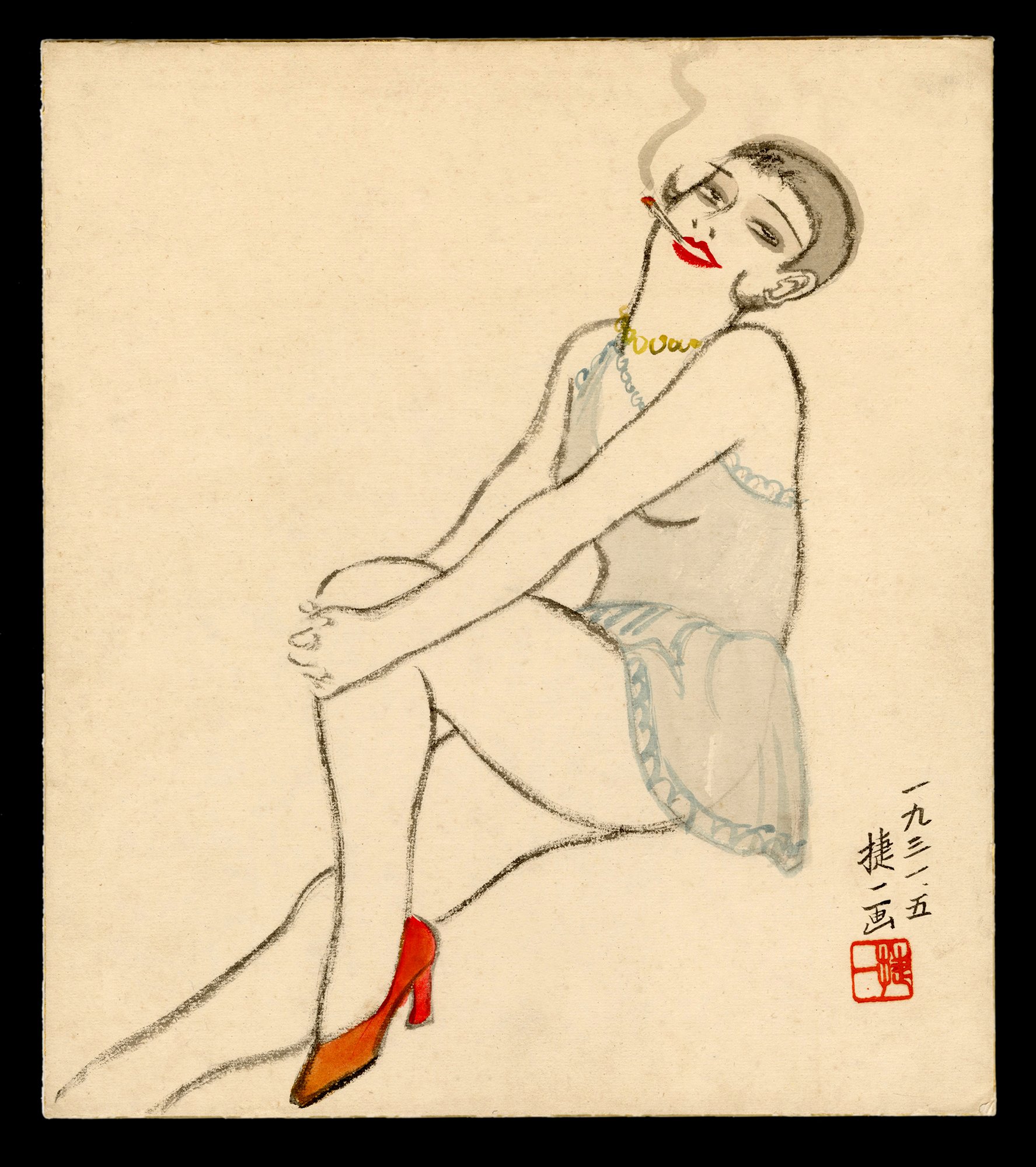
Rendered with remarkable economy of line, this intimate composition captures a reclining young woman suspended between languor and performance. The figure bends elegantly forward, her cropped hair and translucent blue undergarment emphasizing the fashionable sensibilities associated with the urban moga culture of early 1930s Tokyo. Brilliant accents of scarlet define her lips and high-heeled shoes, while the rest of the composition remains restrained and airy, allowing the figure to emerge almost weightlessly from the untouched paper ground. The artist’s abbreviated draftsmanship recalls contemporary fashion illustration and café sketches, yet the work retains the softness and psychological subtlety of a private study rather than a commercial image.
The cigarette is central to the painting’s effect. In Japanese art of the late Taishō and early Shōwa periods, women were frequently shown holding cigarettes as symbols of cosmopolitan sophistication, café culture, or urban leisure. Far rarer, however, were depictions of women actively taking a puff, as seen here. Such imagery carried unmistakable sensual implications and was often regarded as provocative within the conventions of Japanese pictorial culture. Rather than presenting smoking merely as a fashionable accessory, the artist emphasizes the intimate physical act itself: the parted lips, the upward drift of smoke, and the relaxed posture all contribute to an atmosphere of private indulgence. The image quietly destabilizes conventional ideals of feminine decorum while remaining poised and refined.
Created in 1931, the work belongs to a moment when Tokyo had become a center of rapidly changing social identity. Following the reconstruction that succeeded the Great Kantō Earthquake, the city embraced jazz cafés, dance halls, imported fashions, and increasingly visible forms of female independence. The modern girl emerged as both cultural fascination and social anxiety—a figure celebrated for her liberation yet criticized for perceived excess and moral ambiguity. This painting captures that tension beautifully. The woman’s body appears self-possessed and contemporary, yet the surrounding emptiness introduces an introspective stillness that softens overt glamour into something more elusive and emotionally complex.
Connoisseur’s Note
An impressive aspect of the painting’s composition lies in its command of reduction. The unknown artist demonstrates an assured understanding of how little information is required to evoke physical presence. The contours are intentionally incomplete, allowing the untouched paper to participate actively in the composition. This approach aligns the work with a broader international tendency toward economy and linear elegance seen in interwar illustration and design, while still retaining a distinctly Japanese sensitivity to balance and pacing. The figure appears to hover lightly upon the sheet rather than occupy fixed space, lending the composition an unusual sense of immediacy.
The handling of color deserves particular attention. Rather than distributing pigment evenly across the composition, the artist isolates color into highly strategic points of emphasis. The vermillion lips and heels function almost like visual punctuation, creating rhythm and tension within the open field of the paper. This selective use of saturation recalls techniques found in certain bijinga traditions, yet here it is adapted toward a thoroughly modern sensibility. The restraint of the palette prevents the work from becoming overtly decorative; instead, the sparse chromatic accents intensify the emotional temperature of the image.
Works of this nature survive far less frequently than formal woodblock prints or salon paintings from the same period, in part because many were treated as ephemeral studio pieces rather than exhibition works. Their rarity today offers collectors a more intimate encounter with the atmosphere of early Shōwa visual culture. The present work possesses precisely that elusive quality: a feeling of spontaneity refined through exceptional control. Its modest scale and apparent simplicity conceal a highly sophisticated understanding of composition, mood, and modern femininity, rewarding sustained viewing with increasing subtlety and nuance.
More prints by Shoichi Yagihara: