

 Image 1 of 1
Details
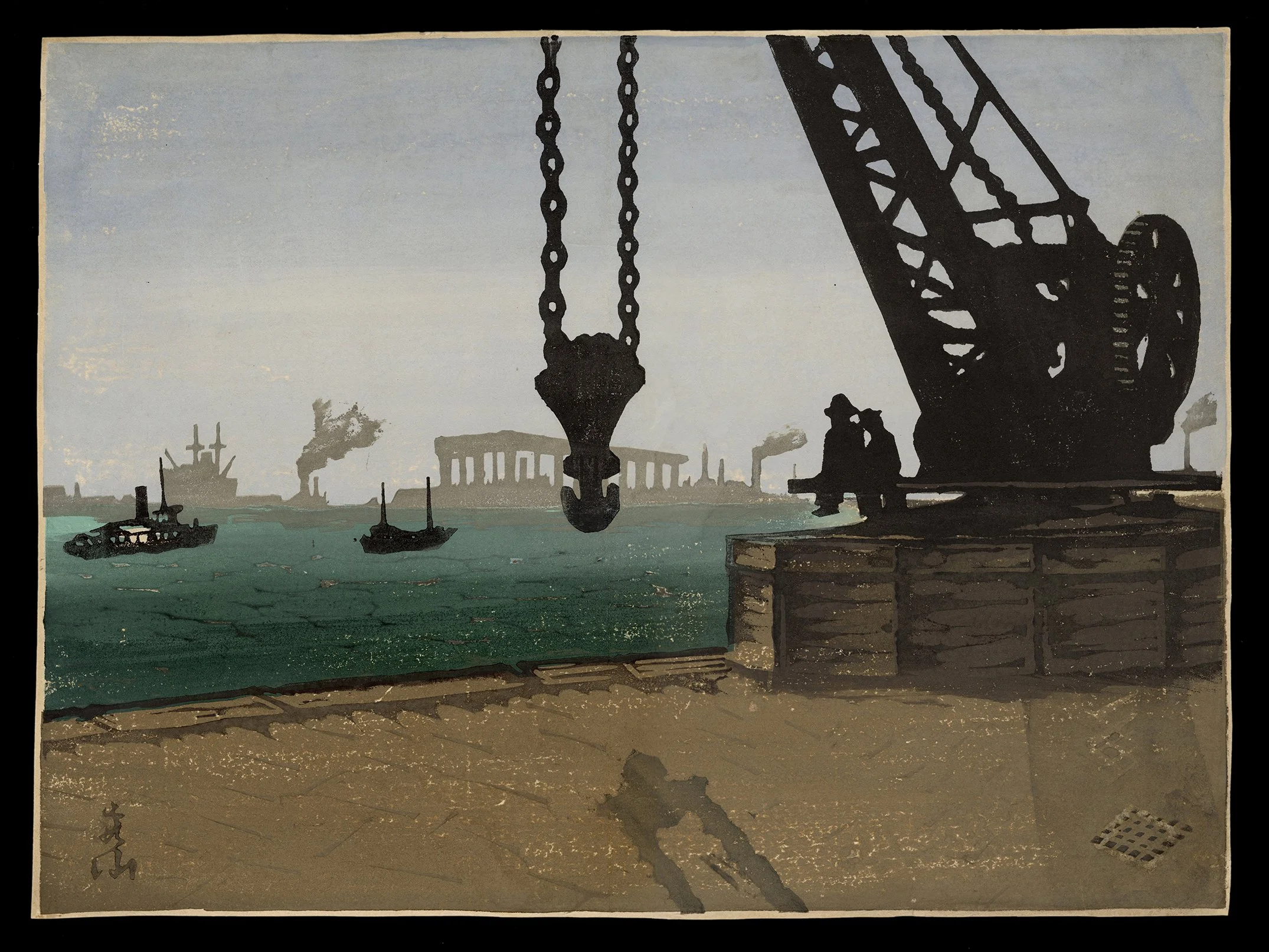
This striking composition presents the Port of Kobe through an austere arrangement of silhouetted industrial forms set against pale atmospheric distance. Dominating the foreground is the massive structure of a harbor crane, its suspended hook and heavy chains hanging dramatically over the water below. Tugboats drift across the harbor while smokestacks and factory structures dissolve into haze along the distant shoreline. The composition is remarkable for its restraint: rather than crowding the scene with descriptive detail, Kasen reduces the harbor to essential geometric masses and broad tonal contrasts, allowing the machinery itself to become the primary visual presence.
By the early Shōwa period, Kobe stood among Japan’s most important international ports, functioning as a critical center of shipping, heavy industry, and foreign commerce. The harbor symbolized Japan’s rapid industrial modernization and expanding global connections during the interwar years. Kasen approaches this environment not through celebratory spectacle, but through quiet observation of industrial scale and atmosphere. The looming crane, rendered almost entirely in black silhouette, conveys both mechanical power and sculptural elegance, while the pale smoke drifting across the horizon softens the severity of the industrial landscape into something contemplative and strangely lyrical. Two small seated figures appear beside the crane in near silhouette, quietly observing the harbor from the dock’s edge. Their understated presence introduces a subtle human dimension to the otherwise monumental industrial setting, emphasizing the immense scale of the machinery and the contemplative stillness of the waterfront despite the constant activity of the port.
The print also reflects the growing fascination among Sosaku Hanga artists with modern infrastructure and urban industry. While earlier Japanese print traditions often emphasized seasonal beauty, famous sites, or theatrical subjects, many artists of the Sosaku Hanga movement turned increasingly toward factories, railways, ports, and cityscapes as worthy subjects of artistic exploration. Here, the harbor becomes a study in balance between solidity and emptiness, weight and atmosphere, modern engineering and open sea.
Connoisseur's Note
Kasen’s compositional strategy reveals a sophisticated understanding of modern graphic reduction. The crane is treated almost abstractly, its angular framework and suspended hook functioning less as descriptive industrial equipment than as commanding formal elements within the picture plane. The massive dark silhouette divides the composition asymmetrically, creating tension between the heavily weighted foreground and the expansive openness of water and sky beyond. This deliberate simplification aligns the print closely with broader international modernist tendencies while remaining deeply rooted in the direct carving aesthetics associated with the Sosaku Hanga movement.
Particularly compelling is the artist’s handling of atmosphere through tonal restraint. Rather than relying on vibrant color contrasts, Kasen limits the palette to muted grays, pale blues, and dark industrial blacks, allowing subtle gradations to carry the emotional register of the scene. The shimmering water surface and softened industrial skyline evoke the humid coastal air of Kobe Harbor, where smoke, sea mist, and reflected light merge into a unified tonal field. The print achieves its emotional effect not through narrative action, but through the quiet tension between monumental machinery and suspended stillness.
Industrial harbor scenes remain comparatively uncommon within prewar Japanese woodblock printing, making works such as this especially significant within the history of modern Japanese printmaking. Kobe’s docks represented one of the clearest visual manifestations of Japan’s industrial transformation during the interwar years, and Kasen approaches the subject with unusual seriousness and formal control. The result is neither documentary nor propagandistic; instead, the print transforms industrial infrastructure into a contemplative modern landscape, revealing how deeply machinery and maritime commerce had entered the visual imagination of early Shōwa Japan.
More prints by Sugato Kasen: