

 Image 1 of 1
Details
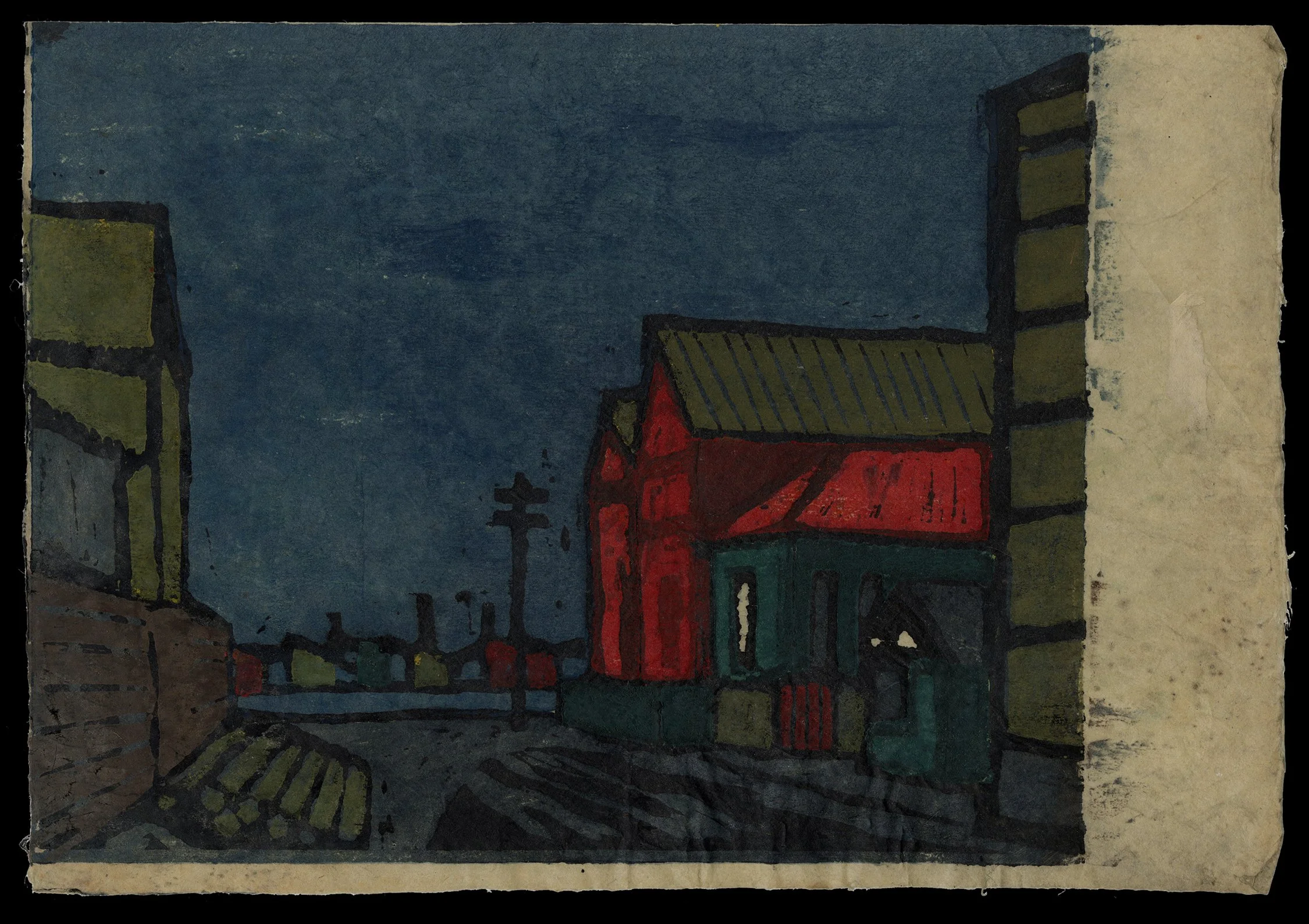
In Factory District (Red Wall), Ono Tadashige turns his attention to the industrial landscape of Tokyo in the decade following the Great Kantō Earthquake of 1923. The catastrophe destroyed vast sections of the capital, but the reconstruction that followed also accelerated Tokyo’s transformation into a modern metropolis. Factories, warehouses, workers’ districts, railways, and new infrastructure spread through the city’s industrial margins, creating a landscape in which rebuilding and modernization were inseparable from the labor of those who sustained them.
Ono presents this new Tokyo without the celebratory rhetoric that so often accompanied images of reconstruction. Beneath a dense blue-black sky, squat factory buildings press toward a narrow roadway. Telegraph poles and chimneys punctuate the horizon, while the composition is dominated by the brilliant red wall and roof of the factory at right. There are no fashionable boulevards, department stores, cafés, or gleaming symbols of metropolitan prosperity. Instead, Ono gives us the working city: compressed, dark, rough-edged, and almost claustrophobic.
The deliberately coarse character of the carving is central to the image. Architecture is reduced to heavy planes bounded by thick black lines; perspective is compressed and irregular; color is dense rather than decorative. The physicality of the woodblock medium remains insistently visible. Such qualities place the work firmly within the prewar sōsaku hanga tradition while also reflecting Ono’s particular interest in art as a socially engaged form of expression.
The industrial expansion represented here depended heavily upon a large workforce of poorly paid and often unskilled laborers, whose working and living conditions could be severe. Ono’s sympathies during these years lay strongly with the political left and with the ideals surrounding the proletarian art movement. His industrial landscapes should therefore be understood not merely as records of a changing city, but as images attentive to the human and social consequences of modernization.
Connoisseur’s Note
The parenthetical title, Red Wall, gives the composition an especially provocative resonance. Visually, the red factory is unmistakably the print’s center of gravity: it burns against the nocturnal blue of the surrounding district, transforming an otherwise anonymous industrial building into the commanding presence of the image.
Given Ono’s leftist sympathies during the prewar period, it is tempting—and reasonable—to perceive a political undertone in this emphatic use of red. The color had already become inseparable internationally from socialism, communism, and the workers’ movement. Without documentary evidence that Ono explicitly intended the wall as a political symbol, however, the association is best understood as suggestive rather than definitive. The ambiguity is precisely what gives the image much of its power. The wall can be read simultaneously as an observed feature of the industrial city, a formal burst of color, and a possible allusion to the political convictions that informed Ono’s view of modern society.
What makes Factory District (Red Wall) particularly compelling is this tension between modernization and its human cost. The rebuilt factories helped create the modern metropolis of Tokyo, yet the prosperity they represented rested in part upon workers whose lives rarely entered the triumphant visual narratives of the reconstructed capital. Ono makes that industrial world itself his subject. The absence of heroic figures is significant: factory, street, wall, and darkened sky become surrogates for labor and the social order surrounding it.
Created in 1934, as political repression increasingly narrowed the possibilities for openly radical cultural expression in Japan, the print belongs to an especially consequential moment in Ono’s development. Its brooding palette, forceful carving, and startling red architecture transform a seemingly modest urban view into something more charged—a portrait of the rebuilt metropolis seen not from its glittering center, but from the industrial margins upon which that modernity depended.
More prints by Tadashige Ono:
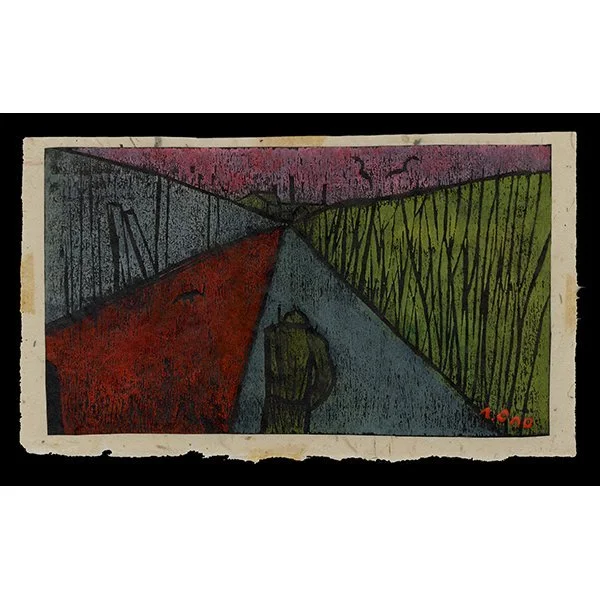
1938
$4,000
Landscape with Bear
Tadashige Ono (1909-1990)
DATE: 1938
MEDIUM: Woodblock Print
DIMENSIONS: 20 ½ x 24 ¾ inches
CONDITION: Excellent impression, color, and condition; light wrinkling to paper
NOTE: Exceedingly rare and early work, possibly unique; silver and gold metallic highlights
PROVENANCE: Ono Tadashige Museum
$4,000.00
Contact us to purchase