

 Image 1 of 1
Details
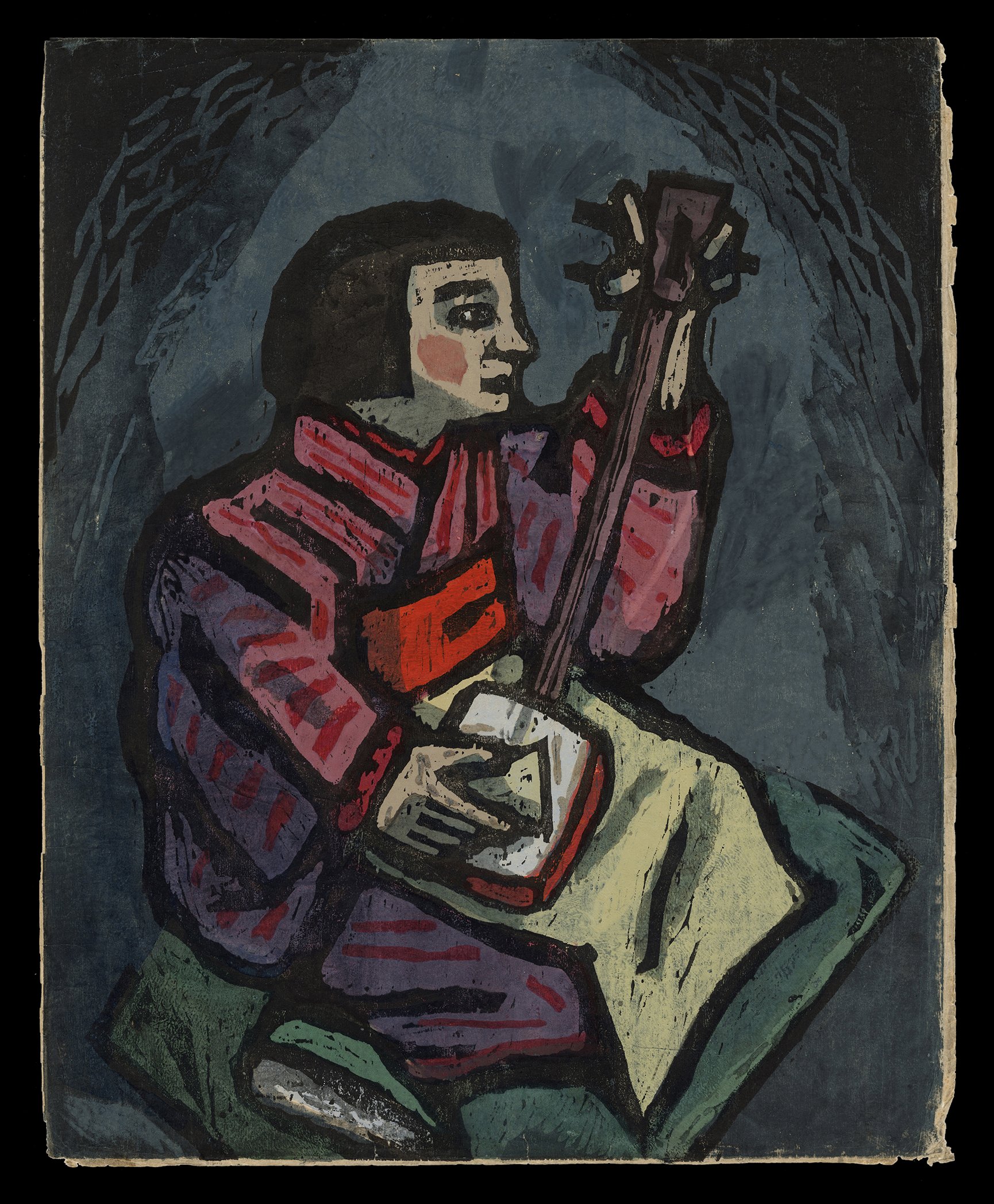
This striking 1934 woodblock print by Tadashige Ono presents a young woman seated with shamisen in hand, rendered through bold angular forms and deeply expressive color contrasts. Executed during the formative years of Ono’s career, Shamisen Performance is an exceedingly rare and highly important early work that demonstrates the artist’s engagement with the experimental spirit of the sōsaku hanga movement. The print’s monumental scale is particularly remarkable: the composition was so large that Ono utilized four separate sheets of paper stitched together in order to realize the design, transforming the traditionally intimate medium of woodblock printing into something almost mural-like in presence.
Unlike the refined lyricism often associated with contemporary shin hanga bijin-ga imagery, Ono approaches the figure through a modernist visual language of flattened planes, thick contouring, and emotionally charged color. The young woman, dressed in a boldly patterned kimono of violet, crimson, and black, appears absorbed in concentration as she practices the shamisen. Her sharply simplified features and mask-like face reveal the influence of European Expressionism and modernist graphic design, while the heavily carved surfaces emphasize the physicality of the woodblock process itself. The darkened blue background swirls around the figure with a near-musical rhythm, enveloping the scene in psychological intensity.
Though the subject matter references a traditional Japanese instrument, the sitter herself possesses the unmistakable aura of the modern girl of early Shōwa Japan. Her cropped hairstyle, stylized pose, and introspective independence align the work with the broader cultural atmosphere of the 1930s, when young women increasingly navigated between inherited traditions and rapidly modernizing urban culture. Ono does not depict the shamisen as nostalgic ornamentation; rather, it becomes an active instrument within modern life, reinterpreted through the sensibilities of a younger generation shaped by contemporary aesthetics and social transformation.
The sheer ambition of the print places it among the most unusual early works of the sōsaku hanga movement. At a time when many creative prints remained modest in scale and private in character, Ono pursued an aggressively modern format whose enlarged proportions amplify both the psychological and physical presence of the figure. The joined sheets themselves become part of the work’s visual structure, emphasizing the handmade nature of the print and the artist’s direct involvement in every aspect of its creation.
Connoisseur's Note
Shamisen Performance occupies an important position within the development of modern Japanese printmaking during the 1930s. Tadashige Ono would later become known for socially engaged imagery and powerful depictions of labor and urban life, yet this early work already reveals the bold formal experimentation and emotional directness that would define his mature career. The print’s expressive carving and unconventional use of scale distinguish it sharply from more commercially oriented woodblock production of the era.
Particularly compelling is the tension Ono creates between modernist abstraction and cultural continuity. The shamisen—a symbol deeply rooted in Japanese artistic tradition—is presented not as a relic of the past, but as part of a living contemporary identity. During the early Shōwa years, artists across Japan grappled with questions of modernization, nationalism, and cultural authenticity. Ono’s response was neither wholly traditional nor wholly Westernized. Instead, he fused the structural dynamism of international modernism with subjects drawn from Japanese daily life.
The work’s rarity cannot be overstated. Large-scale sōsaku hanga prints from this period survive only infrequently, and examples requiring physically joined sheets are particularly scarce. Equally significant is the print’s impeccable provenance: this impression originates from the Ono Tadashige Museum collection, dispersed approximately twenty years ago. Such provenance establishes a direct historical connection to the artist’s preserved legacy and greatly enhances both the scholarly and collector significance of the work.
More prints by Tadashige Ono:
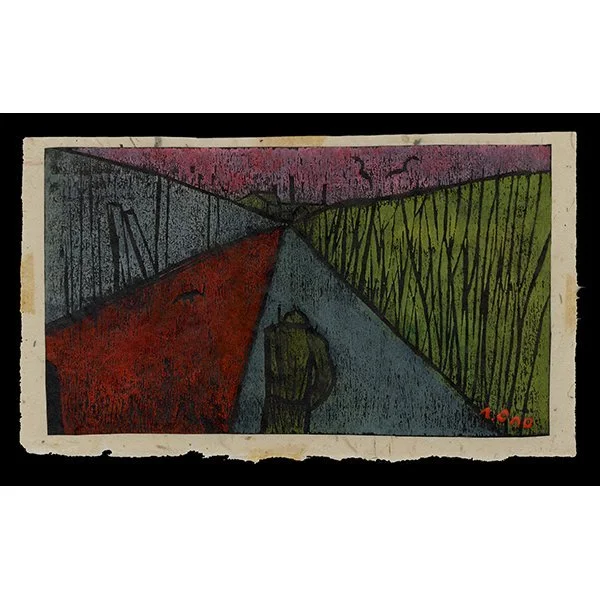
1938
$4,000
Landscape with Bear
Tadashige Ono (1909-1990)
DATE: 1938
MEDIUM: Woodblock Print
DIMENSIONS: 20 ½ x 24 ¾ inches
CONDITION: Excellent impression, color, and condition; light wrinkling to paper
NOTE: Exceedingly rare and early work, possibly unique; silver and gold metallic highlights
PROVENANCE: Ono Tadashige Museum
$4,000.00
Contact us to purchase