

 Image 1 of 1
Details
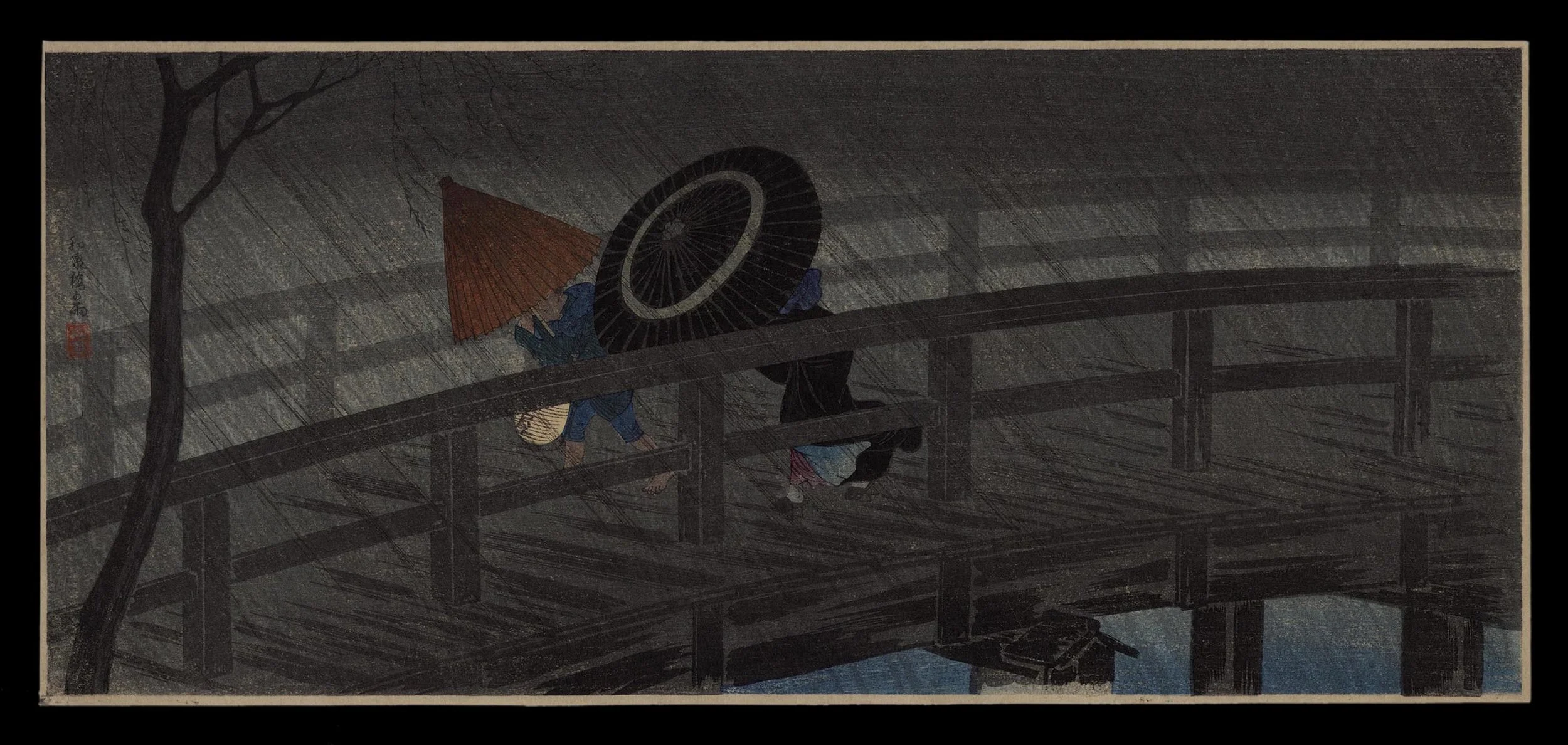
In Izumi Bridge in Rain, Hiroaki revisits one of his most haunting early compositions, reworking it in the years following the Great Kantō Earthquake of 1923. This 1930 version retains the thematic essence of the original—solitary figures traversing a wooden bridge in a downpour—yet the atmosphere here is more dimensional, more tactile, and subtly more humanized.
The scene unfolds with a sense of theatrical immediacy: two travelers, their umbrellas bent against the slanting rain, stride across the curving expanse of the Izumi Bridge. The wood of the bridge is richly textured, almost sculptural in its layered shadows and highlights. The soft illumination of a lantern glows faintly in the distance, while the rain falls in well-defined diagonal strokes that cross the print like a veil, obscuring and revealing with equal measure.
The tree on the left, bare and reaching, adds compositional weight and grounds the viewer in a sense of seasonal passage—likely early spring or late autumn. The pool of reflected color in the water below subtly anchors the composition, offering a quiet contrast to the atmospheric tension above.
Connoisseur's Note
This 1930 edition of Izumi Bridge in Rain is a deliberate reimagining of Hiroaki’s earlier pre-earthquake design Night Rain on Izumi Bridge (c. 1909–1923), which was lost along with its printing blocks in the 1923 disaster. While the earlier version was spare and more abstract—its visual focus diffused by the simplicity of form and limited palette—this later impression introduces greater detail, more defined architecture, and a heightened emotional resonance.
Where the original print evoked mystery through suggestion, this reworking engages the viewer through presence. Figures are more substantial, their garments and movement rendered with vivid contour. The bridge itself feels tactile, its slats and supports firmly etched, and the surrounding world more immersed in light and texture.
Despite these differences, the reworked design succeeds in its own right. It preserves the emotional core of the original—a fleeting human moment amid the solitude of nature—and expands it with a new depth and visual richness. Both prints capture the same scene, but from different aesthetic vantage points: one fleeting and spectral, the other immediate and visceral.
Collectors of Hiroaki’s work will find this later version an important counterpoint to the lost pre-quake design—each print not a repetition, but a reflection. Izumi Bridge in Rain offers a mature, richly layered vision of the same poetic theme: the quiet beauty of passing through rain.
More prints by Takashi Hiroaki Shotei:

1930
$3,000
Mt. Fuji from Hakone
Takahashi Hiroaki (Shotei) (1871–1945)
MEDIUM: Woodblock Print
DATE: 1930
DIMENSIONS: 10 ½ x 15 3/8 inches
CONDITION: Excellent; no condition problems to note
NOTE: Watanabe C-type seal, first state
$3,000.00
Contact us to purchase