

 Image 1 of 1
Details
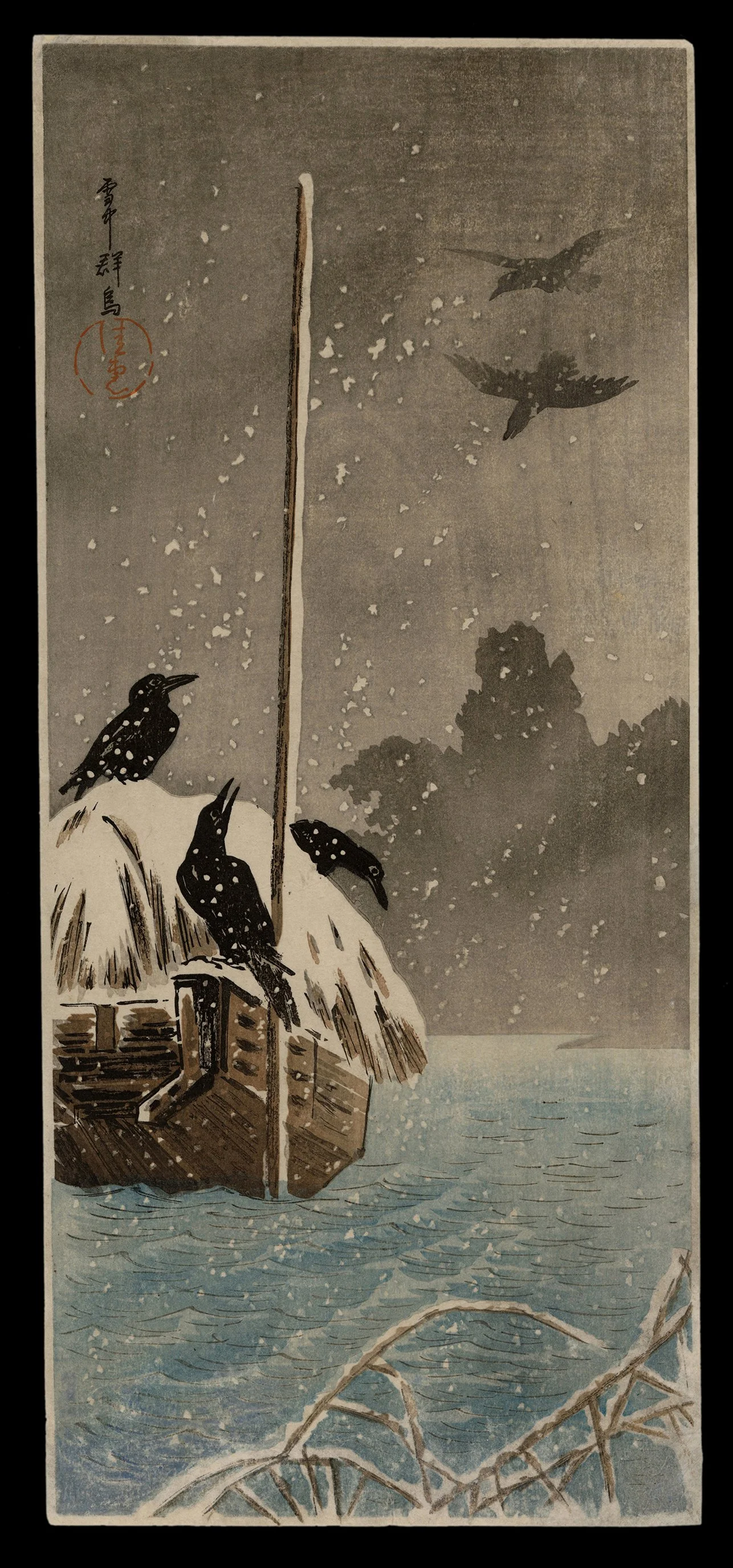
A cluster of crows clings to the snow-laden roof of a fishing boat, while others wing silently across a gray sky as snow falls steadily around them. In Flock of Crows in the Snow, Takahashi Hiroaki (Shōtei) captures a quiet winter scene infused with subtle drama and striking contrast. The dark forms of the birds—some still, some in motion—punctuate a muted, wintry palette of slate grays, soft browns, and icy blues. Each element of the design is carefully balanced: the birds, the softly rippling water, the snow-covered reeds curling in from the lower corner.
The boat, its top blanketed with protective hay and snow, is rendered with warm, earthy tones. Snowflakes fall in varying sizes, giving the composition a depth and sense of motion that feels both real and dreamlike. Shōtei’s restrained use of color and masterful layering of ink creates a sense of mood rather than narrative—a moment suspended in time.
Connoisseur's Note
This hauntingly beautiful design was created before the Great Kantō Earthquake of 1923, which devastated Tokyo and destroyed the Watanabe publishing house along with many of the original woodblocks used by Shin Hanga artists. Flock of Crows in the Snow is one such pre-seismic work—its original blocks lost in the fires that followed the quake.
While Watanabe Shōzaburō would rebuild his studio the following year and reissue some of the designs using newly carved blocks, the original iteration of this print holds particular significance. It showcases Shōtei’s early integration of Western pictorial influences—particularly in the impressionistic handling of atmosphere, light, and perspective—with the lyrical restraint of traditional Japanese composition. The strong woodgrain visible throughout the composition significantly contributes to the romantic atmospheric of this striking composition.
Unlike later reissues, this first version retains a raw immediacy and painterly quality that distinguishes it from more refined post-quake adaptations. It is a rare surviving example of Shōtei’s work during a formative period in the evolution of Shin Hanga—just before the catastrophic event that would reshape both the landscape and the studio practices of modern Japanese printmaking.
More prints by Takashi Hiroaki Shotei:

1930
$3,000
Mt. Fuji from Hakone
Takahashi Hiroaki (Shotei) (1871–1945)
MEDIUM: Woodblock Print
DATE: 1930
DIMENSIONS: 10 ½ x 15 3/8 inches
CONDITION: Excellent; no condition problems to note
NOTE: Watanabe C-type seal, first state
$3,000.00
Contact us to purchase