

 Image 1 of 1
Details
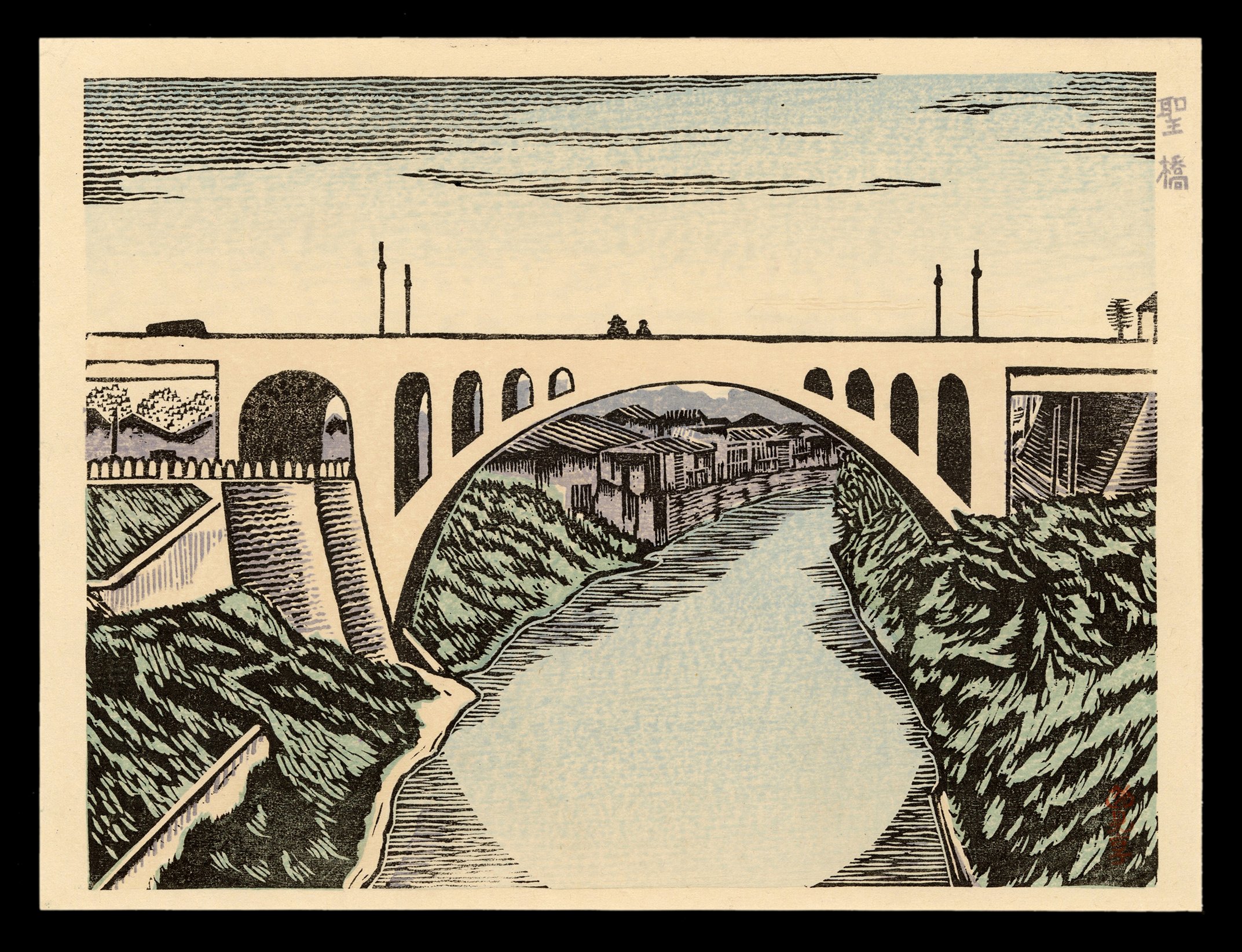
Takashi Henmi’s Hijiri Bridge presents one of Tokyo’s modern engineering achievements through a distinctly graphic and highly structured visual language. The great concrete bridge spans the composition horizontally, its monumental arch framing the canal below like a carefully measured aperture. Beneath it, the waterway narrows into the distance between steep embankments rendered in dense directional carving, while rows of houses and retaining walls emerge quietly beyond the bridge’s central opening. Tiny, silhouetted figures crossing the bridge above emphasize the massive scale of the modern structure against the surrounding urban landscape.
The print is remarkable for its disciplined use of line and compositional balance. Henmi reduces the city into simplified architectural forms and patterned textures, allowing the carved marks themselves to become expressive elements. The alternating rhythms of black linear hatching, pale blue water, and broad untouched areas of paper create a visual clarity reminiscent of both modernist printmaking and traditional Japanese compositional restraint. Unlike atmospheric interpretations of the rebuilt capital, this design celebrates structure itself—the bridge becoming an emblem of order, stability, and civic renewal within the rapidly transforming metropolis.
Connoisseur's Note
Hijiri Bridge held symbolic importance in early modern Tokyo as part of the city’s ambitious infrastructural redevelopment following the Great Kantō Earthquake. Bridges within the reconstructed capital were not merely practical necessities; they became visible declarations of technological progress and urban permanence. Henmi’s interpretation captures this spirit with unusual precision, transforming reinforced concrete architecture into a subject worthy of aesthetic contemplation.
The artist’s emphasis on sharp carving and flattened spatial organization reflects broader currents within the Sosaku Hanga movement, where the expressive possibilities of the woodblock itself were increasingly foregrounded. Rather than pursuing illusionistic realism, Henmi embraces abstraction through structure, rhythm, and reduction. The resulting image possesses an almost architectural purity, revealing how modern Tokyo inspired artists to rethink not only subject matter, but the visual language of printmaking itself.
Only fifty impressions of each design in the One Hundred Views of New Tokyo series were produced, making surviving examples increasingly scarce today. The limited production reflects the highly artisanal nature of the project and the independent ethos central to the Sosaku Hanga movement. Prints from the series are now regarded among the most important visual records of Tokyo’s reconstruction during the interwar period.
More prints by Takashi Henmi: