

 Image 1 of 1
Details
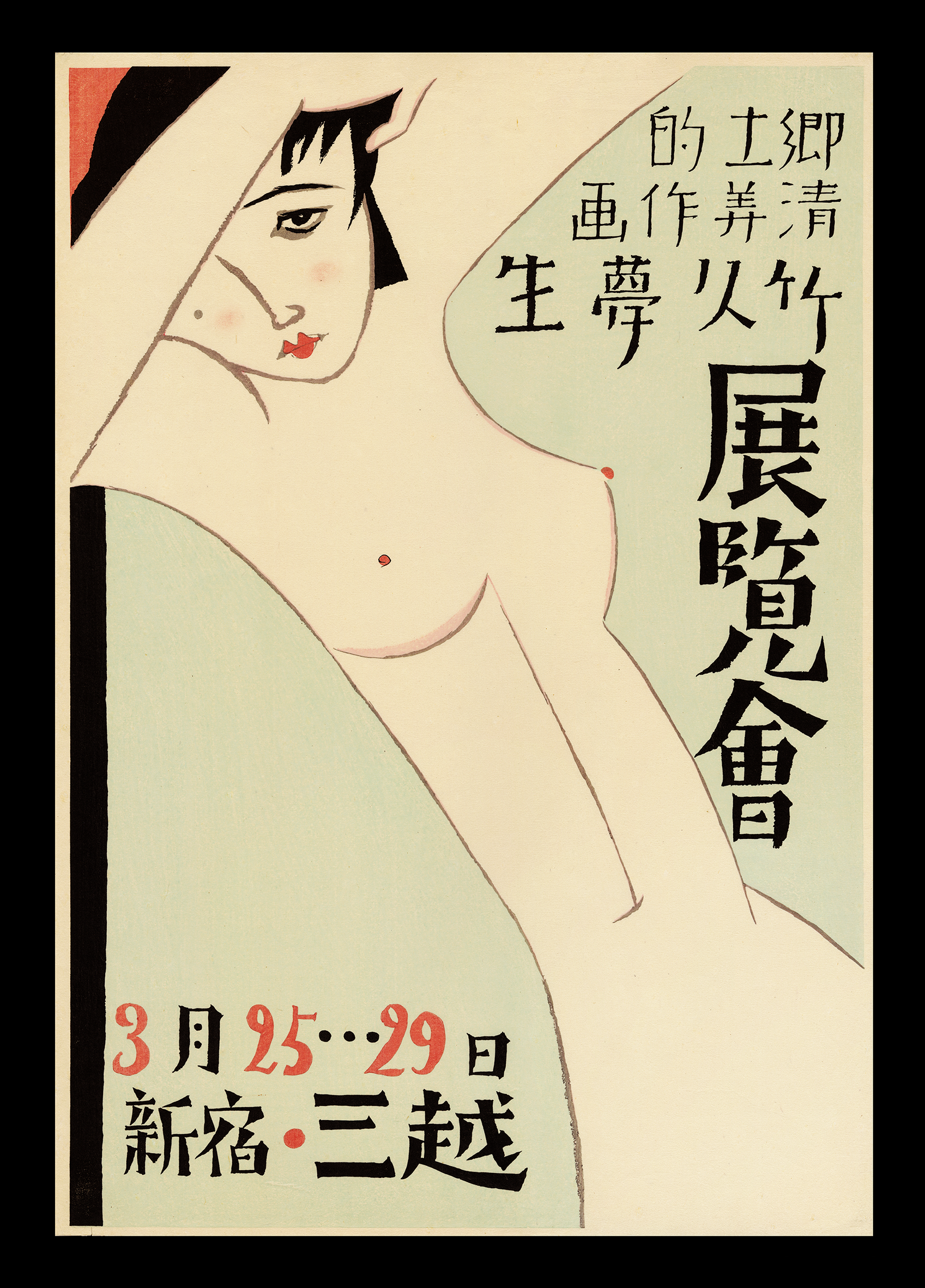
This striking exhibition poster by Takehisa Yumeji presents a modern female nude rendered with remarkable economy and elegance. The figure emerges from a field of pale color and bold typography, her softly curved body framed by graceful lines that guide the eye across the composition. Yumeji reduces the body to flowing contour and simplified volume, creating an image that feels simultaneously intimate, fashionable, and modern.
The poster was designed to advertise an exhibition of Yumeji’s works at the Shinjuku Mitsukoshi Department Store, one of Tokyo’s most important centers of consumer culture during the early Shōwa period. Department stores had become symbols of urban sophistication, functioning not only as commercial spaces but as cultural institutions that hosted exhibitions, concerts, cafés, and gatherings for the city’s increasingly cosmopolitan public. By the early 1930s, Mitsukoshi represented the intersection of commerce, fashion, art, and modern identity.
Yumeji’s image perfectly suited this environment. The woman’s cropped pose, direct gaze, and stylized sensuality reflect the influence of Art Deco design and international commercial illustration, while the elegant integration of Japanese calligraphy preserves a distinctly local visual rhythm. The composition moves fluidly between advertisement and fine art, embodying the growing collapse of boundaries between elite artistic production and modern mass culture.
The figure herself evokes the changing image of femininity in interwar Japan. Neither traditionally idealized nor overtly theatrical, she appears self-possessed and quietly aware of her own presence. Such imagery resonated strongly with contemporary audiences navigating new ideas surrounding fashion, personal freedom, urban leisure, and the visibility of women within modern public life.
Connoisseur's Note
Woodblock printed posters of this nature are exceptionally rare survivors. Produced for short-term promotional use, most were discarded after the close of the advertised exhibition. Their fragile paper and utilitarian function make well-preserved examples highly desirable today, particularly those connected directly to Yumeji’s own exhibitions.
The present work is especially significant as an example of Yumeji’s mastery of graphic simplification during the final years of his career. By the early 1930s, his visual language had evolved into an extraordinarily refined balance of line, negative space, and decorative abstraction. The reduced palette and bold asymmetrical design reveal his sensitivity to both contemporary European poster aesthetics and traditional Japanese compositional restraint.
Collectors increasingly recognize Yumeji not only as a beloved illustrator of women, but as one of the defining architects of modern Japanese visual culture. His posters, magazine designs, and commercial works profoundly shaped the appearance of urban sophistication during the Taishō and early Shōwa eras. In works such as this, the worlds of fine art, advertising, fashion, and department store culture merge seamlessly into a single image of modern Tokyo life.