

 Image 1 of 1
Details
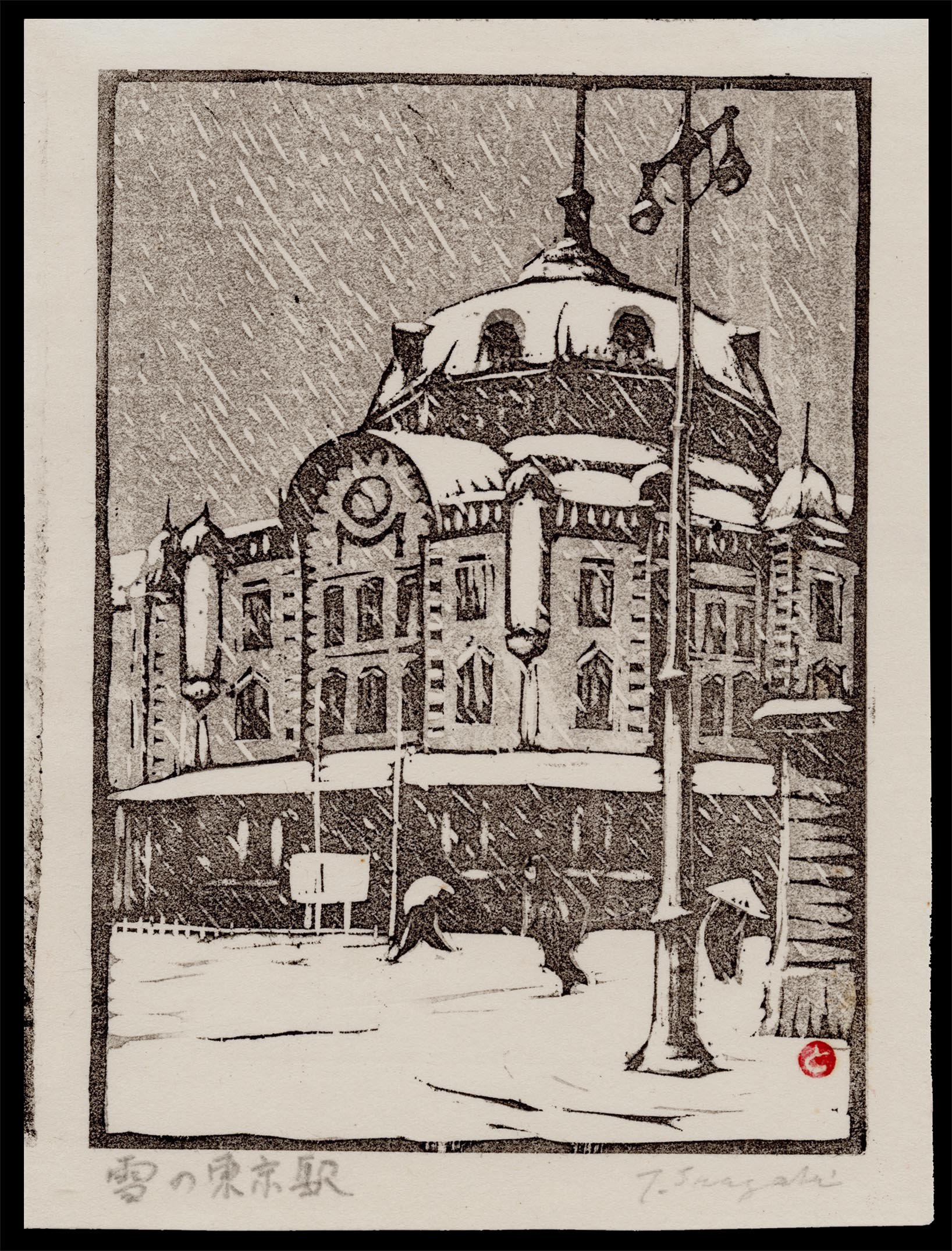
Created in 1929, Tokyo Station in Snow is a remarkable early sosaku hanga work by Tomoo Inagaki, depicting Tokyo Station amid a heavy winter snowfall. Produced before the artist became widely celebrated for his iconic depictions of cats, this print reveals Inagaki’s early fascination with the lived realities of the modern city. Rather than presenting Tokyo through nostalgic idealization or picturesque sentiment, the artist captures the urban environment as it actually appeared in a fleeting winter moment—cold, damp, active, and unmistakably contemporary.
The great domed façade of Tokyo Station rises heavily beneath accumulated snow, its Western-style architecture emerging through dense curtains of falling sleet. Small umbrella-bearing pedestrians move across the foreground with quiet urgency, dwarfed by the monumental station building and the surrounding atmosphere of weather and movement. The composition possesses a striking immediacy, emphasizing not spectacle but observation. Snow falls diagonally across the surface in rapid rhythmic lines, transforming the scene into a study of climate, architecture, and modern urban life.
This approach distinguishes the print sharply from the prevailing aesthetics of shin hanga landscape imagery during the same period. While many shin hanga artists emphasized poetic nostalgia, romanticized atmosphere, or idealized seasonal beauty, Inagaki instead focuses on the material texture of the contemporary city itself. Tokyo Station is not softened into dreamlike sentimentality; it remains an active urban structure at the center of modern circulation and public life. The station’s Western-inspired architecture, erected only fifteen years earlier in 1914, stood as a symbol of Japan’s modernization and expanding metropolitan identity during the Taishō and early Shōwa eras.
As a work of sōsaku hanga, the print reflects the movement’s emphasis on personal artistic vision and direct engagement with modern experience. Inagaki’s simplified carving, restrained palette, and emphasis on graphic structure reveal the influence of modern design aesthetics while retaining the tactile qualities of hand-printed woodblock technique. The subdued monochromatic treatment heightens the sensation of winter silence, allowing the falling snow itself to become the emotional center of the composition.
Connoisseur's Note
Tokyo Station in Snow occupies an important position within Tomoo Inagaki’s early artistic development. Before turning toward the highly stylized animal imagery for which he later became famous, Inagaki explored urban modernity through scenes grounded in direct observation and everyday experience. This print reveals a young artist deeply engaged with the visual realities of Tokyo during a period of rapid social and architectural transformation.
The work also serves as an important document of the evolving identity of Japanese printmaking during the late 1920s. By this period, sōsaku hanga artists increasingly rejected the polished nostalgia often associated with commercial landscape prints, seeking instead a more personal and contemporary mode of expression. Inagaki’s vision of Tokyo is distinctly modern: the city is not a repository of fading tradition, but a living environment shaped by infrastructure, weather, movement, and the rhythms of ordinary urban life.
Particularly compelling is the artist’s treatment of atmosphere. The snowstorm partially obscures architectural detail, dissolving the station into layered tonal textures and soft veils of falling white. Yet rather than romanticizing the scene, the weather intensifies its realism. One senses the cold air, the wet streets, and the muted silence that descends upon a city during heavy snowfall. This sensitivity to transient environmental conditions aligns Inagaki with broader currents of modernist observation emerging internationally during the late 1920s and 1930s.
More prints by Tomoo Inagaki:

1929
RESERVED
Tokyo Station in Snow
Tomoo Inagaki (1902–1980)
MEDIUM: Woodblock print
DATE: 1929
DIMENSIONS: 8 × 6 ½ inches
CONDITION: Excellent, no problems to note
NOTE: Rare early work
$950.00 <RESERVED>