

 Image 1 of 1
Details
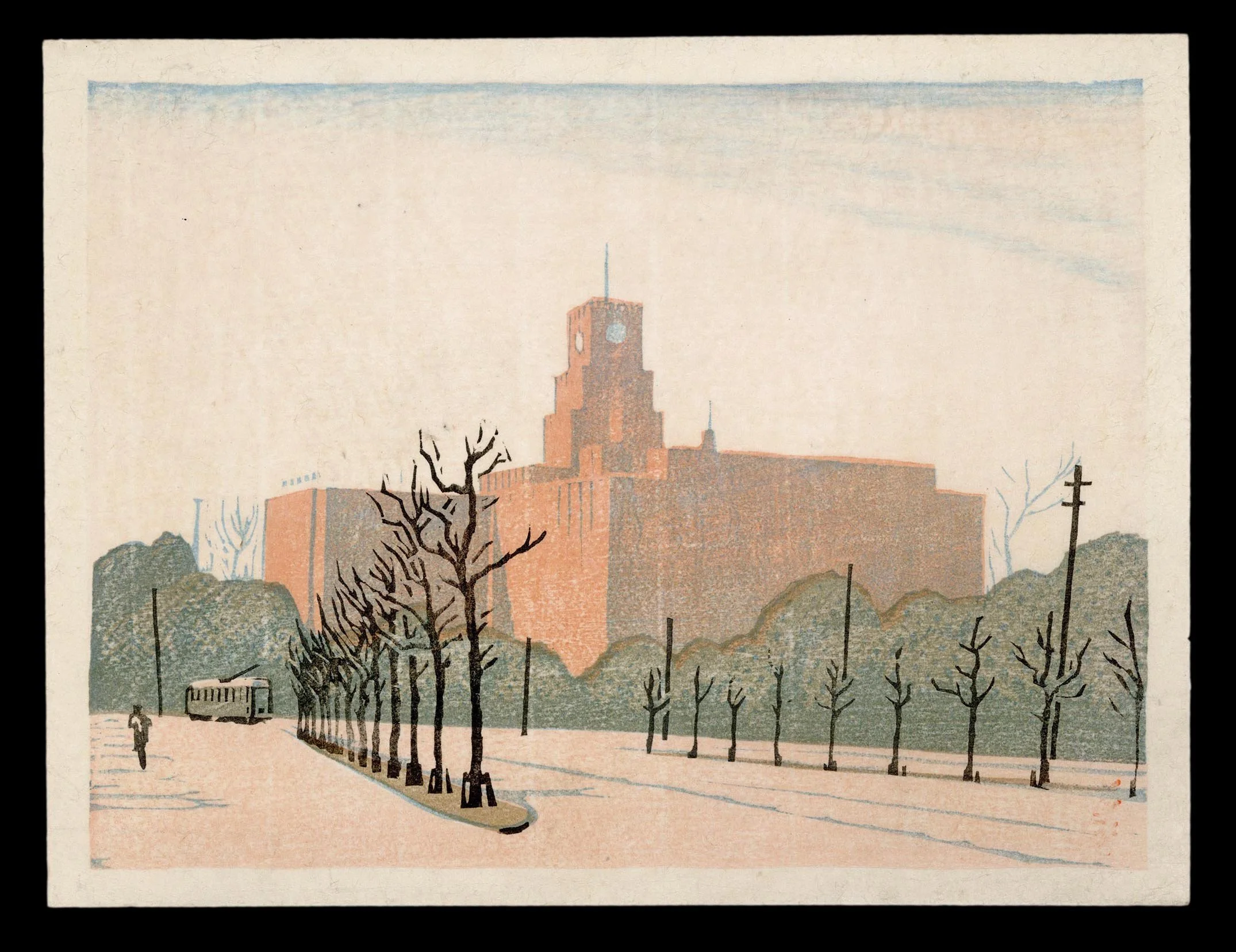
This quietly elegant 1930 woodblock print by Tomoo Inagaki depicts the monumental silhouette of Hibiya Public Hall rising beyond the avenues of central Tokyo. Bare trees line the broad modern boulevard while a solitary streetcar moves across the composition, emphasizing the calm rhythm of the rebuilt metropolis. Rendered in subdued pinks, greys, pale blues, and muted greens, the design possesses an atmosphere of restraint and contemplation unusual for depictions of the modern city.
The print belongs to Inagaki’s series Twenty-Five Views of the Rebuilt Imperial Capital, one of the most striking visual records of Tokyo’s reconstruction following the devastation of the Great Kantō Earthquake. Rather than portraying nostalgic remnants of old Edo, Inagaki focuses directly upon the newly engineered city—its modern public buildings, widened avenues, transportation systems, and carefully planned civic spaces. Hibiya Public Hall itself, completed in 1929, stood as an important symbol of Tokyo’s emergence as a modern international capital, combining civic ambition with contemporary architectural design.
Particularly striking is the artist’s treatment of space and atmosphere. The large geometric mass of the building dominates the composition, yet it is softened through delicate color and expansive emptiness. The broad streets appear almost unusually open, reflecting the newly planned urban scale introduced during reconstruction efforts. Telephone poles, streetcar lines, and rows of winter trees create subtle linear rhythms that guide the eye toward the monumental civic structure while preserving a profound sense of quietude.
Unlike the romanticized landscapes commonly associated with shin hanga, Inagaki’s print embraces the contemporary metropolis as an authentic subject worthy of artistic contemplation. The rebuilt city becomes neither spectacle nor propaganda, but an observed lived environment. The artist captures Tokyo not through bustling crowds or theatrical illumination, but through stillness, infrastructure, and atmosphere—the understated poetry of a modern urban landscape settling into its new identity.
Connoisseur's Note
Hibiya Public Hall stands as one of the finest examples from Inagaki’s early urban period, revealing the artist’s remarkable sensitivity to modern architectural form and civic space. Before his later fame for stylized depictions of animals and cats, Inagaki was deeply engaged with the visual transformation of Tokyo during the early Shōwa era. Prints from this period are increasingly recognized as some of the most important urban images produced within the sōsaku hanga movement.
The series title itself—Twenty-Five Views of the Rebuilt Imperial Capital—carries significant historical resonance. Following the earthquake, Tokyo became a laboratory of modern urban planning. Wide boulevards, reinforced public buildings, electrical infrastructure, bridges, and transportation networks fundamentally reshaped the city’s appearance. Inagaki approached these transformations with unusual clarity, documenting not simply architecture, but the psychological atmosphere of a city reconstructing itself through modernity.
What distinguishes this work is its balance between modernist structure and emotional subtlety. The imposing civic building is reduced into simplified geometric masses, yet the overall mood remains gentle and contemplative. Bare winter trees and the lone streetcar introduce a human scale that tempers the monumentality of the rebuilt capital. This sensitivity to atmosphere reflects the unique strengths of sōsaku hanga, where personal observation and direct artistic expression remained central.
More prints by Tomoo Inagaki:
1929
RESERVED
Tokyo Station in Snow
Tomoo Inagaki (1902–1980)
MEDIUM: Woodblock print
DATE: 1929
DIMENSIONS: 8 × 6 ½ inches
CONDITION: Excellent, no problems to note
NOTE: Rare early work
$950.00 <RESERVED>