

 Image 1 of 1
Details
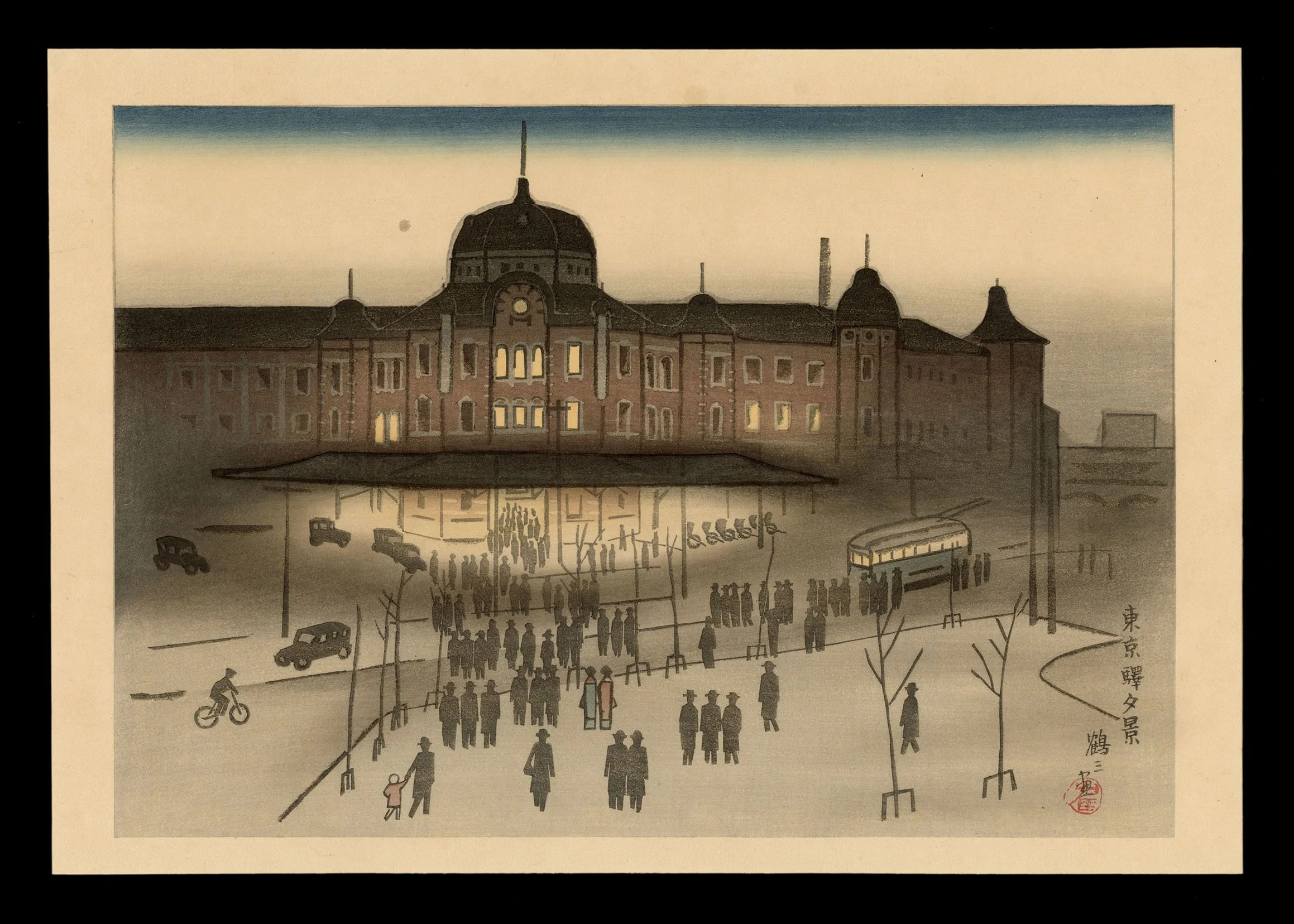
In Tokyo Station, Tsuruzō Ishii portrays one of modern Tokyo’s most important civic landmarks with remarkable restraint and sensitivity. The great red-brick station building rises across the upper half of the composition, its domed roofline and softly illuminated windows emerging through a haze of evening light and urban mist. Completed in 1914 and modeled partially on European station architecture, Tokyo Station quickly became a symbol of Japan’s modern ambitions and international outlook during the Taishō and early Shōwa periods.
Rather than emphasizing monumental grandeur alone, Ishii focuses upon the human rhythms unfolding before the station entrance. Crowds gather beneath the broad canopy in dark silhouettes, moving toward trams, automobiles, and the station’s glowing interior. The modern city reveals itself through circulation: commuters arriving and departing, electric streetcars curving through the plaza, and pedestrians navigating newly planned civic spaces. Small details—a bicyclist crossing the foreground, bare winter trees, the faint glow of interior lighting—lend the composition a quiet immediacy rooted in everyday metropolitan experience.
The print beautifully reflects Tokyo’s identity as a reconstructed capital during the late 1920s. Following the devastation of 1923, urban planners envisioned a city defined by widened boulevards, modern infrastructure, transportation networks, and monumental public architecture. Tokyo Station became one of the clearest symbols of this new metropolitan identity: a gateway through which commerce, labor, leisure, and modern life continuously flowed.
Yet Ishii’s vision remains contemplative rather than triumphalist. The subdued palette of grays, soft browns, and muted violets creates an atmosphere of dusk and reflection. Architectural forms dissolve gently into the surrounding haze, while the figures below become anonymous participants within the larger movement of the city. The resulting mood suggests the psychological texture of modern urban life—simultaneously communal and isolating, energetic and strangely quiet.
Though a self-published print, stylistically, the work occupies an intriguing space between the observational realism associated with Shin Hanga city views and the more personal sensibility encouraged within Sosaku Hanga. Ishii balances careful architectural description with atmospheric softness, allowing mood and sensation to shape the composition as much as precise topography. The print’s spaciousness and tonal restraint lend the scene a distinctly modern emotional register.
Connoisseur's Note
Tokyo Station stands as an elegant meditation on modern Tokyo during one of the most transformative moments in the city’s history. Ishii captures not only the station itself, but the broader social environment surrounding it: the emergence of a highly mobile urban population shaped by transportation, commerce, and the accelerating tempo of metropolitan life.
Particularly compelling is the artist’s handling of scale and anonymity. Though the station dominates the composition architecturally, the true subject of the print may be the movement of people through the city. The silhouetted crowds beneath the station canopy evoke the new social realities of interwar Tokyo, where modern identities were increasingly formed within public spaces, transit hubs, department stores, cafés, and entertainment districts.
The print also reflects the growing fascination among artists during the 1920s with modern infrastructure as an artistic subject. Bridges, railway stations, streetcars, and office buildings became visual emblems of the rebuilt capital, replacing many of the traditional scenic motifs associated with earlier ukiyo-e landscape traditions. Ishii approaches these themes with unusual quietness, avoiding overt celebration in favor of atmospheric subtlety and psychological depth.
Fine impressions of this design are increasingly difficult to encounter, particularly examples retaining such delicate tonal transitions within the evening sky and plaza. The soft gradation surrounding the illuminated station windows is especially noteworthy, creating the impression that the building itself glows gently within the dusk. Today, Tokyo Station remains a deeply evocative document of Tokyo’s emergence as a modern world city during the early Shōwa era.
More prints by Tsuruzo Ishii:
1928
RESERVED
Evening View of Tokyo Station
Tsuruzo Ishii (1887–1973)
MEDIUM: Woodblock print
DATE: 1928
DIMENSIONS: 10 ½ x 15 ½ inches
CONDITION: Excellent, no problems to note
$1,200.00<RESERVED>