

 Image 1 of 1
Details
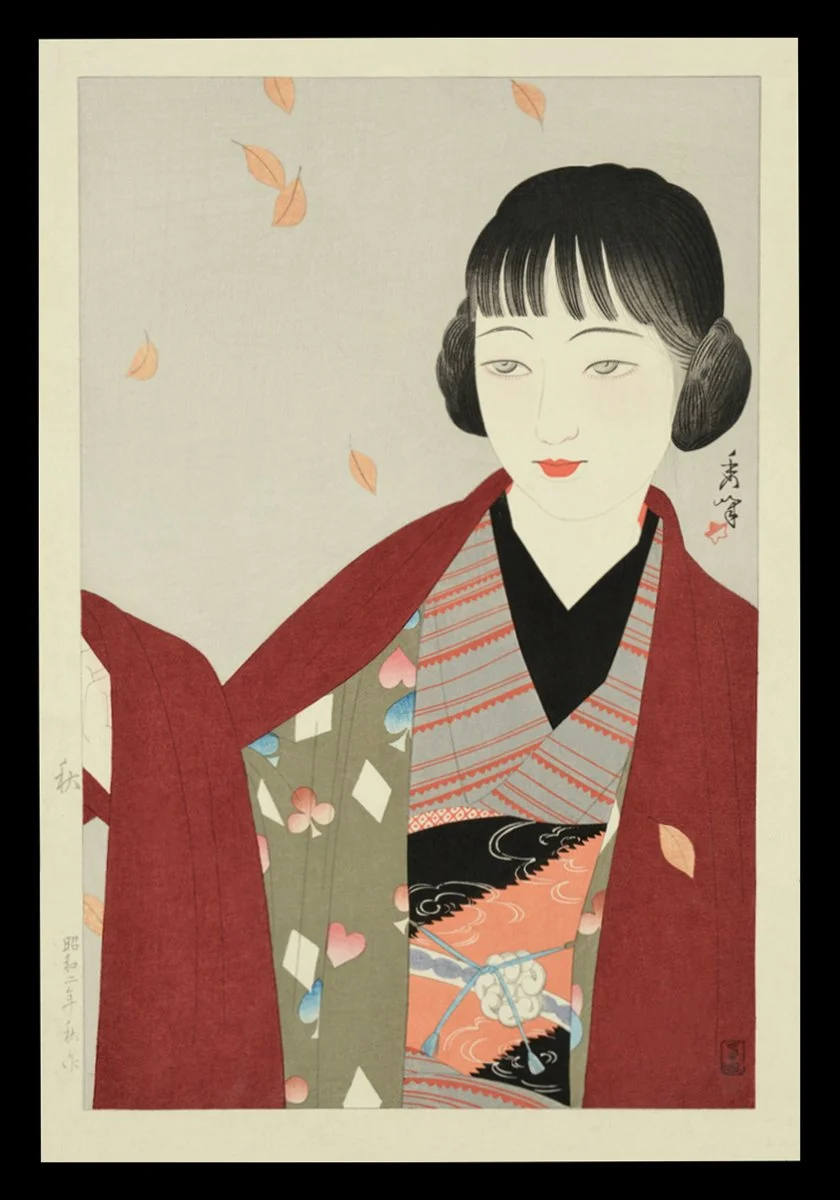
Yamakawa Shūhō’s Autumn presents an elegant vision of the modern Japanese woman at a moment when ideals of feminine beauty were undergoing profound change. Created in 1927, at the threshold of the Shōwa era, the print belongs to his Four Images of Women, a series devoted to the seasons. Here, autumn appears not through an elaborate landscape but through a young woman and a handful of drifting leaves, transforming seasonal imagery into a study of fashion, mood, and modern femininity.
Shūhō gives particular attention to the woman’s strikingly contemporary appearance. Her carefully arranged coiffure, with its blunt fringe and bulbus side sections, departs from the elaborate hairstyles of earlier bijin-ga and immediately signals a new generation. Her delicately modeled face and sidelong gaze project an equally modern sense of composure and self-possession.
Her clothing creates a sophisticated dialogue between tradition and modernity. Particularly striking is the textile of her inner kimono, patterned with motifs derived from Western playing cards: diamonds, hearts, and clubs mingle with an additional clover-like form. These jaunty graphic emblems introduce a distinctly cosmopolitan note into traditional Japanese dress, reflecting the ease with which foreign imagery entered contemporary fashion and design. Geometric stripes and boldly contrasting textiles further animate the ensemble, while the deep red outer garment provides a broad visual frame. Scattered ocher leaves echo its warmth and bring gentle movement to the otherwise still composition.
Connoisseur’s Note
Autumn captures the subtle complexity of the emerging modern woman in late Taishō and early Shōwa Japan. Shūhō does not define modernity through Western dress alone; instead, he locates it in hairstyle, fashion consciousness, textile design, and attitude. Even the playing-card motifs woven into the visual language of the kimono suggest a cosmopolitan culture absorbed and refashioned through Japanese taste.
Against a sparse background with delicate silver mica, the falling leaves retain the traditional association of autumn with transience, yet the woman herself appears composed, fashionable, and unmistakably of her time. Shūhō thus recasts the bijin-ga ideal for a new era, joining established notions of grace and refinement with individuality, stylishness, and an emerging modern identity.
This impression is an early first state of the design, baring the publisher’s seal at the lower right in the design.
More prints by Yamakawa Shuho:
Yamakawa Shuho
1942
$3,000
Tokyo Train Station at Present
Yamakawa Shuho (1898-1944)
MEDIUM: Woodblock Print
DATE: 1942
DIMENSIONS: 19 1/4 x 14 3/4 inches
PUBLISHER: Watanabe F-type seal
CONDITION: Excellent; no problems to note
LITERATURE: The Female Image, pl. 157
$3,000.00
Contact us to purchase