

 Image 1 of 1
Details
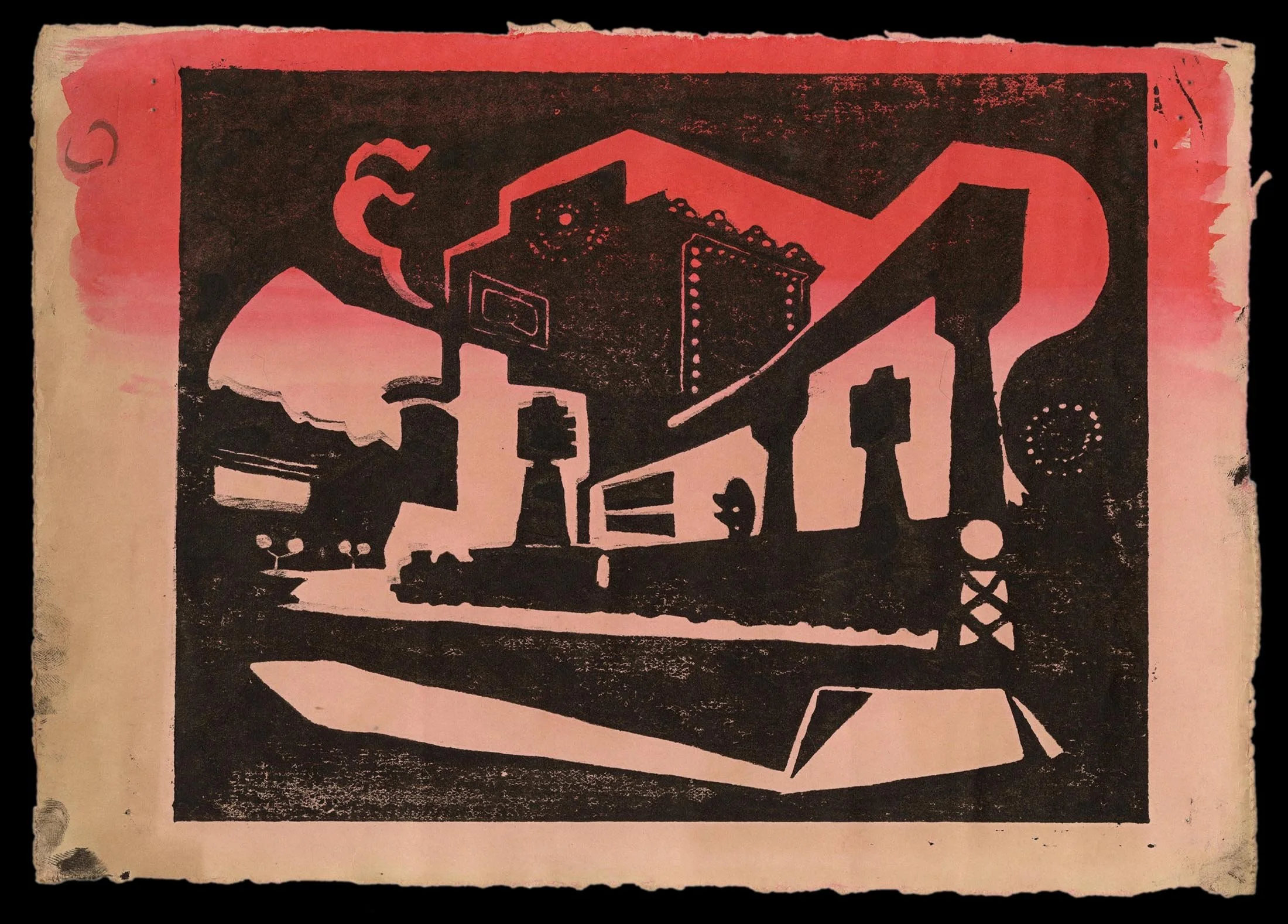
In Train Station, Yasunori Taninaka transforms one of the defining spaces of modern urban life into a strange and exhilarating nocturnal vision. Rather than describe the station conventionally, he fragments its architecture into a compressed arrangement of platforms, tracks, signals, rooftops, and mechanical forms. Heavy passages of black dominate the composition, interrupted by areas of pale paper and an extraordinary wash of pink and coral that seems to illuminate the scene from within.
Taninaka’s radically simplified forms give the image much of its power. The station appears less as a fixed architectural setting than as an accumulation of sensations—the looming mass of machinery, the geometry of tracks and platforms, signal lights punctuating the darkness, and structures glimpsed only momentarily. Forms overlap and collide, creating a deliberate spatial instability that evokes the experience of movement through the modern city. The composition possesses something of a dream: familiar objects remain recognizable, yet their relationships have become mysterious and slightly disorienting.
By 1933, the railway had become inseparable from the rhythms of metropolitan Japan. Stations served not merely as points of arrival and departure but as gateways to an increasingly mobile urban culture, connecting residential districts with department stores, cafés, theaters, dance halls, and entertainment quarters. Taninaka largely eliminates the human figure from this world. Instead, he makes the machinery and architecture of movement themselves the protagonists, finding poetry in the infrastructure of modern life.
Connoisseur’s Note
Taninaka’s self-printed woodblocks possess a physical immediacy central to their character. In this impression, the dense, slightly uneven blacks retain the evidence of hand printing, while the hand-applied pigment introduces an expressive element impossible to separate from the conception of the image. The warm pink-red color spreads irregularly across the sheet, at moments glowing through the black like artificial light against a night sky.
This combination of vigorous carving, direct printing, and individually applied color gives Train Station the character of an original work rather than a mechanically uniform edition. Scarce in this form, the print exemplifies Taninaka’s highly personal approach to Sōsaku Hanga: bold, experimental, and responsive to the psychological experience of the modern city. He takes an ordinary site of transportation and turns it into something far more elusive—a nocturnal landscape of machinery, light, speed, and memory.
More prints by Yasunori Taninaka: