

 Image 1 of 1
Details
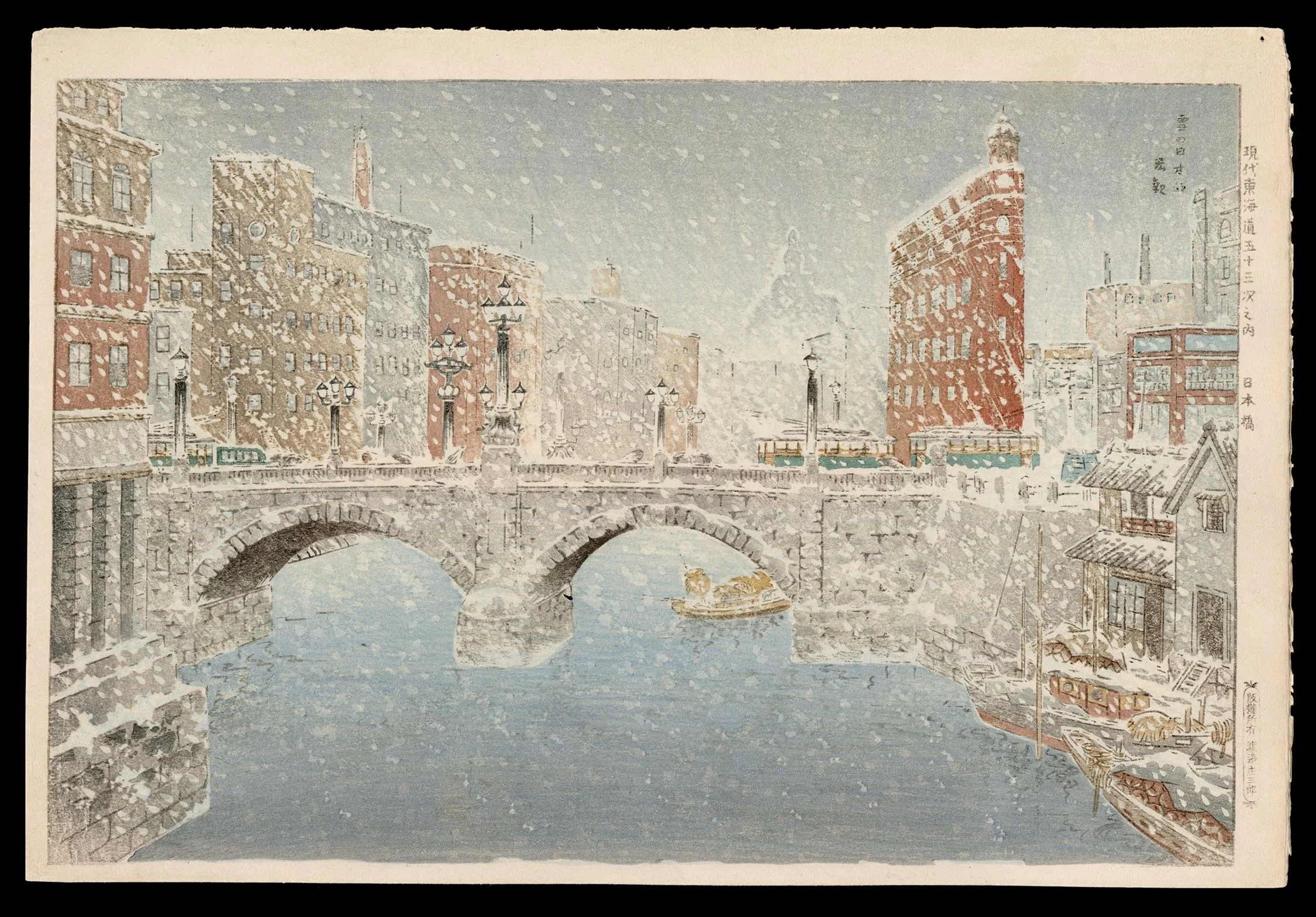
Bannai Kōkan presents Nihonbashi in the midst of a heavy snowfall, transforming one of Tokyo’s most recognizable urban landmarks into a luminous vision of the modern metropolis. The historic stone bridge dominates the foreground, its broad arches spanning the blue-gray river, while streetcars cross above and boats occupy the water below. Beyond rises a dense succession of commercial buildings, their muted brick-red façades receding into the snow-filled atmosphere.
The composition gains much of its character from the contrast between old and new. Traditional riverside structures and working boats remain visible along the water, while streetcars, electric lamps, and substantial Western-style buildings announce the modern city above. Kōkan unifies these competing elements through falling snow, using the weather not merely as a decorative effect but as an atmospheric veil that softens the architecture and gives the bustling commercial district an unexpected serenity.
Connoisseur's Note
Nihonbashi occupied a singular place in Tokyo’s history. For centuries the bridge marked the symbolic center of the capital and the point from which distances along Japan’s great highways were measured. By the early Shōwa period, however, the district surrounding it had become equally emblematic of metropolitan modernity—a center of commerce, transportation, banking, department stores, and urban circulation. Kōkan’s view captures these histories simultaneously: boats continue to work the river beneath the bridge while streetcars and pedestrians traverse the modern city above.
Created in 1933, the print records a Tokyo transformed during the decade following the Great Kantō Earthquake of 1923. Reconstruction brought wider streets, modern infrastructure, new commercial architecture, and increasingly efficient transportation networks. Kōkan makes these features central to the scene. The procession of streetcars across Nihonbashi and the large Western-style buildings beyond the bridge evoke a city whose daily rhythms increasingly depended upon mechanized movement and modern commerce, while the surviving waterfront preserves traces of an older Tokyo within the rebuilt metropolis.
The first-state designation and Watanabe C-type seal give this impression particular connoisseurial interest, placing it within the early printing history of the design under publisher Watanabe Shōzaburō. Its delicate palette and elaborate treatment of falling snow also demonstrate the technical refinement associated with Shin Hanga production. Kōkan turns a familiar Tokyo landmark into something more than a picturesque snow scene: old waterways, modern streetcars, stone architecture, electric lamps, and the enveloping weather combine to portray a city negotiating continuity and change—a historic capital becoming unmistakably modern.
More prints by Yasunori Taninaka: