

 Image 1 of 1
Details
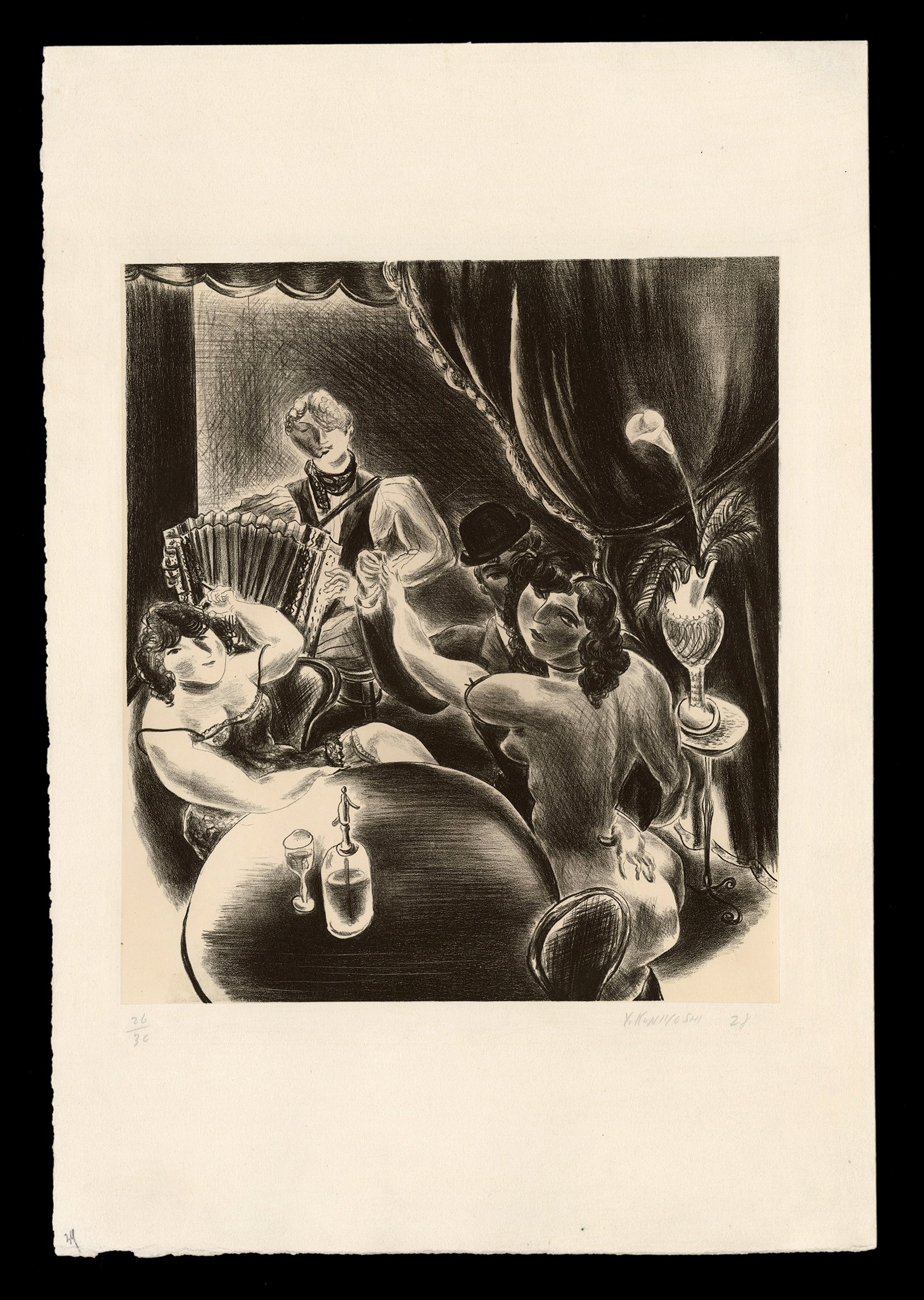
In Dancers, Yasuo Kuniyoshi captures the charged atmosphere of cabaret culture at the height of the late 1920s. Set within a dimly lit interior animated by music, alcohol, and performance, the composition presents an intimate gathering of figures suspended between leisure and spectacle. At the center, an accordion player performs beneath heavy curtains while a provocatively dressed woman reclines and gestures around a café table scattered with glasses and bottles. One figure, a burlesque dancer turns outward toward the viewer with theatrical immediacy, her body illuminated against the surrounding darkness, while guiding her male companion around the table, absorbed within the haze of the room. The composition possesses a cinematic rhythm, unfolding through dramatic contrasts of light and shadow that evoke the nocturnal energy of urban entertainment culture.
Executed as a lithograph with chine appliqué, the work demonstrates Kuniyoshi’s remarkable command of tonal atmosphere. Velvety blacks and silvery gradations dissolve forms into shadow, creating an interior that feels at once seductive and claustrophobic. Unlike the sharply flattened decorative surfaces found in many contemporary Japanese woodblock prints, Kuniyoshi embraces the expressive possibilities of lithography, using dense crosshatching and soft tonal transitions to heighten psychological tension. The resulting image bears the influence of both European cabaret imagery and American urban realism, while retaining the compositional sensitivity and asymmetrical balance often associated with Japanese pictorial design.
The print emerged during a moment when nightlife culture had become a defining symbol of modernity across major cities throughout the world. Parisian cabarets, Berlin nightclubs, Harlem jazz venues, Shanghai dance halls, and Tokyo cafés all shared a common visual language of music, intoxication, fashion, and theatrical social performance. Kuniyoshi, working in the United States as a Japanese immigrant artist deeply attuned to international modernism, situates Dancers within this broader global atmosphere. The cabaret becomes more than a setting; it becomes a modern stage upon which identities are constructed, performed, and consumed.
At the same time, the work resonates strongly with the imagery being produced contemporaneously in Japan during the late Taishō and early Shōwa periods. Artists such as Kobayakawa Kiyoshi and Yamamura Kōka similarly explored themes of urban nightlife, dance culture, and modern femininity through depictions of moga figures inhabiting cafés, dance halls, and cosmopolitan interiors. Yet Kuniyoshi’s treatment differs markedly in emotional tenor. Where many Japanese prints of the period emphasize polished elegance and decorative refinement, Dancers introduces a deeper sense of psychological complexity and physical immediacy. The smoky interior, exaggerated shadows, and expressive distortions suggest not simply glamour, but fatigue, desire, performance, and emotional ambiguity beneath the surface of modern pleasure.
Connoisseur's Note
Among Yasuo Kuniyoshi’s graphic works of the 1920s, Dancers stands as a particularly compelling meditation on urban modernity and theatrical identity. Kuniyoshi occupied a unique cultural position during this period: born in Japan yet artistically shaped within the United States, he absorbed European modernist tendencies alongside American urban realism while remaining deeply conscious of Japanese visual traditions. This layered perspective gives the print its remarkable tension between stylization and psychological intimacy.
The cabaret subject held enormous significance internationally during the 1920s, symbolizing both liberation and instability in societies reshaped by industrialization, migration, and shifting social norms following the First World War. Across Europe, America, and East Asia, nightlife became associated with modern femininity, jazz culture, sexual freedom, and cosmopolitan excess. Kuniyoshi’s figures embody this atmosphere fully, yet they are never merely decorative participants within it. Their expressions and gestures carry an undertone of exhaustion and emotional distance, suggesting the fragility that often accompanied modern urban pleasure.
Collectors frequently note how powerfully Dancers bridges artistic currents developing simultaneously across continents. The print shares thematic affinities with German Expressionist cabaret scenes, French café imagery, and Japanese depictions of café society and dance culture emerging during the same decade. Yet Kuniyoshi synthesizes these influences into something entirely personal. His figures appear softened and distorted not through caricature, but through emotional atmosphere, as though viewed through drifting cigarette smoke and dim electric light.
The lithographic medium itself contributes profoundly to the work’s effect. The rich blacks and textured tonalities create a visual density impossible to achieve through flat color printing alone, enveloping the composition in a mood of nocturnal intimacy. The heavy curtains, reflective tabletops, glowing skin tones, and drifting shadows all reinforce the sensation of a world existing temporarily outside ordinary time. Seen today, Dancers preserves the restless glamour of the late 1920s while quietly revealing the emotional uncertainty that often lay beneath its surface—a fleeting world of music, intoxication, and performance held momentarily in suspension before disappearing into darkness.
More prints by Yasuo Kuniyoshi:
1928
RESERVED
Dancers
Yasuo Kuniyoshi (1889–1953)
MEDIUM: Lithograph with chine appliqué
DATE: 1928
DIMENSIONS: 19 5/8 × 12 7/8 inches
CONDITION: Excellent; no problems to note
NOTE: Numbered 26/30; signed by the artist in pencil at lower right
LITERATURE: Yasuo Kuniyoshi: The Complete Graphic Work, pl. L-29
$6,000.00 <RESERVED>