

 Image 1 of 2
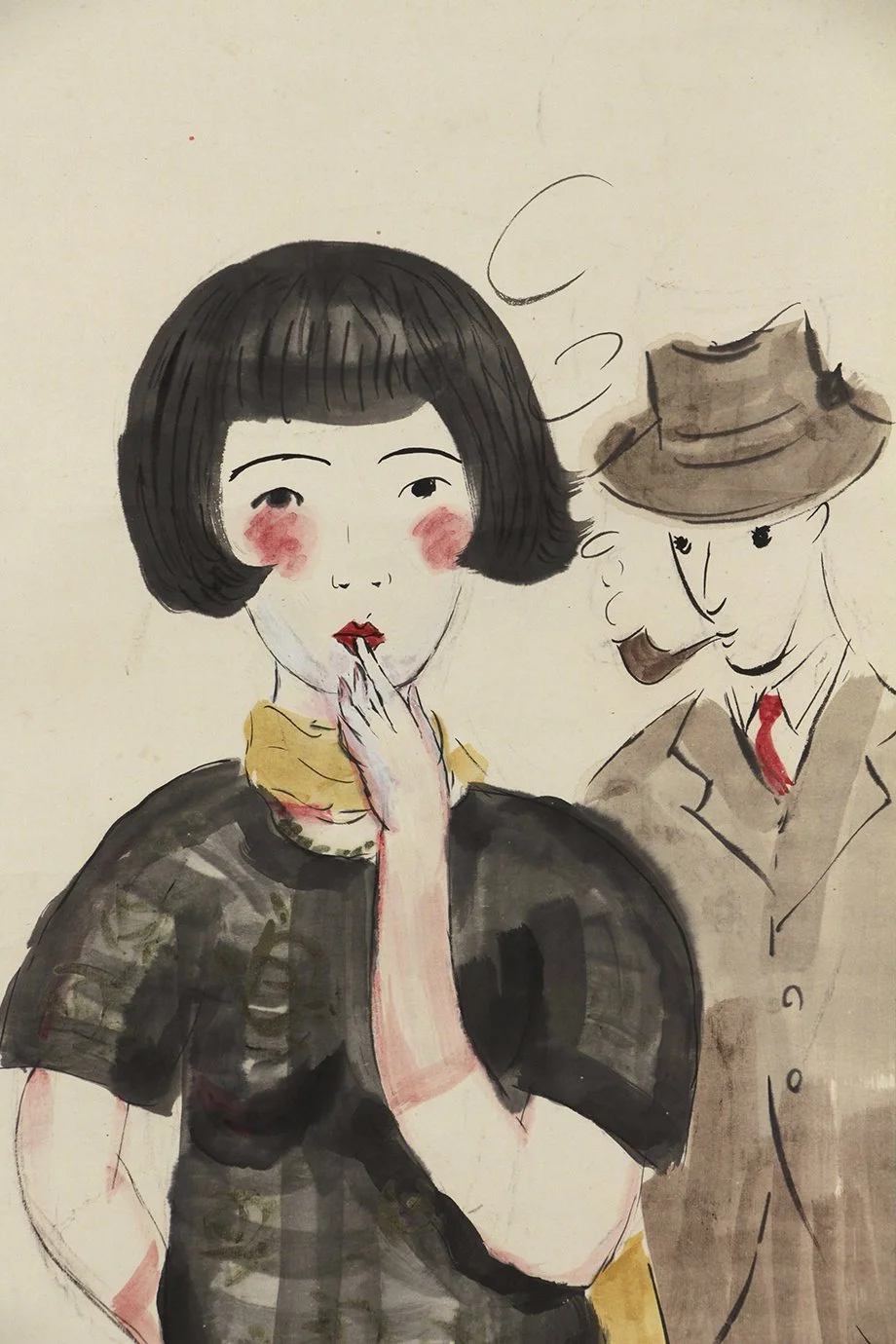 Image 2 of 2
Details
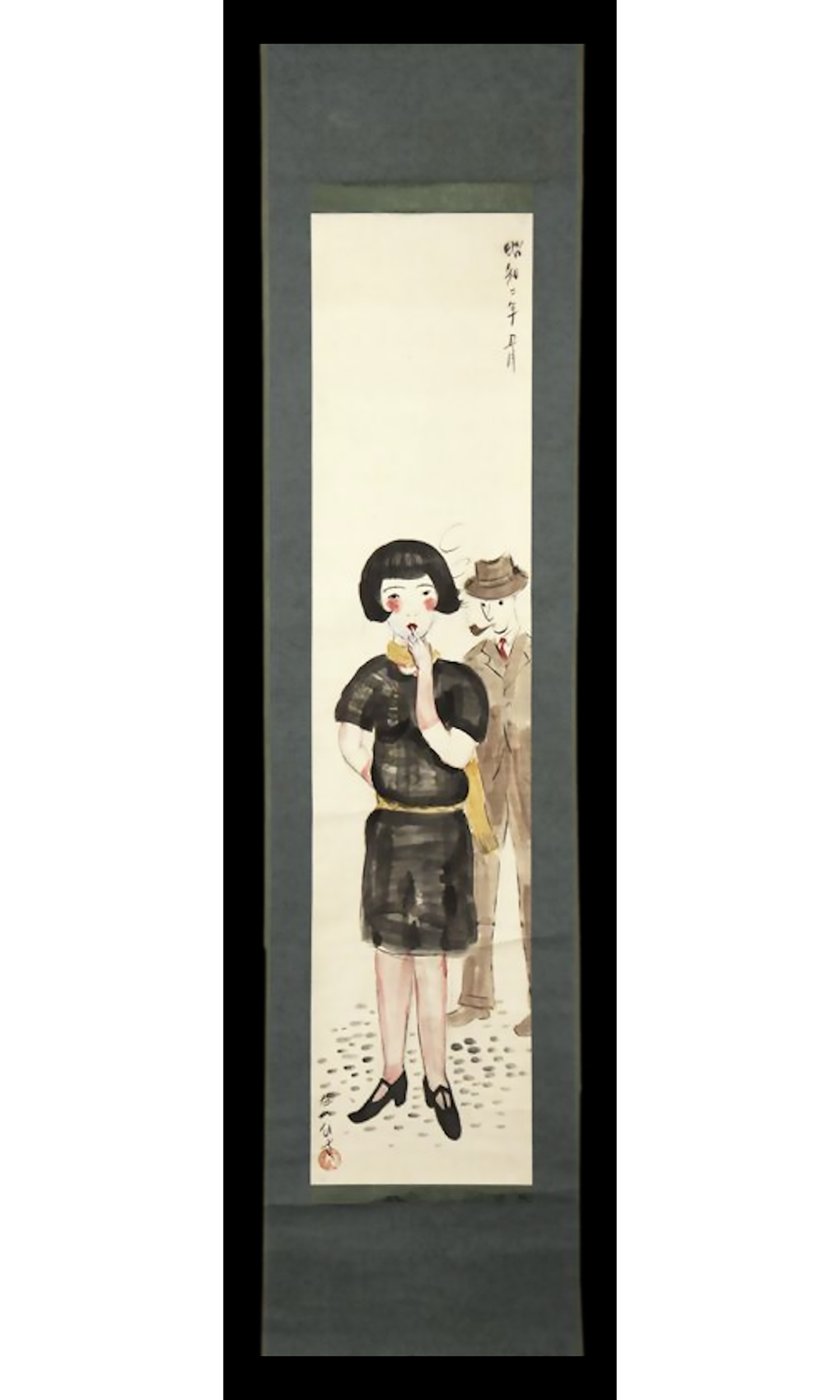
Executed in 1927, this charming painting by Takahisa Kato captures the spirit of Japan’s emerging urban modernity at the close of the Taishō era and the dawn of early Shōwa culture. The composition depicts a fashionable young couple — a moga (modern girl) and mobo (modern boy) — rendered with remarkable lightness and immediacy through expressive brushwork and simplified forms. The young woman stands confidently in the foreground wearing a dark Western-style dress, fashionable heels, and cropped bobbed hair, while behind her appears her pipe-smoking male companion dressed in contemporary Western attire complete with fedora and necktie. Together they embody the youthful sophistication and playful social rebellion associated with Japan’s “Jazz Age.”
The work reflects the dramatic cultural transformation that unfolded within Japanese cities during the 1920s. Cafés, dance halls, cinemas, jazz clubs, and department stores fostered entirely new forms of urban identity centered upon fashion, leisure, and self-presentation. Young men and women increasingly embraced imported Western styles, often to the alarm of more conservative generations. Katō captures this atmosphere with extraordinary economy. The figures appear casual and self-aware rather than formally posed, suggesting the spontaneity of modern city life and the fleeting interactions of fashionable café society.
Particularly striking is the artist’s handling of the female figure. The moga’s short hairstyle, rouged cheeks, painted lips, and relaxed posture immediately identify her as a figure of contemporary cosmopolitan culture. Yet despite the playful stylization present within the composition, Katō preserves a strong sense of individuality and emotional presence. The young woman appears quietly confident and self-possessed, while the gently smiling mobo behind her introduces a subtle narrative tension that animates the scene without disrupting its elegant restraint.
The painting’s brushwork contributes significantly to its modern sensibility. Loose ink contours dissolve into transparent washes of pigment, allowing the figures to emerge with an almost improvisational freshness. This immediacy mirrors the informal vitality of the subject matter itself. Mounted traditionally as a hanging scroll, the work creates a fascinating dialogue between modern urban imagery and classical Japanese presentation format, reflecting the broader coexistence of tradition and modernity that defined the period.
Connoisseur's Note
Paintings devoted explicitly to moga and mobo subjects remain among the most compelling visual documents of interwar Japanese urban culture. More than simply fashionable archetypes, the modern girl and modern boy became symbols of changing attitudes toward gender, leisure, romance, and personal freedom during the late Taishō and early Shōwa years. Artists were deeply fascinated by these new urban identities, which represented both excitement and cultural anxiety within rapidly modernizing Japanese society.
The present work is particularly notable for its tone of affectionate observation. Whereas some contemporary depictions of moga culture carried undertones of satire or moral critique, Katō approaches his subjects with warmth and visual delight. The figures feel approachable and human rather than symbolic abstractions. Their proximity, gestures, and expressions suggest familiarity and companionship, quietly emphasizing the emergence of more modern forms of social interaction between young men and women during the period.
Equally compelling is the painting’s synthesis of traditional and contemporary artistic languages. Although the subject matter is unmistakably modern, Katō retains elements of nihonga brush sensibility in the fluidity of line and selective use of empty space. At the same time, the exaggerated facial stylization, abbreviated anatomy, and graphic simplification reveal the influence of contemporary illustration, magazine culture, and commercial design. This hybrid visual language was central to much of Japan’s most innovative interwar figure painting.
As a surviving original scroll painting devoted to moga and mobo imagery, the work possesses considerable historical and cultural significance. Few subjects encapsulate the atmosphere of Japan’s 1920s metropolitan culture more vividly than the fashionable urban couple moving through the social world of cafés, cigarettes, jazz, and modern romance. In Katō’s hands, however, these icons of modernity are rendered not with spectacle, but with remarkable intimacy and charm.
More prints by Takahisa Kato: