

 Image 1 of 1
Details
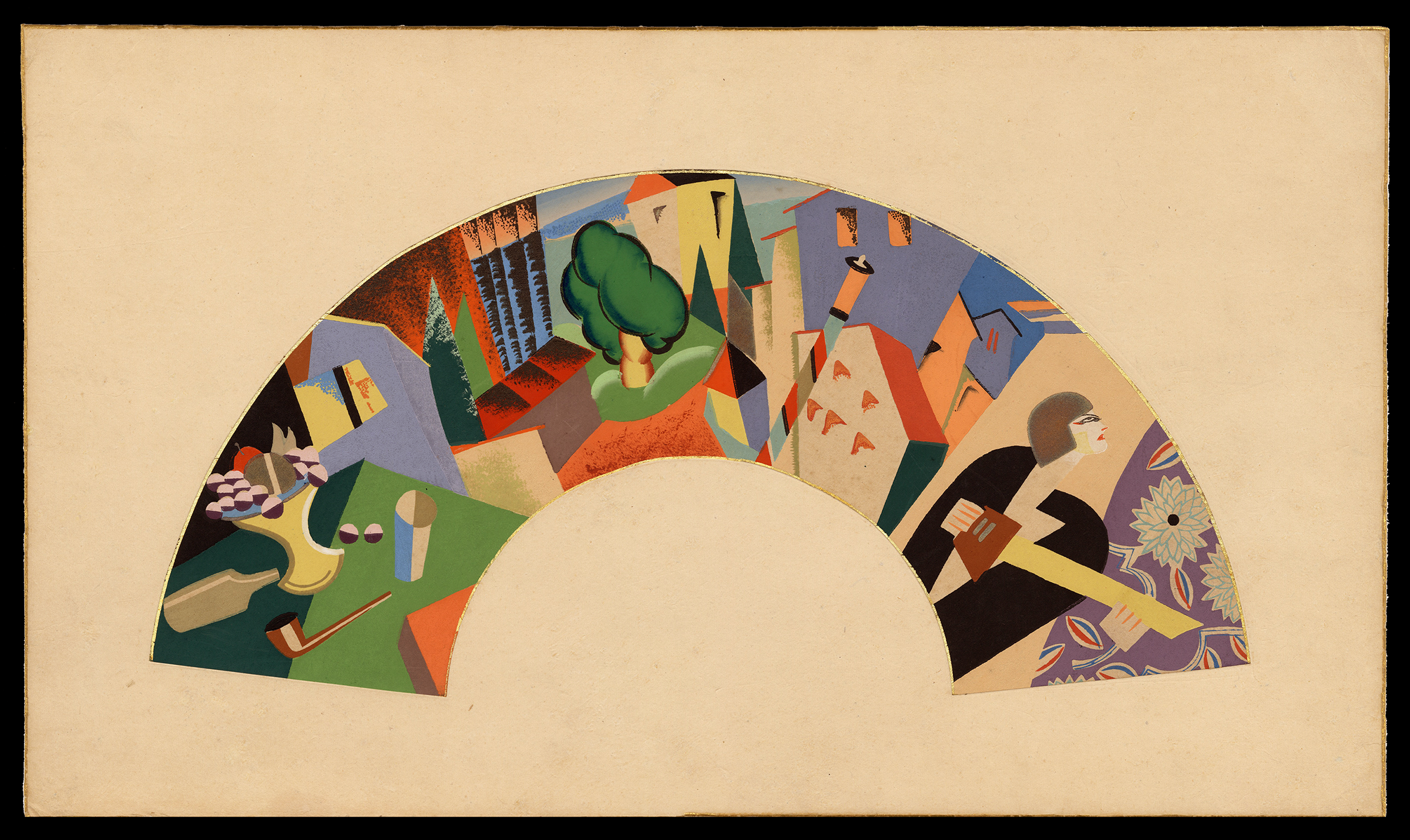
Executed around 1925, this striking fan-shaped woodblock print on silk embodies the sophisticated visual experimentation that emerged in Japan during the height of the interwar avant-garde. The composition unfolds as a continuous panoramic sequence, moving fluidly from a Cubist-inspired still life arrangement to an abstracted landscape and finally into an urban theatrical vignette centered upon a modern female musician. Though produced by an unidentified artist, the work demonstrates remarkable fluency in the visual language of international modernism as it was absorbed and transformed within Japanese design culture during the Taishō and early Shōwa periods.
The left side of the composition presents an angular tabletop arrangement composed of fruit, vessels, smoking accessories, and geometric objects fractured into simplified planes of color. Rather than describing space naturalistically, the artist compresses perspective into overlapping blocks and sharp diagonals, creating a rhythmic visual structure closely aligned with Cubist and Art Deco experimentation circulating internationally during the 1920s. The still life gradually transitions into a stylized pastoral landscape of trees, rooftops, and winding roads before evolving seamlessly into a condensed urban streetscape defined by steep architectural forms and theatrical spatial compression.
This remarkable fluidity of transition reveals the artist’s sophisticated synthesis of both Japanese and Western compositional traditions. The panoramic progression across the fan recalls the narrative continuity of Japanese decorative screens, where shifting environments and spatial intervals unfold organically across a single continuous surface. Much like folding screens of earlier centuries, the composition encourages the eye to travel gradually through changing visual worlds rather than settle upon a singular focal point. At the same time, the work also reflects the influence of Western mural painting and decorative modernism, particularly in its integration of multiple scenes into a unified architectural rhythm. The imagery behaves almost cinematically, with one visual environment dissolving into another through carefully orchestrated color harmonies and geometric continuity. This fusion of screen aesthetics and mural-like spatial progression gives the work an unusually modern sense of movement and visual simultaneity.
At the far right, the composition culminates in the image of a modern woman with a shamisen. Dressed in dramatically patterned costume and rendered with face paint that sharply stylized facial features and coiffure, the figure occupies a curious space between tradition and modern performance culture. Although the shamisen remained associated with classical Japanese music, the figure herself appears unmistakably contemporary. Her angular posture, cropped hairstyle, and theatrical presentation evoke the cultivated sophistication of metropolitan entertainment culture during the interwar years, when traditional arts were increasingly reframed within modern urban settings.
The fan format itself contributes significantly to the work’s visual effect. Rather than functioning merely as decorative support, the sweeping arc organizes the composition into a cinematic progression of imagery. The viewer’s eye moves laterally across changing environments — domestic still life, rural memory, urban architecture, and staged performance — producing the sensation of modern experience unfolding through fragmented impressions rather than fixed narrative continuity.
Connoisseur's Note
Woodblock-printed silk designs of this ambition and compositional complexity remain highly unusual within the broader field of modern Japanese printmaking. The present work occupies a fascinating intersection between decorative arts, theatrical design, and avant-garde graphic experimentation. Its synthesis of Cubist simplification, stylized landscape imagery, and modern feminine subject matter suggests an artist deeply engaged with the rapidly internationalizing visual culture of 1920s Japan.
Particularly compelling is the work’s treatment of spatial transition. Rather than separating the composition into discrete scenes, the artist allows forms to dissolve organically into one another, creating a visual continuity that mirrors the instability and acceleration of modern urban life itself. Rural imagery gives way to architecture, still life becomes cityscape, and decorative surface merges with theatrical performance. This fluid movement between environments reflects the broader transformation of Japanese society during the interwar years, when distinctions between tradition and modernity increasingly blurred within everyday experience.
The use of silk as the printing surface further heightens the work’s refinement. The material softens the geometry of the composition while enriching the luminosity of the pigments, particularly within the blues, greens, and warm terracotta tones. Unlike paper, silk absorbs and diffuses color with a subtle translucency that lends the image an unusual atmospheric depth despite its highly stylized forms. This tactile quality reinforces the work’s status as an object of luxury design rather than purely commercial production.
The unidentified authorship only deepens the work’s intrigue. Many experimental decorative designs produced during the 1920s circulated outside conventional fine art channels, often created for boutique publishers, theatrical circles, or design ateliers whose records remain fragmentary today. Yet the sophistication of the present composition places it firmly within the broader current of Japanese modernism that sought to reconcile international avant-garde aesthetics with native print traditions and evolving urban sensibilities.