

 Image 1 of 1
Details
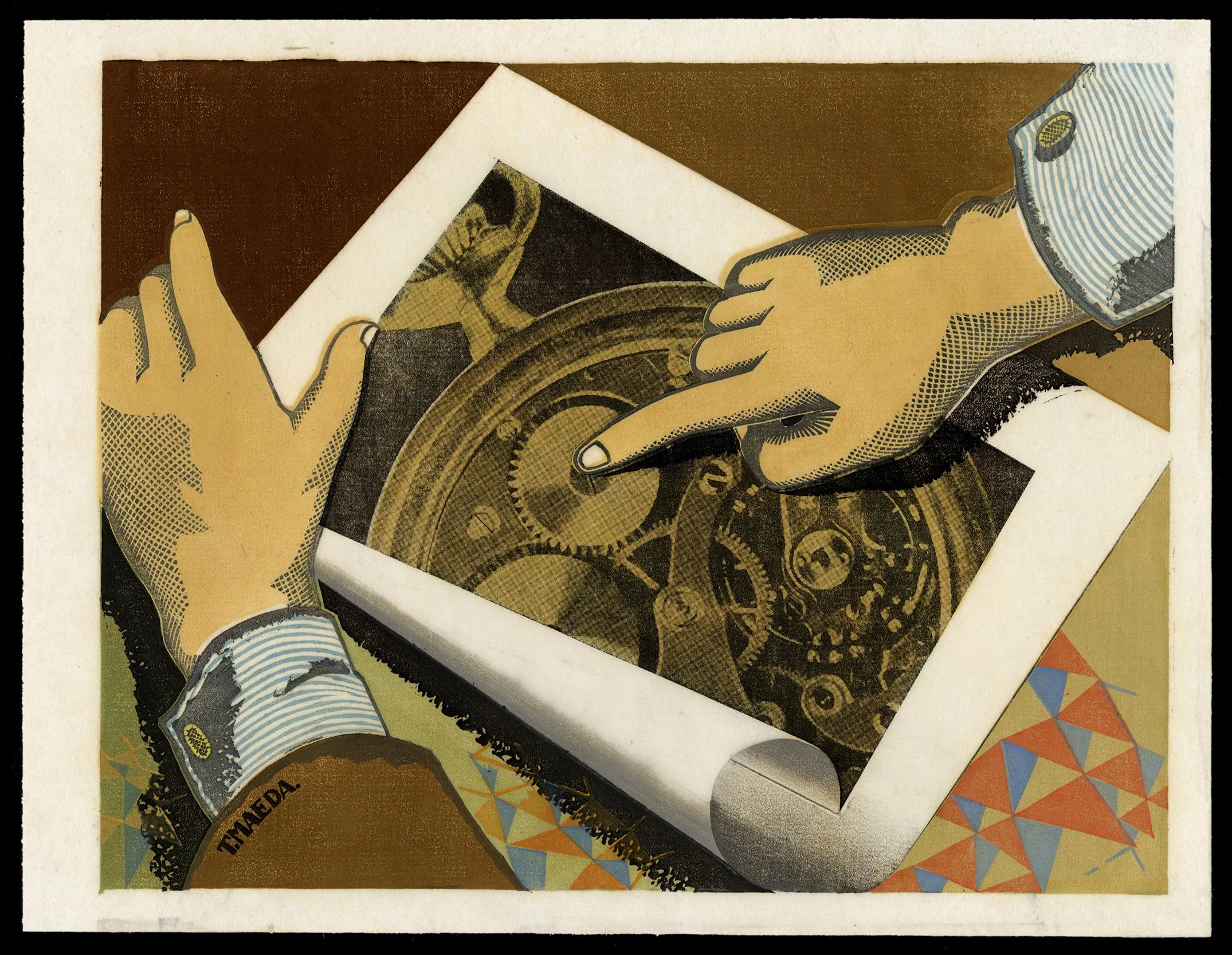
This enigmatic print presents a tightly compressed arrangement of hands, rolled paper, and exposed clockwork rendered through sharply simplified forms and intricate mechanical detail. Two oversized hands dominate the composition, appearing to manipulate or unveil an image containing the inner workings of a timepiece—its gears, springs, and rotating mechanisms exposed beneath a curling sheet. Around this central motif, Maeda incorporates angular geometric ornament and carefully balanced planes of muted ochre, black, silver-gray, and pale blue, creating a visual field that oscillates between technical illustration and surreal abstraction.
Produced during the early 1930s, the work reflects the growing fascination among avant-garde Japanese artists with machinery, precision instruments, photography, and the altered psychology of modern life. The exposed gears and mechanical interior evoke not merely industrial technology, but the increasing sense that contemporary existence itself had become regulated by systems of speed, efficiency, measurement, and mass production. Maeda transforms these themes into something psychologically charged: the viewer is invited not simply to observe the mechanism, but to participate in an act of revelation, as though the hidden interior of modernity itself were being carefully unfolded before the eye.
The print’s hybrid technique is especially significant. By combining linocut with copper-plate photoengraving, Maeda merges the bold graphic clarity of relief printing with the precision and tonal subtlety associated with photographic reproductive processes. This synthesis of media mirrors the broader experimental spirit of interwar Japanese printmaking, when artists increasingly explored the intersections between handcrafted traditions and mechanically reproduced imagery. The sharply outlined hands retain the tactile force of carved relief printing, while the intricate clockwork imagery achieves a density and precision suggestive of photographic or industrial illustration. The result is a work that feels technologically modern not only in subject matter, but in material process itself.
Connoisseur's Note
Maeda occupies a particularly important position within the development of modern Japanese printmaking for the way he synthesized Sosaku Hanga technique with the experimental visual language of European surrealism and graphic modernism. While many Sosaku Hanga artists focused upon landscapes, cityscapes, or scenes of daily life, Maeda increasingly explored the psychological dimensions of mechanized modernity through fractured compositions and symbolic imagery. In this work, the machine is not treated as a neutral object of industrial progress, but as an enigmatic structure capable of evoking anxiety, fascination, and intellectual curiosity simultaneously.
The print’s compositional sophistication lies in its extraordinary manipulation of scale and surface. The monumental hands flatten against the picture plane while the intricate clockwork recedes inward through dense layers of mechanical detail. This tension between flatness and depth mirrors the broader visual instability characteristic of interwar avant-garde art, where photography, cinema, industrial design, and advertising increasingly challenged traditional modes of representation. Maeda’s sharply defined contours, halftone textures, and patterned surfaces reveal an artist deeply attuned to the graphic innovations transforming visual culture during the late 1920s and 1930s.
Within the broader context of interwar Japanese urban culture, the print resonates strongly with the intellectual and psychological atmosphere surrounding modern city life during the period. Department stores, cafés, railway systems, commercial advertising, and industrial technology reshaped not only the physical environment, but also contemporary perceptions of time, labor, consumption, and identity. Maeda’s image of exposed machinery and fragmented perception reflects these broader cultural transformations with unusual subtlety. Rather than depicting the visible spectacle of modernity directly, the print turns inward toward its hidden mechanisms, revealing the fascination—and unease—that accompanied Japan’s accelerating encounter with the machine age.
More prints by Toshiro Maeda: