

 Image 1 of 1
Details
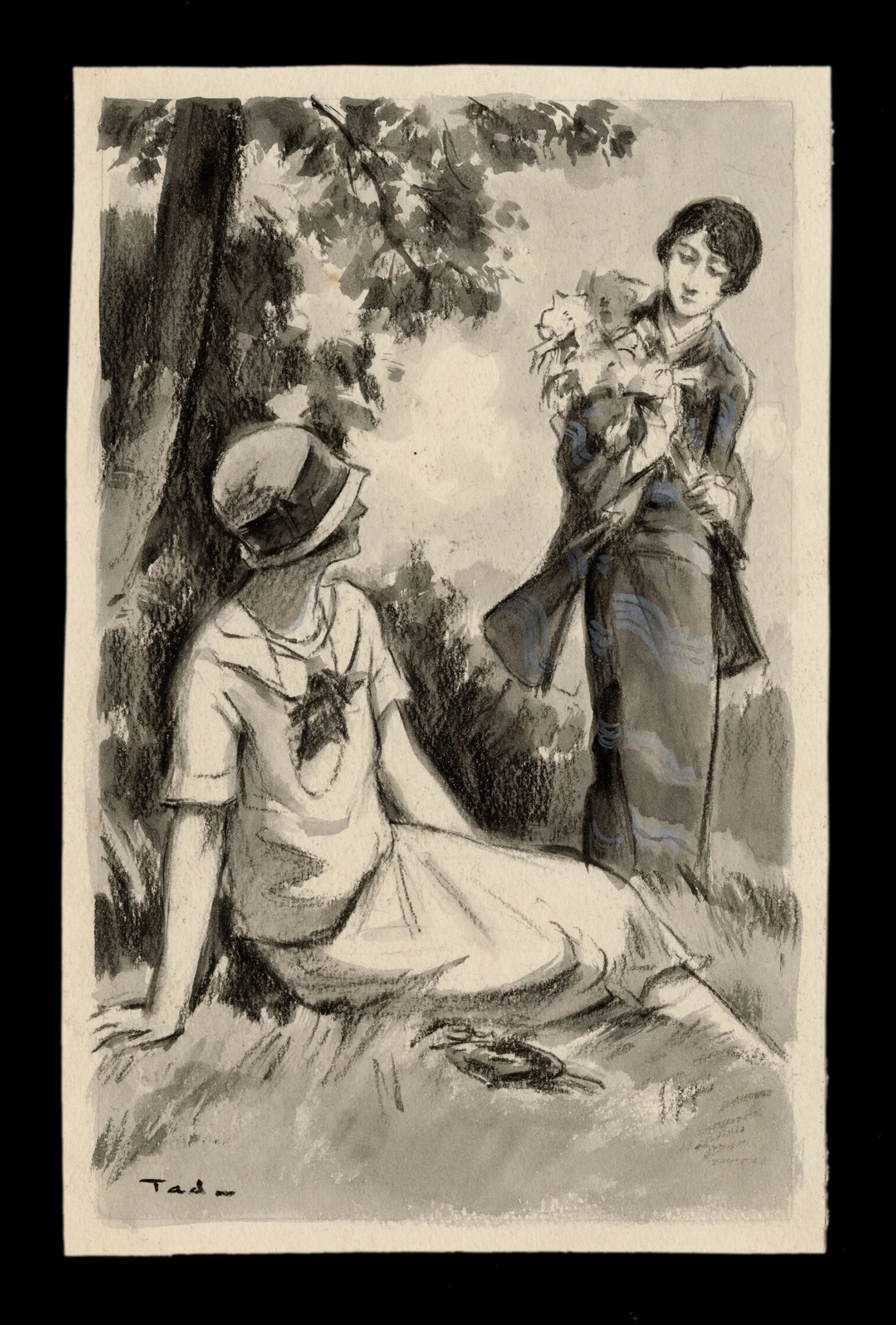
This lyrical ink drawing depicts two women gathered beneath a shaded tree in what appears to be a quiet park or garden setting. One figure, dressed in contemporary Western attire with cloche hat and short-sleeved dress, reclines casually upon the grass while gazing upward toward her companion, who stands holding a bouquet of flowers while dressed in kimono. Executed with soft washes and abbreviated brushwork, the composition possesses the intimacy and narrative ambiguity characteristic of interwar Japanese illustration and popular fiction imagery.
Though seemingly gentle in subject, the drawing reflects the cultural tensions and transformations of late Taishō and early Shōwa Japan. The juxtaposition between Western dress and kimono immediately establishes a dialogue between modern urban identity and older social conventions. Such visual pairings became increasingly common within serialized fiction and women’s magazines during the 1920s, where female characters often navigated competing worlds of modern independence and traditional expectation. Rather than presenting direct conflict, however, the present composition suggests emotional introspection and quiet companionship.
The work was likely produced as a preparatory illustration or narrative study connected to the rapidly expanding world of Japanese pulp fiction publishing. During this period, publishers increasingly relied upon atmospheric illustrations capable of conveying emotional nuance with economy and immediacy. The soft tonal handling and open-ended narrative here invite the viewer to imagine an unfolding psychological drama rather than a fixed literary episode.
Particularly striking is the drawing’s treatment of gesture and gaze. The seated woman’s upward glance introduces a subtle emotional charge into the composition, while the standing figure’s flowers function as both visual accent and narrative clue. The scene feels suspended between conversation and silence, lending the work a contemplative quality unusual within more overtly dramatic pulp imagery.
Connoisseur's Note
Original illustration studies from Japan’s interwar literary culture remain comparatively scarce, particularly examples preserving such painterly sensitivity and emotional restraint. Unlike finished printed reproductions, works such as the present drawing reveal the immediacy of the artist’s hand and the exploratory nature of the creative process. The visible adjustments in wash and contour suggest a composition developed intuitively rather than mechanically transferred for reproduction.
The drawing also reflects the growing importance of female-centered narratives within Japanese popular culture during the 1920s. Women increasingly appeared not merely as romantic accessories to male protagonists, but as psychologically complex figures navigating modern life, friendship, romance, and social transition. The present composition captures this shift subtly but effectively through its focus upon female interaction and emotional atmosphere rather than overt action.
Stylistically, the work reveals strong affinities with contemporary magazine illustration and cinematic visual culture. The soft tonal gradations, asymmetrical composition, and cropped framing suggest familiarity with both European illustration techniques and Japanese shin hanga sensibilities adapted to modern narrative art. This hybrid visual language became central to much of Japan’s most sophisticated commercial illustration during the period.
Today, such drawings offer valuable insight into the visual imagination surrounding Japan’s early modern fiction culture. The present work preserves not simply an isolated image, but an entire emotional world shaped by changing ideals of femininity, leisure, and modern social identity.