

 Image 1 of 1
Details
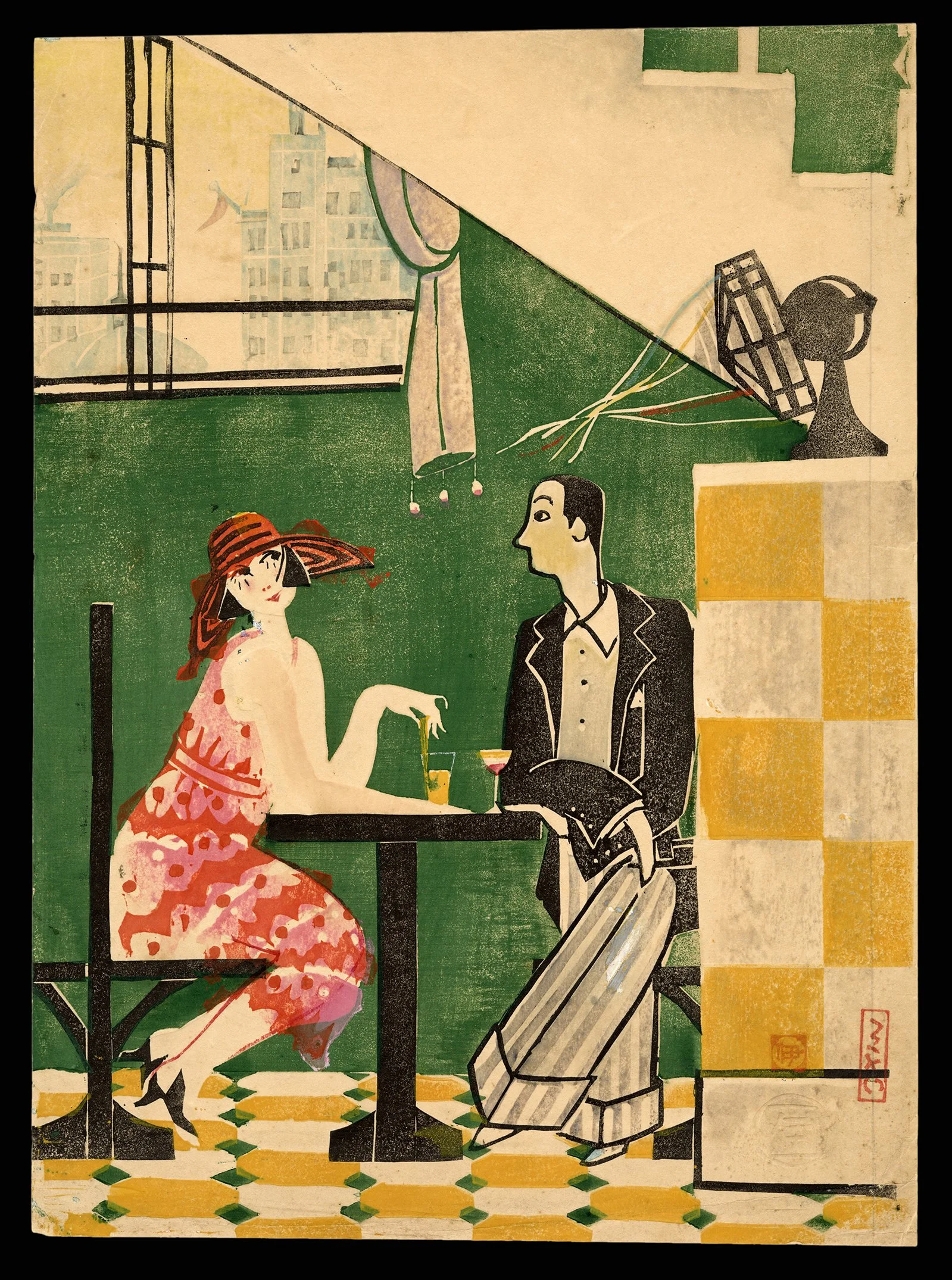
In Café – A Cocktail Between Skyscrapers, Isaku Nakagawa captures the cultivated artificiality and seductive glamour of Tokyo’s modern café society. A stylish woman in a translucent patterned dress and extravagant hat reclines casually at a small table beside a sharply dressed companion clothed in a black dinner jacket and wide leg trousers. Cocktails rest between them as the city rises faintly beyond the café window, where distant office towers and smokestacks emerge through a haze of pale light. The interior itself becomes a stage of modern design: tiled floors, geometric wall panels, angular shadows, and carefully balanced planes of green, yellow, black, and cream evoke the cosmopolitan visual language of Art Deco and avant-garde illustration.
The print reflects the increasingly important role cafés played within urban Japanese culture during the late 1920s and early 1930s. More than simple places of refreshment, cafés functioned as social theaters where modern identities could be performed and observed. Here, Nakagawa presents both figures as embodiments of a newly cosmopolitan urban generation. The male figure, impeccably dressed in a black dinner jacket and dramatically wide-legged trousers, is as fashion-conscious as his companion—a consummate mobo, or modern boy, whose elegant Western attire signals sophistication and metropolitan ease. Beside him, the woman embodies the moga, or modern girl, in her patterned sleeveless dress, extravagant brimmed hat, high heels, and languid, self-possessed pose. Together, rather than representing a contrast between Western modernity and traditional Japan, they form a distinctly modern couple, united by fashion, leisure, and the cultivated rituals of café life. Their interaction unfolds beneath the looming suggestion of the modern city itself, allowing Nakagawa to bind personal style and social performance to the larger spectacle of metropolitan modernity.
Executed within the expressive vocabulary of Sosaku Hanga, the print demonstrates Nakagawa’s remarkable sensitivity to flattening, asymmetry, and decorative rhythm. The large fields of unmodulated color and sharp contouring lend the image an almost cinematic quality, while the compressed interior space heightens the sense of intimacy and performance. The composition feels simultaneously playful and psychologically distant, capturing the peculiar emotional texture of urban café culture during the interwar years.
Connoisseur's Note
Nakagawa’s Café – A Cocktail Between Skyscrapers stands among the most compelling visualizations of café modernity produced within prewar Sosaku Hanga. At its center is the quintessential metropolitan pairing of moga and mobo: two figures whose fashionable Western dress, poised gestures, cocktails, and studied air of sophistication transform the café into a stage for modern urban identity. Nakagawa synthesizes fashion, architecture, graphic design, and social ritual into a highly stylized interior that feels distinctly international in spirit while remaining inseparable from the atmosphere of early Shōwa Japan.
The present impression is especially notable as a rare variant state in which the upper section containing the ascending staircase is absent. In the more commonly encountered version, the staircase introduces an additional architectural element that further emphasizes vertical movement and urban layering. Its omission here produces a more compressed and concentrated composition, focusing greater attention on the interaction between the two figures and the stark geometry of the café interior itself. Such variations offer valuable insight into the fluid and experimental nature of Sosaku Hanga production during the period, where artists frequently adjusted compositions, carving structures, and printed formats outside standardized publishing conventions.
More prints by Isaku Nakagawa: