

 Image 1 of 1
Details
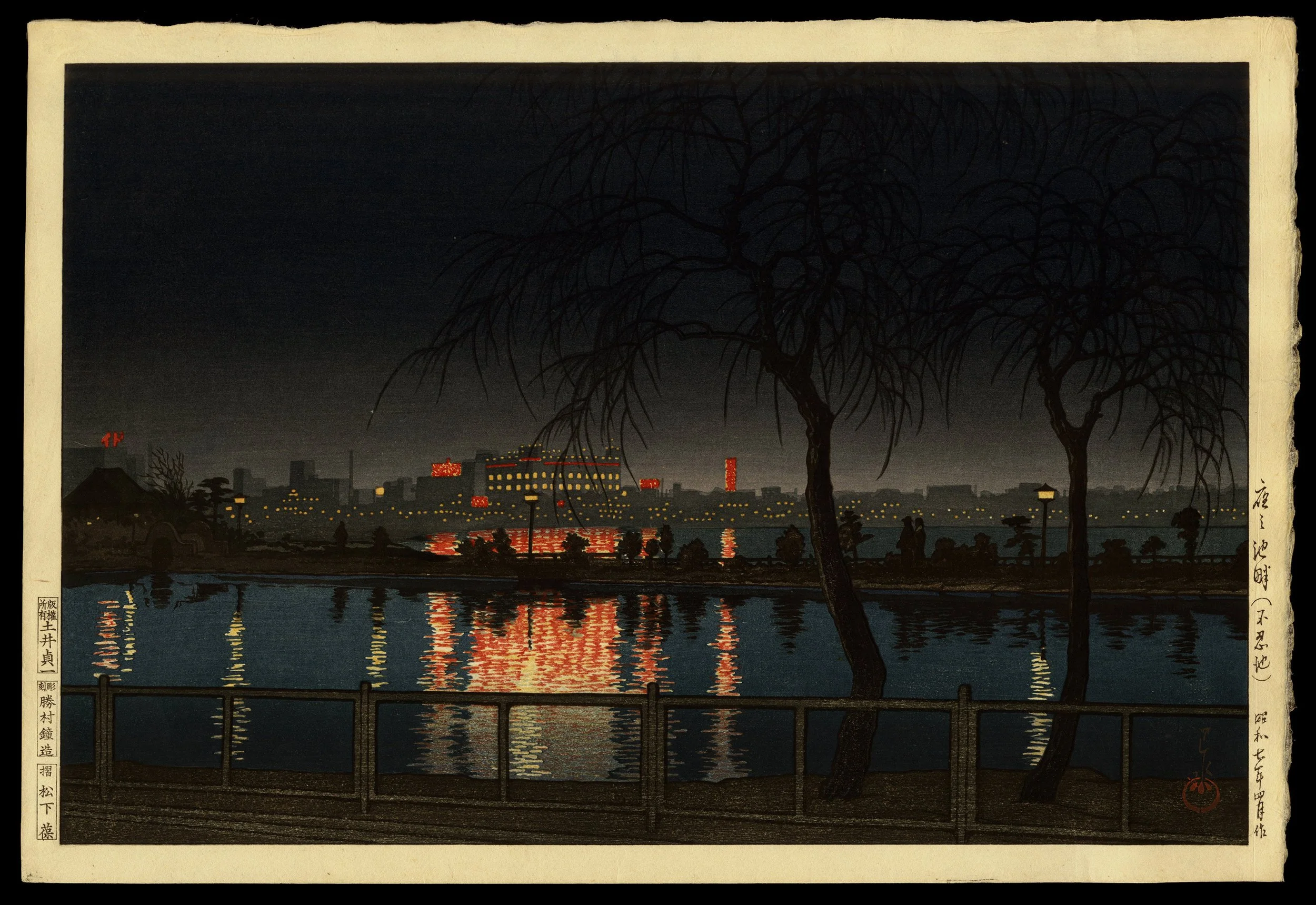
Shinobazu Pond at Night offers an unusually modern vision within Kawase Hasui’s celebrated landscape oeuvre. Rather than transporting the viewer toward the quiet temples, old streets, and solitary corners of Japan for which he remains best known, Hasui turns his attention to contemporary Tokyo. Across Shinobazu Pond, the city stretches along the horizon as a low silhouette punctuated by Western-style buildings, electric signs, and innumerable points of artificial light. Brilliant reds and yellows ripple across the dark water, transforming the pond into a mirror for the illuminated metropolis.
Hasui nevertheless retains the lyrical devices that distinguish his finest nocturnes. Two leafless trees frame the view, their twisting branches spreading across the dark sky, while silhouetted figures stroll along the opposite bank. Yet the source of enchantment has changed. The warm lantern light and moonlit atmosphere associated with an older Japan give way to electric illumination, glowing advertisements, and the reflected brilliance of the modern city. Nature and metropolis coexist within the same image, but modern Tokyo unmistakably commands the distance.
Connoisseur’s Note
By 1932, Tokyo had emerged from the enormous reconstruction that followed the Great Kantō Earthquake of 1923 as a markedly different metropolis. New architecture, improved transportation, expanding commercial districts, electric signage, and a flourishing culture of nighttime entertainment altered both the appearance and experience of the city. Shinobazu Pond, bordering the Ueno district, offered Hasui an ideal vantage point from which to observe this transformation. Across the water, illuminated buildings and signs announce a Tokyo increasingly defined by commerce and electricity, while the small figures along the shore suggest the evening promenade as part of modern metropolitan life.
This subject stands apart within an oeuvre so closely associated with poetic evocations of an older Japan. Hasui does not reject his familiar language of darkness, water, trees, and reflection; instead, he uses it to describe modernity. The pond becomes a field of broken color as red, yellow, and white electric lights shimmer across its surface. The juxtaposition proves especially compelling: the silhouetted willows belong to the traditional vocabulary of the Japanese landscape, while the illuminated skyline beyond them belongs emphatically to the twentieth-century city. Hasui thus captures modern Tokyo without sacrificing the atmosphere and emotional restraint that define his art.
The print also occupies a distinctive place within Hasui’s production. Published by Doi Sadakazu rather than Watanabe Shōzaburō, it belongs to the comparatively small group of Hasui designs issued outside his long association with Watanabe. The present example is a first-state impression, adding further connoisseurial significance to an already uncommon subject. More importantly, Shinobazu Pond at Night reveals a side of Hasui too easily overshadowed by his nostalgic reputation: an artist capable of finding poetry not only in the disappearing Japan of temples and lanterns, but in the electric spectacle of the rebuilt metropolis.
c. 1933
$6,000
Kasuga Shrine in Snow, Nara
Kawase Hasui (1883-1957)
MEDIUM: Woodblock Print
DATE: c. 1933
DIMENSIONS: 15 ¼ x 10 ¼ inches
CONDITION: Mounted onto original backing, minor losses to silver edge of backing, small loss to coversheet of calendar; minor soiling and staining
NOTE: Full-size woodblock print
$6,000.00
Contact us to purchase