

 Image 1 of 1
Details
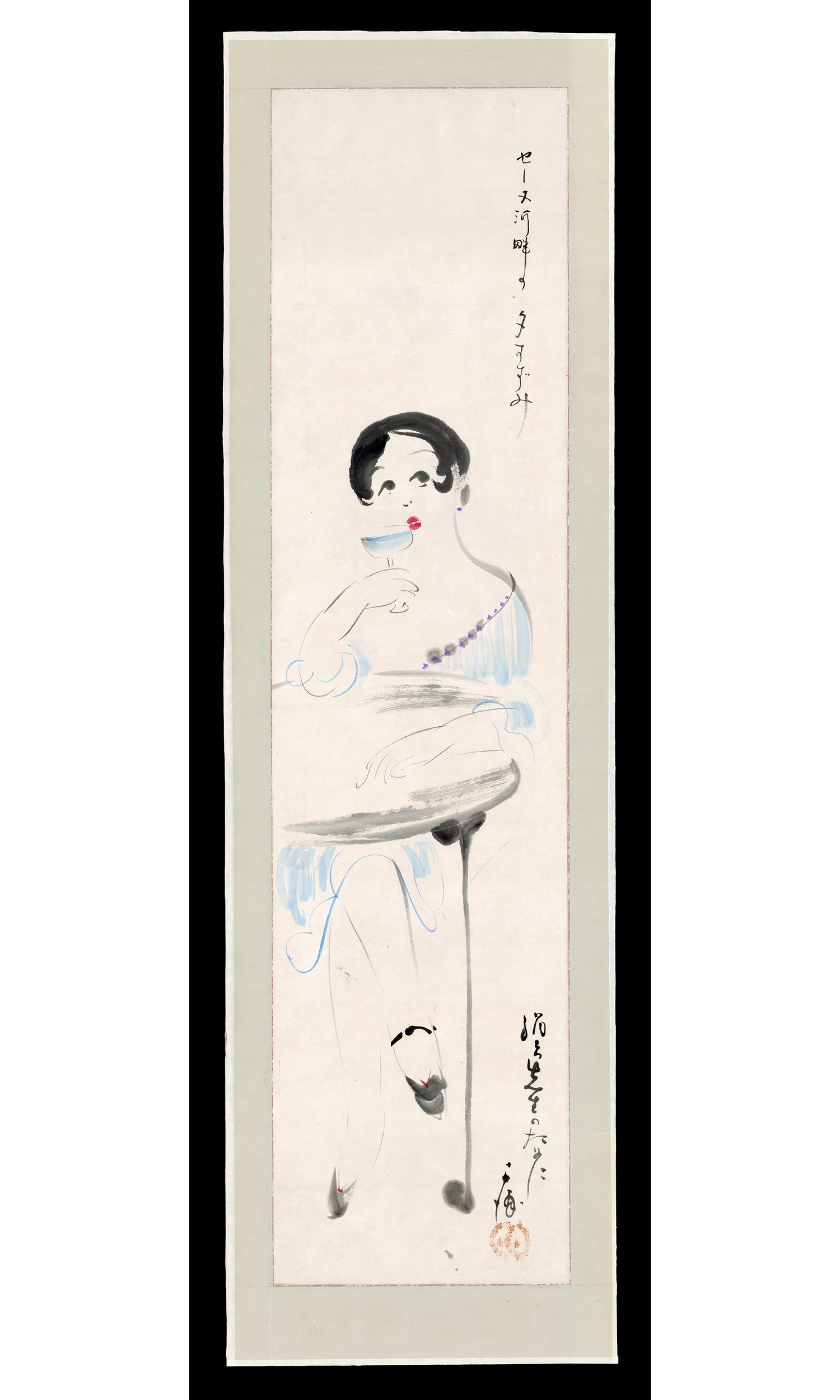
This rare and highly unusual original work by Chiura Obata presents a striking image of modern urban femininity rendered through the artist’s uniquely cosmopolitan sensibility. Painted during Obata’s 1930 return visit to Tokyo, the composition depicts a fashionable moga seated elegantly upon a barstool while raising a martini glass toward her lips. Her softly waved coiffure, vivid lipstick, exposed shoulders, and abbreviated Western-style dress place her unmistakably within the café and cocktail culture that defined Tokyo’s Ginza district during the early Shōwa period.
The inscription references the Seine, a celebrated Ginza bar deeply shaped by Parisian café culture and continental nightlife. The inscription reads: Seinu ka han no Yusuzumi “Enjoying the cool evening breeze alongside the Seine (bar).” The inscription evokes the cultivated atmosphere of modern sophistication that establishments such as the Seine sought to create within Tokyo’s rapidly internationalizing urban environment. Following the Great Kantō Earthquake of 1923, Ginza became a center of modern consumer culture filled with jazz cafés, cocktail lounges, dance halls, and avant-garde social spaces inspired by Paris, Berlin, and New York. Within this setting, the moga emerged as an emblem of cosmopolitan identity, feminine independence, and urban leisure.
Although Obata is best known today for his majestic depictions of the American landscape and for the celebrated California-themed woodblock prints he produced with the Takamizawa workshop during this same Tokyo visit, the present work demonstrates that he was deeply engaged with modernism itself. Obata embraced modernity not only through subject matter, but through atmosphere, composition, and cultural perspective. His career moved fluidly between Japanese artistic traditions, American experience, and international modern aesthetics. This painting reveals an artist fully attuned to the social and visual transformations shaping metropolitan life during the late 1920s and early 1930s.
Visually, the composition possesses an extraordinary sense of immediacy and elegance. The figure emerges through remarkably economical brushwork, with delicate washes of pale blue and gray dissolving softly into the surrounding paper. Large areas remain intentionally open, allowing the image to breathe with remarkable lightness and spontaneity. Her vivid red lips and tiny accents of violet jewelry punctuate the composition with flashes of sophistication, while the elongated vertical format enhances the work’s theatrical refinement. The result feels both modern and ephemeral, as though capturing a fleeting moment observed beneath the soft glow of café lighting late in the evening.
Connoisseur's Note
This painting occupies a singular position within Chiura Obata’s oeuvre and significantly broadens our understanding of his relationship to modernism. While his reputation has long centered upon lyrical landscapes of California and the Sierra Nevada, Obata was never solely a painter of nature. He participated actively in the international artistic currents of the early twentieth century, absorbing influences from modern design, cosmopolitan urban culture, and evolving conceptions of identity that circulated between Japan and America during the period.
The present work demonstrates how naturally Obata engaged with the visual language of modern urban life. The moga subject was one of the defining icons of Japanese modernity during the late Taishō and early Shōwa years, appearing across painting, printmaking, photography, cinema, and advertising. Obata’s interpretation differs notably from the sharper Art Deco stylizations of contemporaries such as Kobayakawa Kiyoshi or Ishikawa Toraji. His approach is softer, more lyrical, and psychologically restrained. The figure appears neither satirical nor overtly glamorous; instead, she inhabits an atmosphere of cultivated ease and quiet sophistication.
Collectors will recognize the extraordinary rarity of such imagery within Obata’s body of work. Produced during the same Tokyo sojourn that resulted in his famous collaborations with the Takamizawa publishing house, this painting serves as a fascinating counterpoint to the grand American landscapes that established his international reputation. Here, Obata turns away from mountains and forests toward the intimate theater of metropolitan nightlife, revealing the breadth of his artistic curiosity and the depth of his engagement with contemporary culture.
The work also preserves the fragile glamour of Ginza before the increasingly restrictive political climate of the later 1930s altered the character of Japanese urban life. The moga seated at the Seine becomes more than a fashionable figure; she embodies a fleeting cosmopolitan moment shaped by jazz, cocktails, imported aesthetics, and the seductive promise of international modernity. Through its sparse brushwork and luminous restraint, the painting captures not simply a woman in a bar, but the atmosphere of an era poised delicately between elegance, experimentation, and impermanence.
More prints by Chiura Obata:
1930
RESERVED
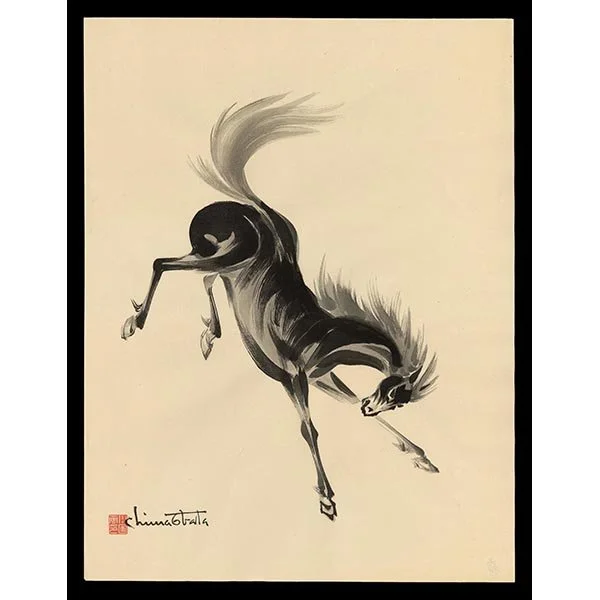
Leaping Horse (Left)
Chiura Obata (1885–1975)
DATE: 1930
MEDIUM: Woodblock Print
DIMENSIONS: 20 ½ x 15 ¼ inches
CONDITION: Excellent impression and color; no issues to note
NOTE: Brush signature and seal of the artist lower left
$800.00 <RESERVED>
Contact us to purchase