

 Image 1 of 1
Details
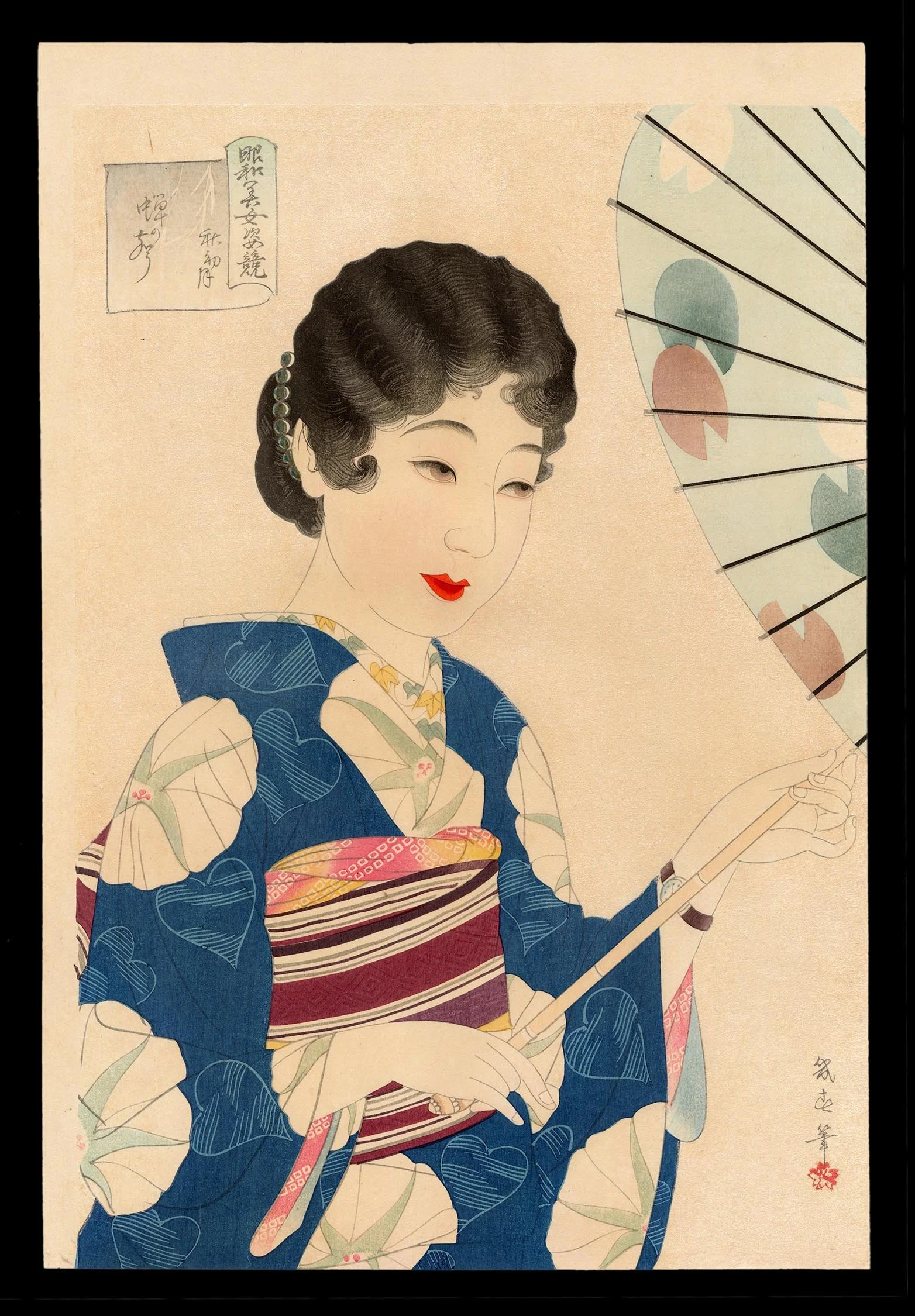
Watanabe Ikuharu’s July — Chorus of Cicadas captures the quiet refinement of summer during the late Taishō and early Shōwa years through a subtle fusion of traditional beauty imagery and emerging modern sensibility. A young woman dressed in a deep blue summer kimono patterned with stylized floral motifs holds an elegant round fan before her, her softly waved coiffure and vivid crimson lips immediately situating her within the fashionable urban culture of 1920s Japan. The title’s reference to the chorus of cicadas evokes the dense atmosphere of midsummer, where sound itself becomes inseparable from heat, memory, and seasonal rhythm.
Unlike the overtly cosmopolitan café scenes and dance-hall imagery that increasingly defined representations of the moga during the decade, Watanabe approaches modern femininity through restraint and atmosphere. The figure retains the grace and composure associated with earlier bijin-ga traditions, yet her hairstyle, cosmetics, and subtly individualized expression reveal the influence of contemporary fashion and urban beauty culture. By the late 1920s, department stores, women’s magazines, beauty salons, and cinema had transformed ideals of feminine appearance throughout Japan, creating a new visual language that blended traditional elegance with modern sophistication. Watanabe’s figure inhabits this transition delicately, embodying refinement without abandoning contemporary identity.
The composition itself is remarkably understated. The silver mica background creates an atmosphere of luminous summer haze, allowing the rich blue kimono and softly patterned fan to emerge with quiet clarity. The figure’s downward gaze and measured gesture suggest introspection rather than theatrical display. The cicadas referenced in the title remain unseen, yet their imagined sound permeates the composition, filling the surrounding stillness with the sensory weight of midsummer. This subtle interplay between silence and implied sound gives the print its remarkable emotional resonance.
July — Chorus of Cicadas reflects broader developments within Japanese print culture during the late 1920s. Artists increasingly sought ways to reconcile traditional bijin-ga aesthetics with the realities of modern urban life and changing feminine identity. In this design, Watanabe’s approach remains gentler and more lyrical than many contemporary depictions of modern girls engaged in nightlife or Westernized leisure culture, yet the work nevertheless participates fully in the visual transformation of femininity occurring throughout Japan during the period.
Connoisseur's Note
Among seasonal bijin-ga of the early Shōwa period, July — Chorus of Cicadas stands out for its remarkable balance of refinement, atmosphere, and modern sensitivity. Watanabe Ikuharu avoids overt narrative entirely, instead allowing gesture, color, and seasonal suggestion to shape the emotional experience of the print. The result possesses an almost cinematic stillness, as though the figure has paused momentarily within the heavy quiet of a summer afternoon.
The work belongs to a broader artistic moment in which Japanese printmakers explored new forms of feminine beauty shaped by both tradition and modern consumer culture. During the 1920s, women’s magazines and advertising increasingly circulated images of fashionable hairstyles, cosmetics, and seasonal attire, reshaping visual ideals across urban Japan. Watanabe absorbs these developments subtly. The sitter’s softly waved hair and carefully applied lipstick reveal the influence of modern beauty trends, yet her composure and understated elegance preserve a connection to classical ideals of grace and restraint.
Collectors are particularly drawn to works such as this because they reveal another dimension of modernity distinct from the jazz cafés and dance halls often associated with the period. Here, modern life appears quieter and more introspective. The fan, summer kimono, and seasonal atmosphere evoke continuity with older cultural rhythms even as the figure herself embodies the evolving identity of contemporary womanhood. This delicate tension between continuity and change gives the image its enduring sophistication.
The print’s emotional power ultimately lies in its atmosphere of transience. The unseen cicadas become a poetic device suggesting the passage of time, the intensity of summer, and the fleeting nature of youth itself. Watanabe transforms an ordinary seasonal moment into something deeply evocative, preserving not simply the image of a woman in summer attire, but the emotional texture of modern Japan poised delicately between memory, tradition, and transformation.
More prints by Ikuharu Watanabe:
1927
RESERVED
Kuchibeni (November - Rouge)
Ikuharu Watanabe (1895–1975)
SERIES: A Competition of Showa Beauties
MEDIUM: Woodblock print
DATE: 1927
DIMENSIONS: 16 x 11 inches
CONDITION: Exceedingly fine state of preservation with pristine mica background
NOTE: Silver mica background
LITERATURE: The Female Image, pl. 254
$4,500.00 <RESERVED>