

 Image 1 of 1
Details
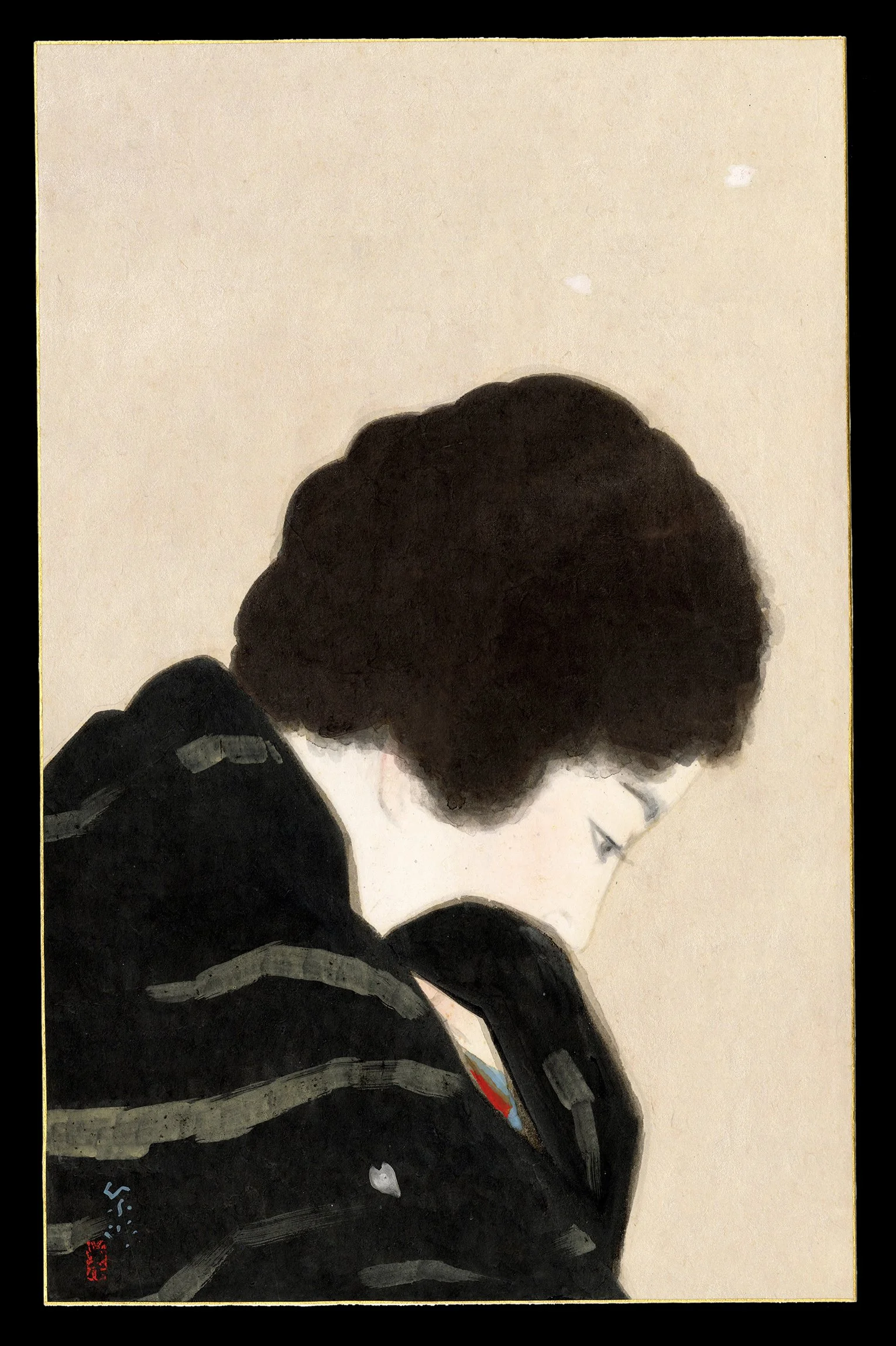
This hauntingly elegant painting by Shimei Terashima depicts a modern woman turned gently away from the viewer, her face partially obscured beneath softly modeled dark hair and the sweeping mass of a black kimono. Executed in sumi, mineral pigments, gofun, and silver mica on paper, the composition is remarkable for its restraint and atmospheric subtlety. Broad passages of deep black contrast against the luminous silver mica ground, producing an image that feels simultaneously grounded and immaterial. The figure seems less placed within a conventional setting than enveloped by the peculiar radiance of a winter day.
The soft and subtle touches of white gofun appear to represent falling snow. Scattered sparingly across the silver field, these softly defined flakes transform our understanding of the otherwise unarticulated space surrounding the woman. The mica ground itself consequently assumes a more evocative role. Its cool, softly reflective surface suggests the diffuse light of snowfall—the silvery luminosity of a sky in which earth, air, and distance have momentarily dissolved.
The figure’s kimono is dominated by exceptionally deep blacks and muted gray passages, its visual weight suggesting the heavier fabrics and subdued palette associated with the colder season. Against this darkness, Terashima permits only the smallest chromatic accents near the collar to emerge. A single pale form upon the robe, together with the drifting flakes beyond, punctuates the otherwise nearly monochromatic composition. The effect is one of remarkable tonal economy: black garment, pale flesh, white snow, and silver light.
The woman herself embodies a distinctly modern refinement. Her softly waved coiffure and simplified profile reflect changing ideals of feminine elegance during the late Taishō and early Shōwa years, when urban fashion and contemporary beauty culture increasingly shaped artistic representations of women. Yet Terashima avoids overt glamour or decorative excess. The figure remains introspective and emotionally distant, absorbed within private contemplation rather than outward display. Set against the silence of falling snow, her inwardness becomes still more pronounced.
Terashima’s training under Kaburaki Kiyokata is evident in the graceful economy of line and careful balance of form, though the present composition moves beyond traditional bijin-ga conventions toward a more distilled modern sensibility. The reduction of detail, asymmetrical cropping, and broad tonal fields reveal an artist interested in atmosphere and emotional suggestion rather than descriptive realism. Here, season itself becomes psychological: winter is not merely represented by snow, but conveyed through stillness, muted color, and the profound quiet surrounding the solitary figure.
Connoisseur’s Note
The present painting demonstrates Shimei Terashima’s remarkable ability to fuse traditional materials with the visual language of modern design. While executed using sumi, mineral pigments, gofun, and mica—materials deeply associated with Japanese painting practice—the composition possesses an almost cinematic sense of reduction and framing. The figure occupies only a portion of the pictorial field, allowing the expansive silver ground to function not merely as backdrop but as an active atmospheric presence.
The identification of the scattered white gofun forms as falling snow provides an especially compelling key to the composition. Against the silver mica, these isolated flakes seem to materialize and disappear according to the light falling upon the painting. The mica itself consequently acquires an almost meteorological quality, evoking the cool, diffuse illumination produced by a snow-filled sky. Terashima does not describe a winter landscape; instead, with remarkable economy, he conjures the sensation of winter through material, tone, and light.
Particularly striking is the role of the woman's dark kimono within this seasonal conception. Rendered through dense, layered applications of sumi and pigment, the garment becomes the painting’s primary structural form, its near-black tonality suggesting both the visual weight and subdued coloration of winter dress. Against this darkness, the smallest accents—the pale contour of the cheek, the muted red and blue at the collar, and the isolated touch of white upon the robe—acquire extraordinary sensitivity. The contrast between the enveloping garment and the luminous snowfall beyond heightens the impression that the figure has been caught in a fleeting, private moment within the winter city.
The painting also reflects broader shifts occurring within modern Japanese figure painting during the interwar period. Artists increasingly moved beyond purely decorative bijin-ga imagery toward psychologically nuanced portrayals of contemporary feminine identity. Here the woman's averted gaze and withdrawn posture create an emotional ambiguity that feels distinctly modern. She appears self-contained, contemplative, and inaccessible—less an idealized beauty presented for admiration than an interior presence momentarily glimpsed through falling snow.
Winter imagery has a long history in Japanese art and poetry as a vehicle for silence, transience, and heightened emotional awareness. Terashima's treatment, however, is strikingly modern. There is no snow-covered garden, architectural setting, or landscape to establish the season. Instead, winter has been reduced to its essential sensations: black, white, silver, cold light, and silence. The sparse snowflakes and shimmering mica allow atmosphere itself to carry the narrative.
Works by Terashima of this intimacy and restraint remain comparatively scarce, particularly examples in which the reflective surface contributes so fundamentally to the conception of the image. In the present painting, silver mica is not simply a luxurious decorative material: it becomes winter light. Against it, the dark figure assumes an almost silhouetted presence, suspended for an instant within the quiet passage of snow. The result is a work of extraordinary emotional economy, quietly bridging traditional nihonga materials, modern urban femininity, and the enduring Japanese poetic language of the seasons.
More prints by Shimei Terashima:
1925-1930
RESERVED
Moga in Black Kimono
Shimei Terashima (1892-1975)
MEDIUM: Sumi and pigment on paper
DATE: 1925-1930
DIMENSIONS: 18 ¼ x 11 ½ inches
CONDITION: Excellent, no problems to note
NOTE: Silver mica background with white gofun; mounted on presentation board with gold edges
$4,500.00 <RESERVED>