

 Image 1 of 1
Details
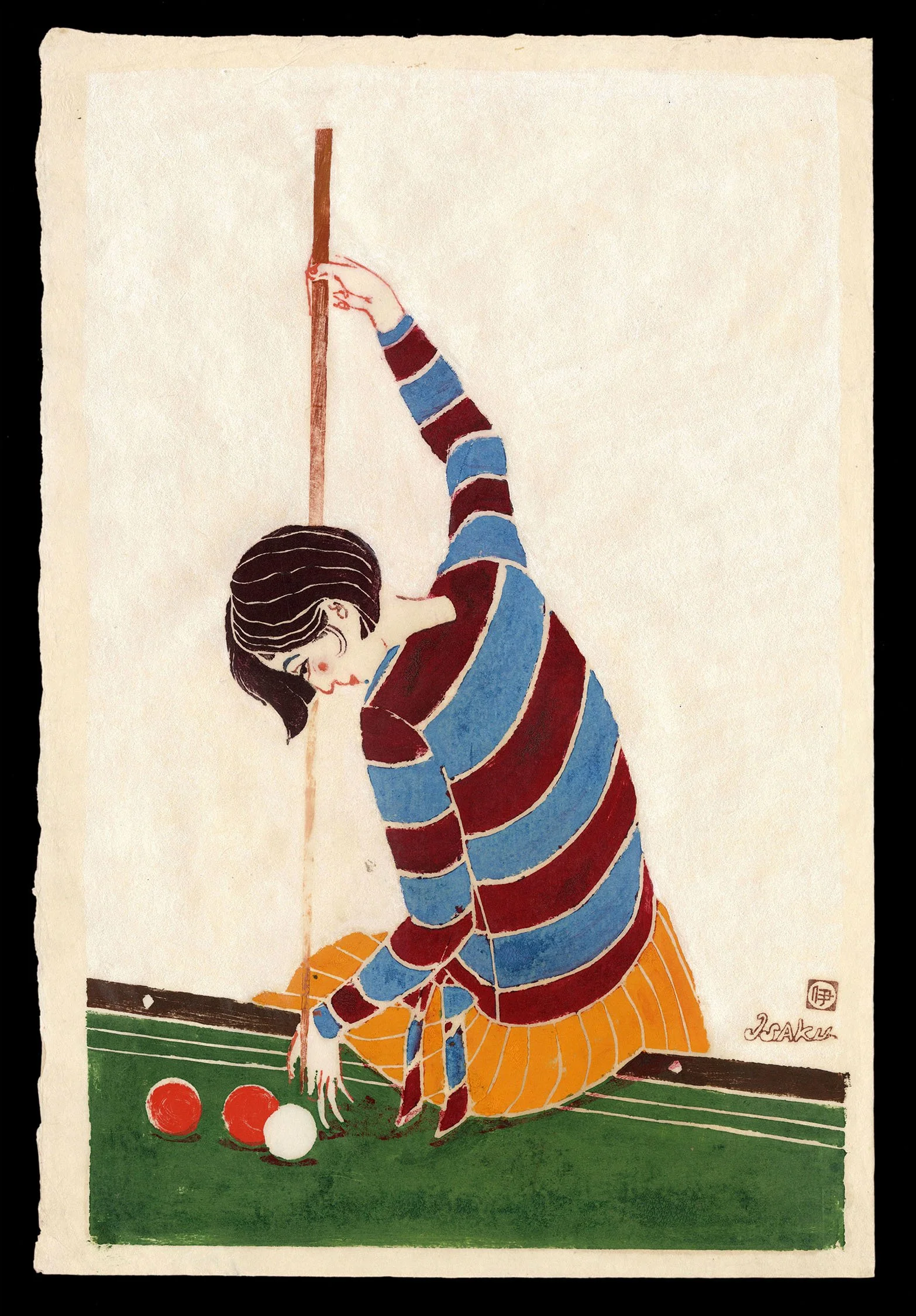
In Grand-Massé, Isaku Nakagawa distilled the spirit of the modern woman into a composition of remarkable elegance and concentration. The seated billiards player stretches diagonally across the sheet, her elongated posture echoing the poised precision required for the difficult trick shot referenced in the title. Clad in a boldly striped sweater and vibrant skirt, she appears entirely absorbed in the moment before impact, transforming an ordinary leisure activity into an image of psychological intensity and cultivated sophistication. The stark economy of the composition heightens the figure’s presence: the nearly empty background isolates her gesture with theatrical clarity, allowing the body itself to become the primary vehicle of rhythm and movement.
The print reflects the emergence of new feminine identities within urban Japan during the early Showa period. Billiard halls, cafés, dance clubs, and cinemas became modern social environments where women increasingly participated as visible and self-directed figures within metropolitan life. Nakagawa’s heroine belongs unmistakably to this changing world. She is neither decorative accessory nor passive observer, but the active center of the composition—disciplined, stylish, and self-contained. Such imagery resonated deeply with the era’s fascination with the modern girl, whose presence expanded across advertising, literature, popular magazines, and film. Here, the language of Sosaku Hanga merges with the atmosphere of contemporary urban culture to produce a figure that feels both intimate and iconic.
The print’s formal restraint further intensifies its modernity. Broad areas of unmodulated space, sharply simplified contours, and carefully balanced color relationships reveal Nakagawa’s sensitivity to graphic design and contemporary illustration. The composition possesses a quiet confidence that avoids sentimentality, presenting the modern woman as intellectually engaged and emotionally interior rather than overtly performative.
Connoisseur's Note
This impression represents a rare and unusual variant of Grand-Massé, differing from the more familiar version generally regarded as the standard state of the design. Unlike the earlier and more commonly encountered impression, which is printed on heavier paper without margins and lacks a visible in-image signature, the present example appears on thinner paper with full margins and includes Nakagawa’s signature incorporated directly into the composition. The palette also differs subtly, with brighter and slightly cleaner tonal relationships that lend the image a lighter and more openly decorative sensibility.
These variations suggest the possibility that this impression may have been produced as a more commercially accessible version of the design. Whereas the better-known impression possesses a denser physical presence and greater austerity, this variant feels more refined toward presentation and display, emphasizing elegance and visual immediacy. Such distinctions offer valuable insight into the fluid nature of Sosaku Hanga production during the early 1930s, when artists frequently experimented with papers, pigments, and printing approaches outside rigid commercial publishing systems.
Nakagawa would later become celebrated as a Living National Treasure for his ceramics rather than for printmaking, and surviving impressions of his woodblock prints remain exceptionally scarce. Variant states such as the present example are rarer still, making this work an important document of both Nakagawa’s artistic experimentation and the evolving visual culture surrounding the modern woman in prewar Japan.
More prints by Isaku Nakagawa: