

 Image 1 of 1
Details
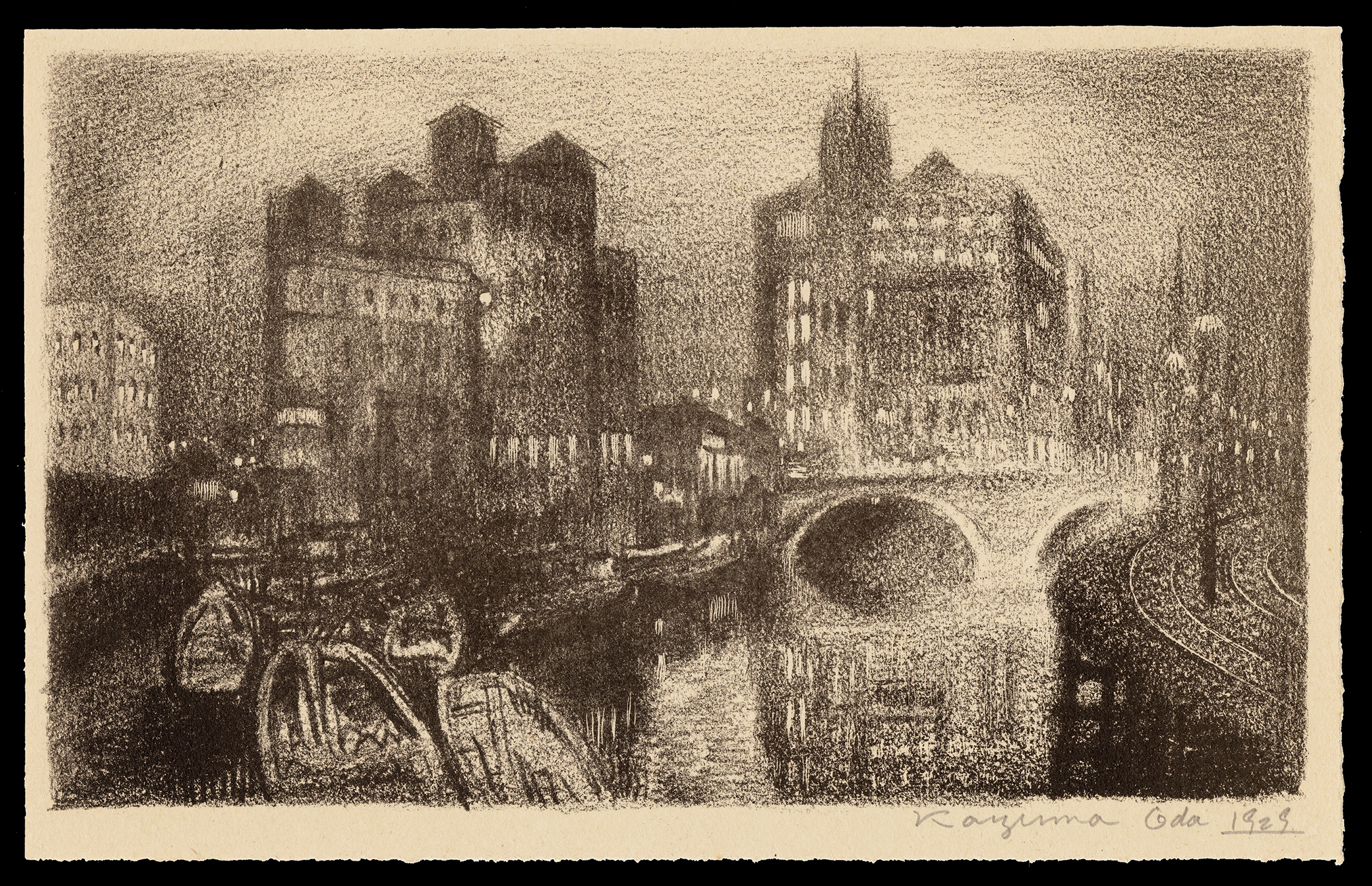
In Sukiya Bridge at Night, Kazuma Oda presents Tokyo as a shimmering world of reflected light, softened architecture, and nocturnal movement. The bridge arches gracefully across the canal while the surrounding buildings dissolve into a haze of luminous grain and shadow. Reflections ripple through the water beneath the bridge, creating an almost dreamlike instability between the solid city above and its mirrored counterpart below. Along the canal edge, bicycles, rail lines, and scattered streetlights quietly animate the composition, suggesting the subdued persistence of urban life after evening has settled over the district.
The composition reveals Oda’s remarkable sensitivity to lithography as a medium capable of capturing atmosphere rather than precise description. The surface is built from soft accumulations of tonal texture, allowing forms to emerge gradually from darkness. Electric illumination flickers gently across the cityscape without overwhelming it, producing an image defined by restraint rather than spectacle. Sukiya Bridge itself became emblematic of Tokyo’s modernization during the late Taishō and early Shōwa periods, when reinforced infrastructure, expanding transportation systems, and commercial redevelopment reshaped the capital into an increasingly cosmopolitan metropolis. Oda captures this transformation through mood and sensation rather than documentary realism.
The district surrounding Sukiya Bridge was deeply associated with the rhythms of Ginza nightlife: cafés, restaurants, theaters, and entertainment establishments drew crowds of office workers, artists, students, and fashionable urbanites into the area after dusk. Yet the print resists overt narrative. Instead, the city appears suspended in a moment of reflective quiet, where modern architecture and industrial infrastructure merge with water, mist, and light into a unified atmospheric field. The result is one of the most visually restrained and emotionally nuanced designs from Oda’s interwar urban series.
Connoisseur's Note
Kazuma Oda’s lithographs from the late 1920s occupy an important place within the evolution of modern Japanese printmaking. While many artists of the period remained committed to traditional woodblock production, Oda pursued lithography with unusual seriousness and sophistication. His works demonstrate how the medium could convey tonal complexity, immediacy, and psychological atmosphere unavailable through more conventional techniques. In this regard, Oda stands among the most innovative interpreters of urban modernity working in Japan during the interwar years.
Particularly significant in this print is the emphasis placed upon the steel bridge itself. In Europe and America during the same period, artists and architects often celebrated the vertical monumentality of skyscrapers as symbols of modernity and industrial triumph. In Japan, however, bridges frequently carried a more profound emotional and cultural resonance. Long central to Japanese visual tradition, bridges historically symbolized transition, connection, and passage between worlds—between districts, seasons, and emotional states. Following the destruction of the Great Kantō Earthquake, newly rebuilt steel bridges came to embody not only technological progress but also civic recovery and continuity within the urban landscape. Oda’s treatment of Sukiya Bridge reflects this distinctly Japanese sensibility, where infrastructure becomes less an object of mechanical spectacle than a quietly poetic presence woven into the daily rhythms of the city.
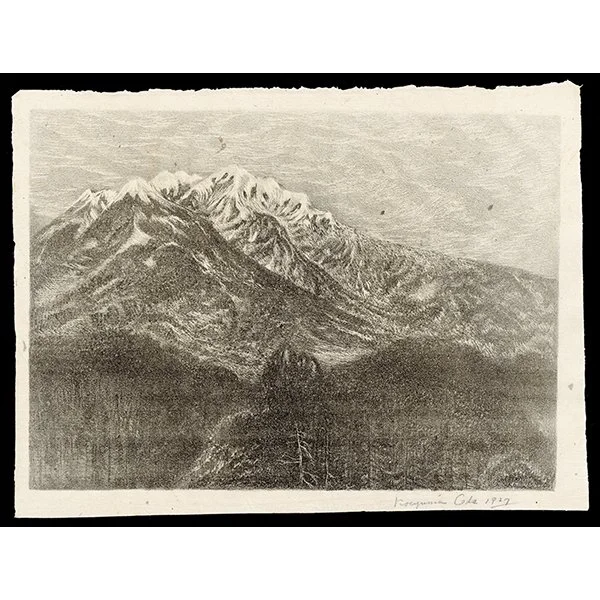
More prints by Kazuma Oda:
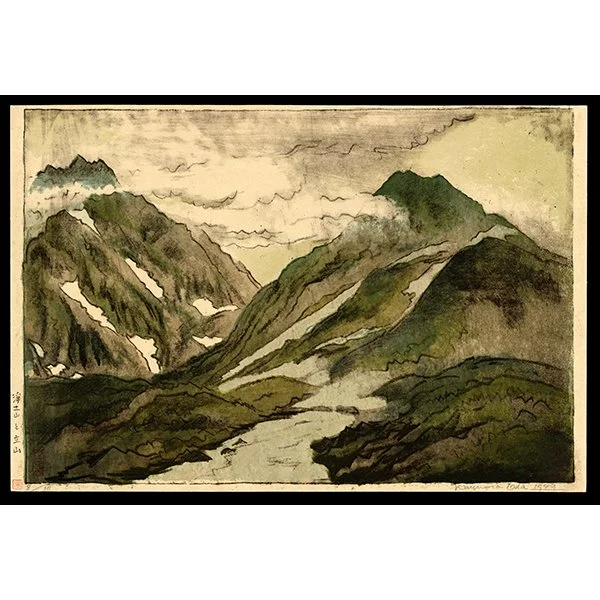

c.1920
RESERVED
View of Yagishima
Kazuma Oda (1882-1956)
MEDIUM: Woodblock print
DATE: c.1920
DIMENSIONS: 10 3/8 × 15 7/8 inches
CONDITION: Excellent, no problems to note
NOTE: Numbered 40/100 on the reverse
$3,500.00 <RESERVED>