

 Image 1 of 1
Details
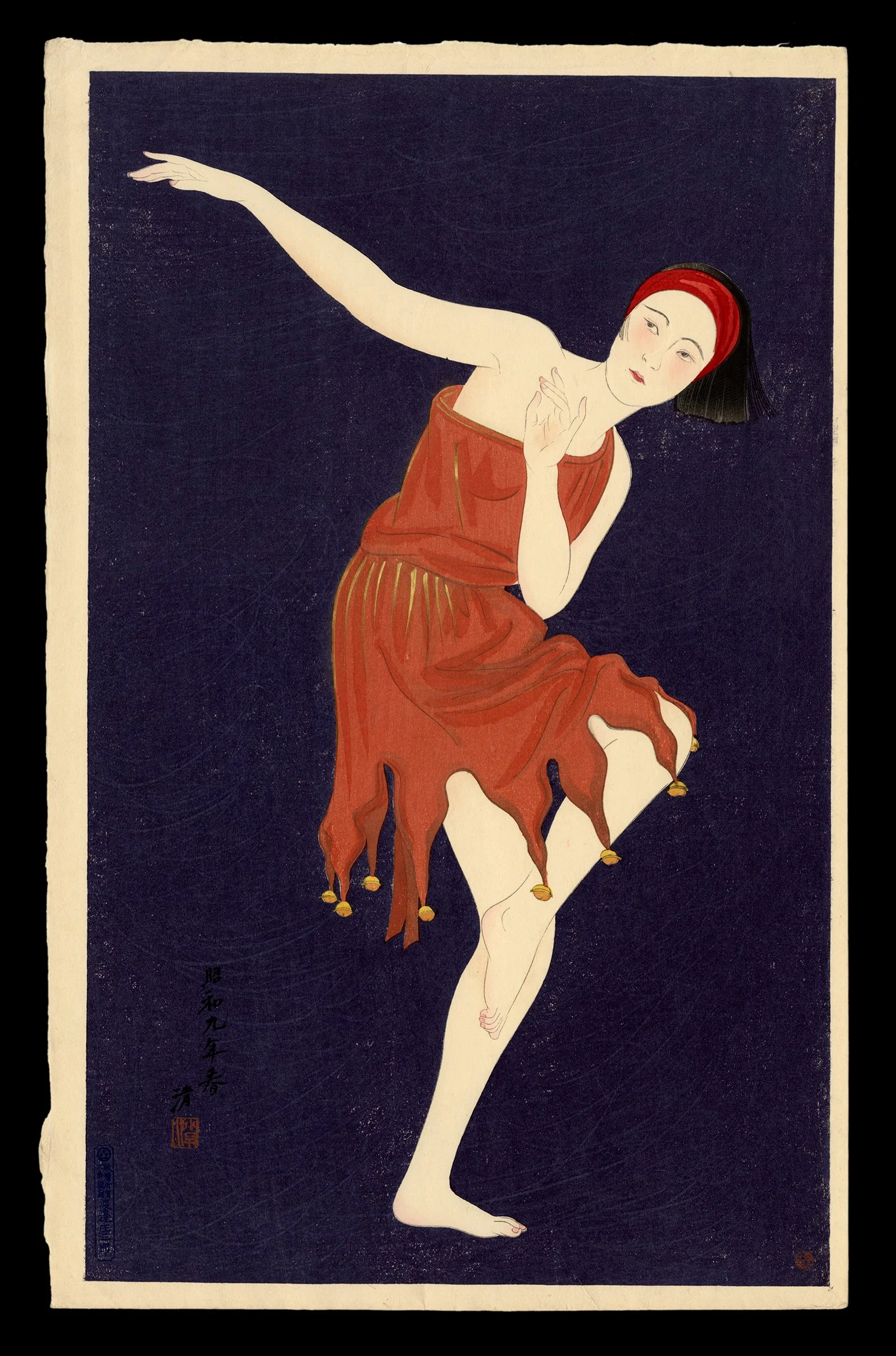
In Western Style Dancing, Kobayakawa Kiyoshi distills the vitality of early Shōwa modernity into a single suspended gesture. A young woman dressed in a vivid dance costume appears poised mid-motion against a vast field of deep blue, her elongated limbs extending rhythmically across the composition with extraordinary grace. The figure seems to hover weightlessly rather than stand, balanced delicately between movement and stillness. Her sharply bobbed hair, narrow headband, and abbreviated costume immediately evoke the influence of Western dance culture that swept through urban Japan during the late 1920s and early 1930s.
By 1934, dance halls, jazz cafés, cabarets, and revue theaters had become central to metropolitan entertainment culture in Tokyo and Osaka. Imported social dances such as the Charleston, foxtrot, and tango captivated younger generations eager to embrace the cosmopolitan atmosphere associated with Europe and America. Kiyoshi’s dancer embodies this cultural transformation with remarkable economy. Barefoot and lightly adorned, she appears liberated from traditional conventions of posture and movement, her body becoming an instrument of rhythm and self-expression rather than formal decorum. The work reflects the broader fascination with the modern female body as a symbol of urban sophistication, personal freedom, and shifting social identity.
At the same time, the print quietly reflects the tensions shaping Japan during the mid-1930s. As nationalism intensified and public discourse increasingly emphasized traditional values, Westernized leisure culture occupied an uncertain position within society. Dance halls in particular became associated with moral anxiety, youthful excess, and imported modernity. Kiyoshi captures this fragile atmosphere not through overt commentary, but through stylization itself. The dancer exists within an almost abstract void, isolated from any architectural setting or audience, as though suspended within a fleeting cultural moment already beginning to recede.
Visually, the composition demonstrates Kiyoshi’s remarkable mastery of reduction and graphic design. The saturated indigo ground heightens the luminosity of the dancer’s pale skin and vermilion costume, while the sweeping diagonals of the body create a striking sense of motion across the paper. Tassel-like accents at the hem of the dress introduce subtle rhythmic repetition, echoing the syncopated cadence of contemporary jazz music. Though rooted in traditional woodblock technique, the image possesses the immediacy of modern poster design and avant-garde illustration, revealing the artist’s deep engagement with both Japanese and international visual culture.
Connoisseur's Note
Among Kobayakawa Kiyoshi’s most compelling explorations of modern femininity, Western Style Dancing stands apart for its extraordinary sense of abstraction and theatrical restraint. Unlike many contemporary depictions of urban nightlife that emphasize crowded interiors or overt glamour, this work isolates the dancer entirely, transforming her into an emblem of movement itself. The absence of contextual detail allows posture, line, and color to carry the emotional and symbolic weight of the composition.
The print belongs to a broader moment in Japanese visual culture when artists increasingly engaged with cinema, graphic advertising, modern theater, and international fashion. Kiyoshi understood how modernity reshaped not only appearance, but gesture and physicality. Here, the dancer’s extended arm and tilted torso suggest a body newly conscious of public display and self-expression, reflecting changing attitudes toward gender, performance, and individuality during the early Shōwa years.
Collectors are especially drawn to works from this period because they capture the fragile intersection between experimentation and uncertainty that defined Japan during the 1930s. While the figure radiates elegance and freedom, the surrounding field of deep blue introduces an almost melancholic stillness. The image feels less celebratory than suspended, preserving a cultural atmosphere already shadowed by growing social restraint and political transformation.
Kiyoshi’s extraordinary command of composition gives the print its enduring power. Every element has been distilled to its essential form: the curve of the arm, the flash of red against blue, the quiet tension between weightlessness and control. The result is both intensely modern and profoundly atmospheric, preserving not merely the image of a dancer, but the emotional cadence of a generation captivated by motion, spectacle, and the fleeting promise of reinvention.
More prints by Kobayakawa Kiyoshi:
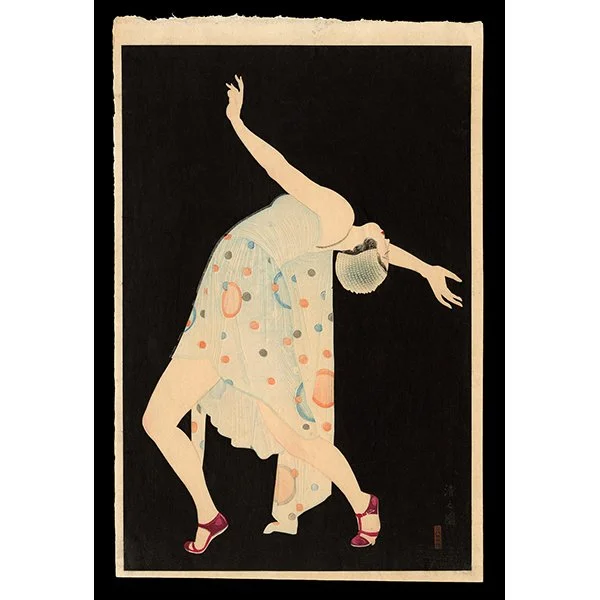

1932
$20,000
Odori
Kobayakawa Kiyoshi (1899–1948)
MEDIUM: Woodblock print
DATE: 1932
EDITION: 33/100
DIMENSIONS: 17 ¾ x 12 ¾ inches
CONDITION: Excellent; no problems to note
NOTE: Silver Mica Background; limited edition numeration on reverse
LITERATURE: The Female Image, pl. 196
$20,000.00