

 Image 1 of 1
Details
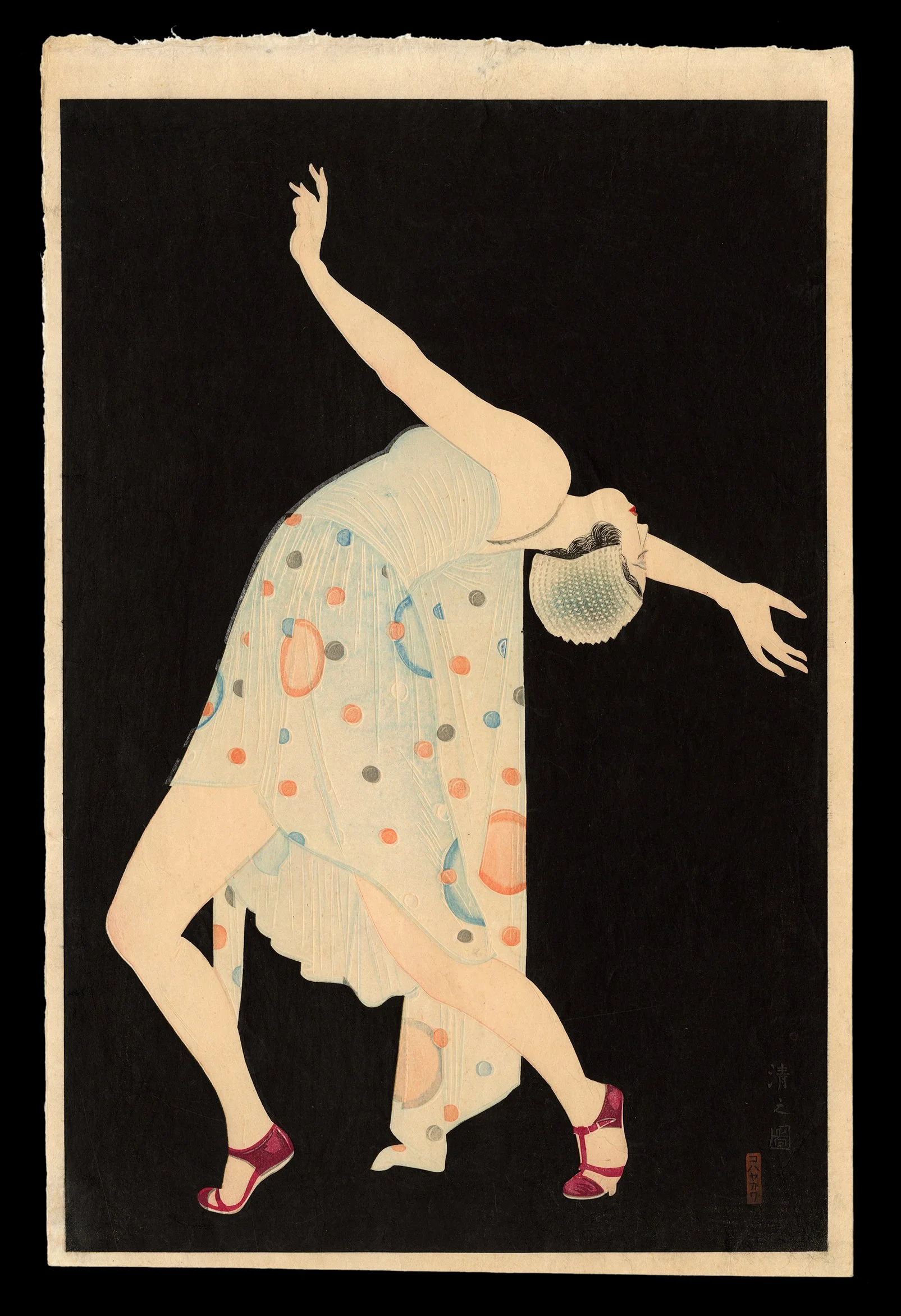
Often referred to as Arch of the Instant, Kobayakawa Kiyoshi’s Dancer is widely regarded as the artist’s most celebrated and sought-after depiction of Western-style dance. The composition presents a female dancer suspended in a dramatic backward arch against an immense field of velvety black, her body stretched almost to the point of abstraction. Clad in a translucent patterned dress and vivid pink heels, she appears captured at the height of motion, poised between elegance and physical abandon. The sheer boldness of the composition distinguishes the print not only within Kiyoshi’s oeuvre, but within the broader landscape of early Shōwa printmaking itself.
The print emerged during a period when Western dance culture had become deeply embedded within urban Japanese life. By the early 1930s, jazz halls, cabarets, cafés, and dance revues flourished throughout Tokyo and Osaka, offering younger generations new forms of entertainment and self-expression shaped by international influences. Kiyoshi transforms this cultural phenomenon into a striking visual language of rhythm and movement. The dancer’s bare shoulders, abbreviated dress, and high-heeled shoes reflect the modern sensibilities associated with metropolitan nightlife, while her exaggerated pose suggests the influence of contemporary revue performance and avant-garde stage choreography circulating through Japan during the period.
Particularly remarkable is the artist’s attention to fleeting physical detail. One of the dancer’s toes slips delicately free from her shoe, a small but unforgettable gesture that heightens the sense of movement and immediacy within the composition. This subtle detail transforms the image from stylized performance into something unexpectedly human and tactile. The escaped toe suggests not perfection, but motion so forceful and spontaneous that the body briefly exceeds the constraints of costume and presentation. Kiyoshi’s sensitivity to such nuances gives the print its extraordinary vitality.
At the same time, Dancer reflects the complex atmosphere of Japan in the early 1930s, when cosmopolitan culture and growing social conservatism increasingly existed in tension. Western dance was embraced by many as a symbol of sophistication and liberation, yet it was also criticized by conservative voices who associated dance halls and jazz culture with moral instability and excessive Western influence. Kiyoshi does not engage these tensions directly, but they linger quietly beneath the surface of the image. The dancer exists isolated against darkness, removed from any visible audience or setting, as though suspended within a fleeting cultural moment whose freedom already feels fragile.
Connoisseur's Note
Among Kobayakawa Kiyoshi’s depictions of modern femininity, Dancer remains unparalleled in both ambition and execution. The print demonstrates the artist’s extraordinary ability to reduce form to its essential emotional and rhythmic elements while preserving a remarkable sense of elegance. The composition is almost radically minimal: figure and void, motion and stillness, flesh against darkness. Yet within this reduction lies immense psychological and visual complexity.
The dancer’s arched body recalls the influence of contemporary Art Deco aesthetics, modern theater design, and the increasingly cinematic sensibility shaping Japanese visual culture during the early Shōwa years. Kiyoshi understood the modern body not merely as a subject of beauty, but as a vehicle for performance, individuality, and transformation. Here, the dancer’s pose becomes an emblem of modern existence itself—dynamic, unstable, theatrical, and fleeting.
Collectors have long prized Dancer not only for its rarity and visual power, but because it encapsulates the atmosphere of a rapidly changing Japan with extraordinary precision. The print captures a society captivated by speed, jazz rhythms, imported fashion, and new forms of urban pleasure, even as broader political currents moved toward increasing rigidity and nationalism. In retrospect, the image feels almost suspended between exuberance and disappearance, preserving a moment of artistic and cultural openness before the tonal shift of the later decade.
The immense black background contributes profoundly to the work’s emotional resonance. Rather than functioning merely as negative space, it becomes an active force surrounding the figure, amplifying her luminosity while introducing an undertone of silence and isolation. Against this darkness, every detail acquires heightened intensity: the pale curve of the arms, the translucent folds of the dress, the gleam of pink heels, and most memorably, the tiny exposed toe slipping from the dancer’s shoe. It is precisely this fleeting imperfection that gives the image its lasting humanity, transforming stylized performance into something immediate, vulnerable, and unforgettable.
More prints by Kobayakawa Kiyoshi:

1932
$20,000
Odori
Kobayakawa Kiyoshi (1899–1948)
MEDIUM: Woodblock print
DATE: 1932
EDITION: 33/100
DIMENSIONS: 17 ¾ x 12 ¾ inches
CONDITION: Excellent; no problems to note
NOTE: Silver Mica Background; limited edition numeration on reverse
LITERATURE: The Female Image, pl. 196
$20,000.00