

 Image 1 of 1
Details
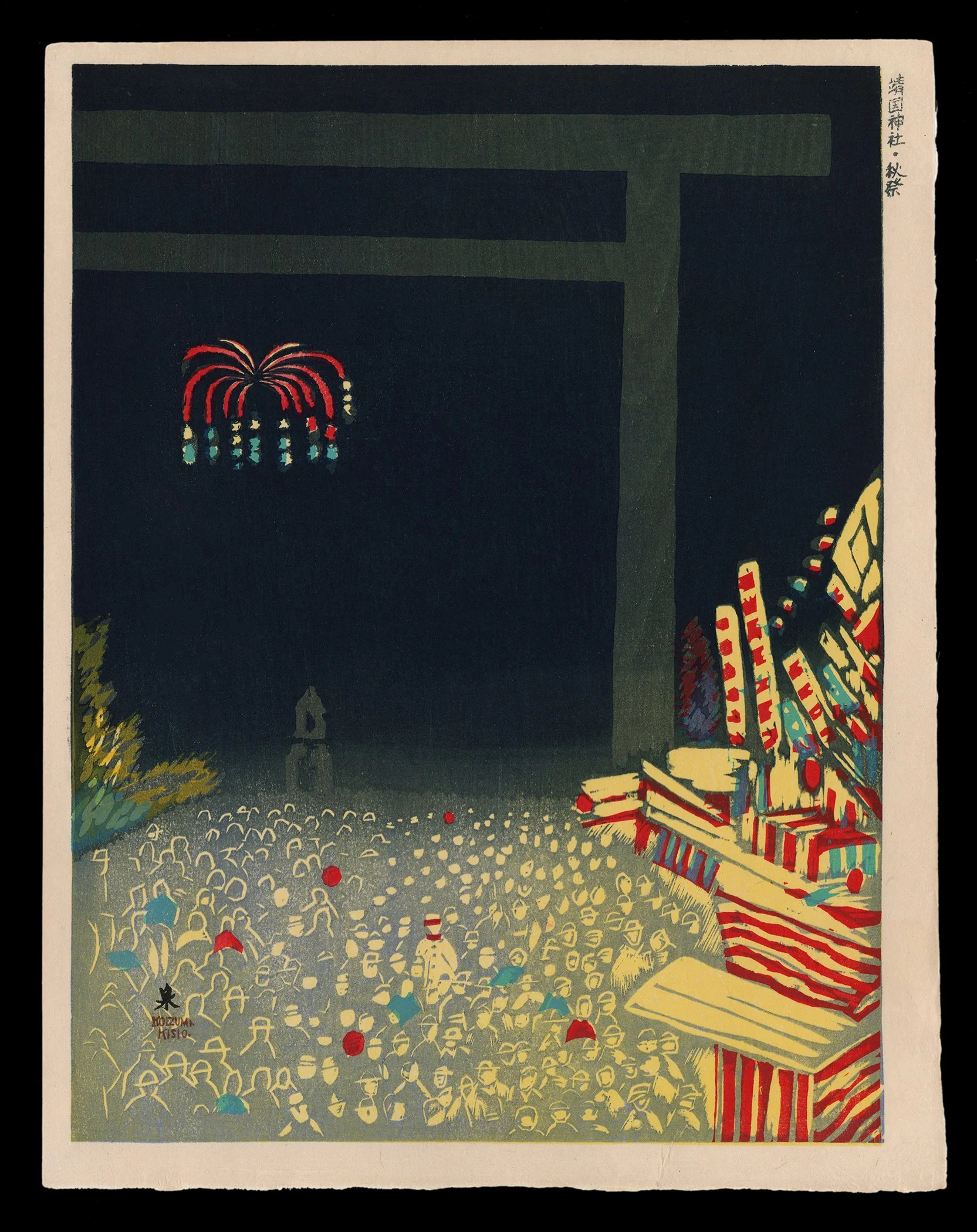
Kishio Koizumi’s Autumn Festival at Yasukuni Shrine captures the charged atmosphere of a Tokyo festival night with remarkable economy and graphic power. Beneath the monumental silhouette of a towering torii gate, an immense crowd gathers in luminous clusters of pale forms, their simplified faces and hats flickering like lantern light against the dense indigo darkness. At the upper left, a burst of fireworks blooms briefly in the night sky, while brightly striped festival structures rise along the right edge of the composition, their red, white, and blue accents punctuating the otherwise restrained palette. The scene balances spectacle and abstraction with extraordinary sophistication, reducing the energy of urban festivity into bold rhythms of light, shadow, and pattern.
Created in 1931 as design number nineteen in Koizumi’s ambitious One Hundred Pictures of Great Tokyo in the Showa Era, the print reflects the artist’s fascination with a metropolis suspended between memory and transformation. Tokyo in the early Shōwa period was increasingly defined by electric illumination, expanding crowds, modern transportation, and new forms of public leisure, yet festivals such as those held at Yasukuni Shrine preserved older communal rituals within the modern city. Koizumi’s composition evokes precisely this coexistence. The gathering crowd includes office workers, laborers, families, and fashionably dressed urbanites moving together through a shared civic spectacle, suggesting how traditional celebrations adapted themselves to the rhythms of an increasingly modern capital.
The composition itself is strikingly cinematic. The immense dark void occupying much of the print creates a sensation of scale rarely encountered in earlier Japanese woodblock traditions. Rather than filling the image with descriptive detail, Koizumi allows darkness itself to become an active visual force. The result is both monumental and ephemeral: a fleeting festival moment suspended beneath the vastness of the Tokyo night.
Connoisseur's Note
Koizumi’s One Hundred Pictures of Great Tokyo in the Showa Era stands among the most important documentary achievements of the Sosaku Hanga movement. Begun in 1928 and completed over the course of nine years, the series chronicled a city undergoing rapid reconstruction and cultural reinvention following the devastation of the Great Kantō Earthquake. Entirely self-carved and self-printed, the project embodies the central ideals of Sosaku Hanga while simultaneously serving as a deeply personal visual record of Tokyo during one of the most dynamic periods in its history.
What distinguishes Autumn Festival at Yasukuni Shrine within the series is its ability to transform collective experience into atmosphere rather than anecdote. Koizumi later recalled with nostalgia the entertainments once associated with such festivals—circuses, musicians, and even moving pictures—suggesting his awareness that these communal urban rituals were already beginning to fade amid the accelerating pace of modern life. That sense of recollection quietly permeates the print. Though crowded with figures, the image possesses an almost dreamlike stillness, as if the artist were preserving not simply a location, but the emotional texture of a vanished Tokyo evening.
The print is also an exceptional example of Koizumi’s mature graphic language. His confident use of large unmodulated areas of color, simplified figural forms, and daring asymmetrical structure reveals an artist deeply attuned to modern design aesthetics while remaining rooted in the traditions of Japanese woodblock printing. Today, impressions from this celebrated series are admired not only as masterworks of Sosaku Hanga, but also as poignant visual meditations on urban identity, collective memory, and the fragile continuity between tradition and modernity.
More prints by Kishio Koizumi:
1931
RESERVED
Autumn Festival at Yasukuni Shrine (no. 19)
Kishio Koizumi (1893-1945)
SERIES: One Hundred Pictures of Great Tokyo in the Showa Era
MEDIUM: Woodblock print
DATE: 1931
DIMENSIONS: 15 1/2 x 11 7/8 inches
CONDITION: Excellent, no problems to note
$2,500.00 <RESERVED>