

 Image 1 of 1
Details
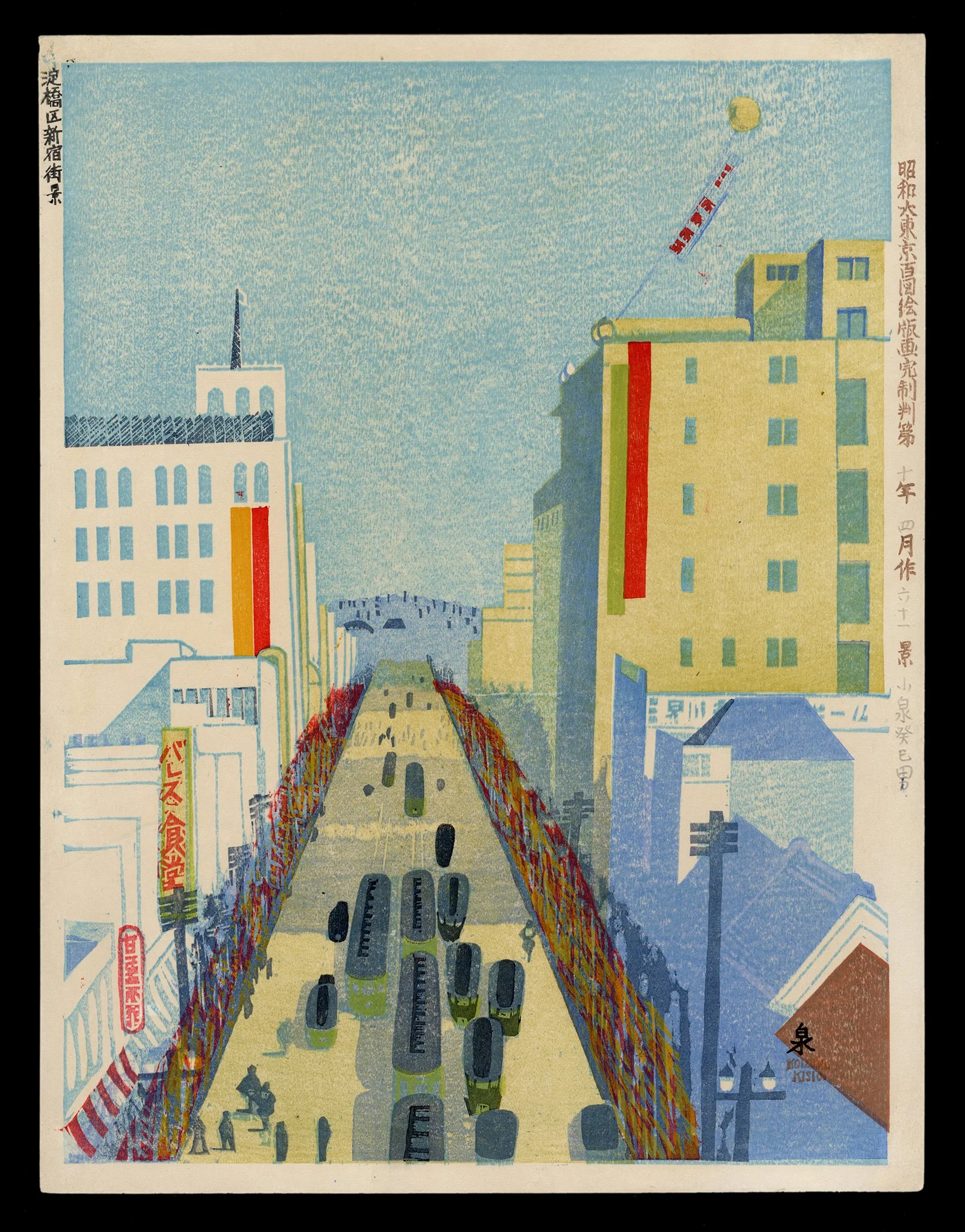
In Streetscape at Shinjuku, Kishio Koizumi presents Tokyo as a city defined by expansion, velocity, and new urban geometries. Viewed from an elevated vantage point, the broad avenue cuts dramatically through the composition, carrying streams of buses, automobiles, and pedestrians toward the distant horizon. Tall commercial buildings rise on either side in simplified planes of pale cream, blue, and gray, while vivid vertical signs and banners punctuate the architecture with flashes of red and yellow. Above, the faint moon hangs in a luminous morning sky, lending the otherwise modern streetscape a curious stillness.
The design captures Shinjuku during its emergence as one of Tokyo’s most fashionable and rapidly developing districts in the early Shōwa era. Rebuilt and transformed following the devastation of the Great Kantō Earthquake, areas west of the imperial center increasingly became associated with modern middle-class life, intellectual culture, cafés, cinemas, and new forms of metropolitan leisure. Koizumi’s carefully ordered perspective reflects this changing urban environment: traffic moves efficiently, commercial signage rises confidently, and the rebuilt city projects an image of disciplined modernity. The scene suggests not merely physical reconstruction, but the psychological reorientation of Tokyo toward a cosmopolitan future.
Koizumi’s compositional economy reveals the influence of modern graphic design and contemporary architecture. Buildings are reduced to flattened volumes and rhythmic bands of color, while the avenue itself becomes an abstract corridor of movement extending into atmospheric distance. Yet the print avoids coldness through subtle touches of human activity—tiny pedestrians, roadside figures, and the delicate interplay of morning light across façades. The elevated viewpoint evokes the sensation of surveying a city in transition, where everyday life unfolds beneath the growing scale of modern urban planning.
In his 1940 annotated index, Koizumi remarked that “Yodobashi, Suginami and Nakano are the fashionable places for the intellectual class to gather.” That observation quietly informs the atmosphere of the print. Shinjuku appears here not simply as a transportation hub or commercial district, but as a center of emerging modern identity where students, office workers, artists, and urban consumers participated in the creation of a new Tokyo culture.
Connoisseur's Note
This print stands among the clearest expressions of Koizumi’s fascination with the modern city as a visual system of structure, circulation, and rhythm. Unlike earlier Japanese city views that emphasized landmarks or seasonal atmosphere, Streetscape at Shinjuku focuses on the experience of metropolitan organization itself. Streets, signage, vehicles, and architecture merge into an ordered network that reflects the increasingly rationalized character of urban life during the 1930s.
The composition is especially notable for its restrained palette and daring use of negative space. Koizumi employs expansive fields of pale blue and cream to create a sensation of openness unusual in depictions of Tokyo, a city often represented through density and congestion. This restraint allows the brightly colored roadside banners and moving vehicles to animate the design with remarkable subtlety. The effect recalls the aesthetics of contemporary advertising graphics and department-store displays, visual languages that shaped the experience of modern Tokyo as profoundly as architecture itself.
As part of One Hundred Pictures of Great Tokyo in the Showa Era, the print also reveals Koizumi’s documentary ambition. Entirely self-carved and self-printed, the series became an extraordinary personal record of Tokyo during one of the most transformative decades in its history. Produced across nine years and eventually expanded through substitute designs, the project reflects not only technical dedication but a sustained meditation on how modernity altered the visual and social fabric of the city. In Streetscape at Shinjuku, Koizumi captures a moment when Tokyo’s expanding suburbs and commercial corridors had become symbols of aspiration, sophistication, and new patterns of urban belonging.
More prints by Kishio Koizumi:
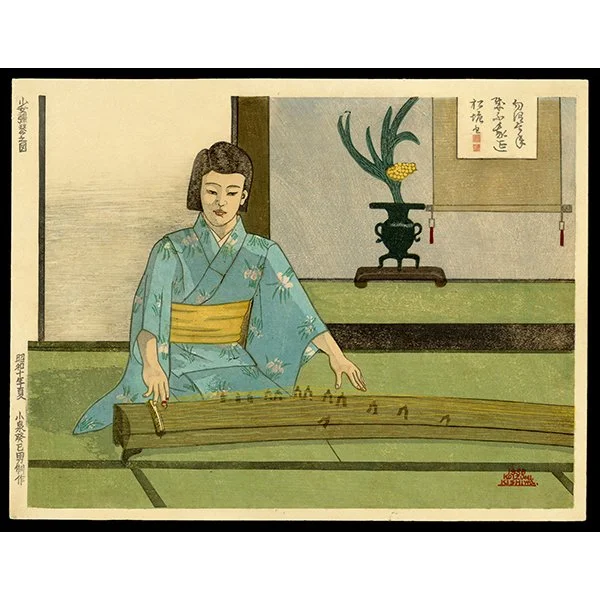
1931
RESERVED
Autumn Festival at Yasukuni Shrine (no. 19)
Kishio Koizumi (1893-1945)
SERIES: One Hundred Pictures of Great Tokyo in the Showa Era
MEDIUM: Woodblock print
DATE: 1931
DIMENSIONS: 15 1/2 x 11 7/8 inches
CONDITION: Excellent, no problems to note
$2,500.00 <RESERVED>