

 Image 1 of 1
Details
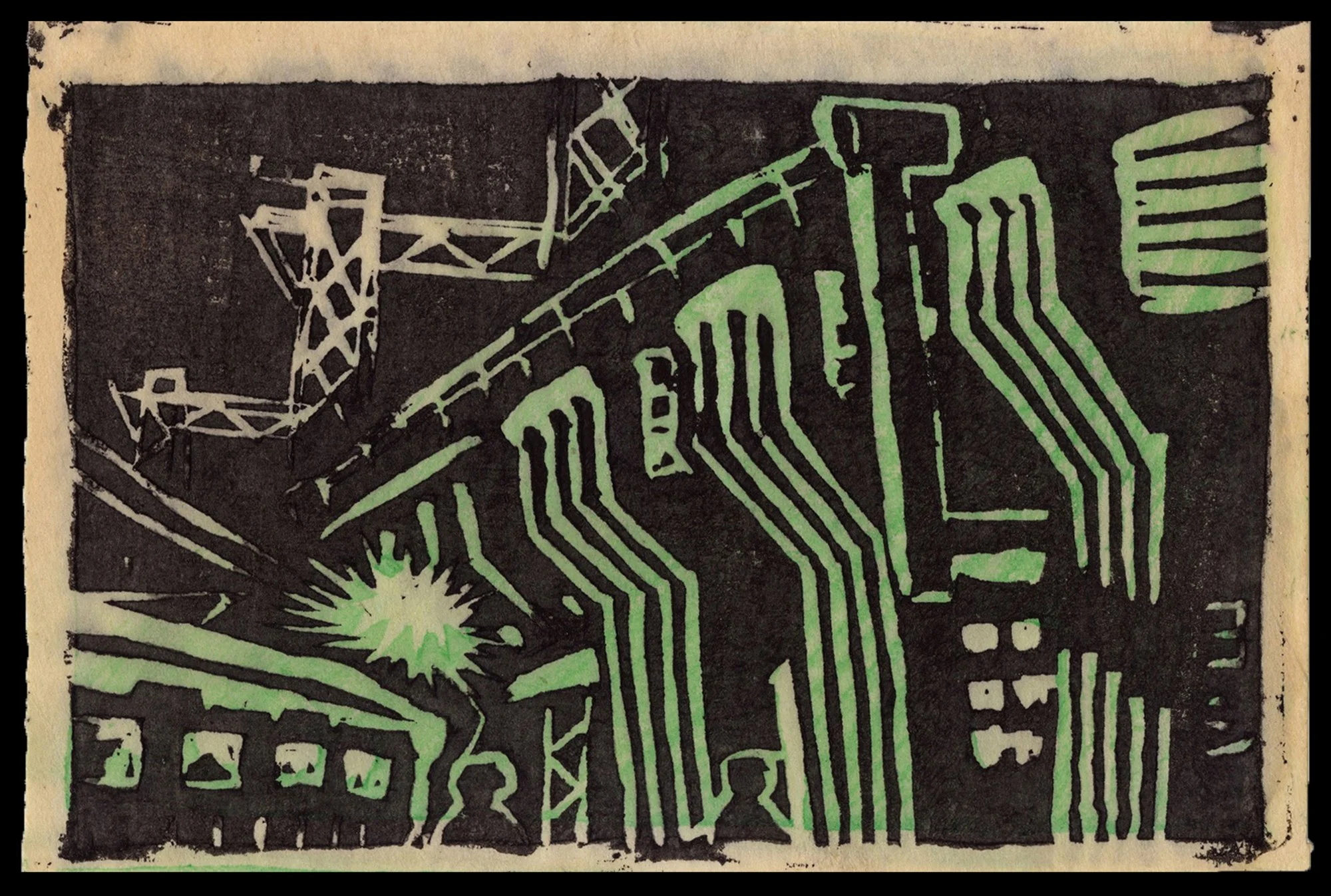
In Near Okachimachi, Yoshio Fujimaki presents a vision of Tokyo transformed into a dense mechanical landscape of rail infrastructure, industrial towers, electric illumination, and compressed architectural forms. Executed in stark black relieved by sharp passages of pale green, the composition reduces the city to an arrangement of angular beams, scaffolding, utility poles, and looming structures that appear to pulse with nervous energy. The image evokes the district surrounding Okachimachi Station, an area deeply associated with rail transit, commerce, and the expanding industrial networks that reshaped Tokyo during the interwar years.
Fujimaki abandons conventional perspective in favor of a fragmented and highly subjective urban experience. Buildings tilt inward, elevated tracks slice across the composition, and electric towers rise like skeletal monuments against the darkened sky. A burst of artificial light erupts near the center of the design, becoming the emotional and visual anchor of the print. Rather than describing the city realistically, Fujimaki conveys the sensation of navigating a modern metropolis defined by noise, movement, machinery, and continual reconstruction.
The print reflects the rapid transformation of Tokyo following the Great Kantō Earthquake of 1923, when districts surrounding major railway arteries became symbols of industrial recovery and metropolitan growth. Okachimachi, positioned between Ueno and Akihabara, embodied this changing urban environment where transportation, commerce, and modern leisure converged. Beneath the looming structures, shadowed silhouettes suggest anonymous city dwellers absorbed into the larger machinery of urban life. Their diminished presence within the composition underscores the psychological scale of the modern city, where individuals moved through increasingly mechanized environments shaped by electric transit, mass entertainment, and industrial labor.
Fujimaki’s aggressive carving style and severe contrasts exemplify the experimental spirit of Sosaku Hanga. Unlike the polished atmospheric effects associated with Shin Hanga, his approach preserves the raw physicality of the carved block itself. Jagged contours, uneven textures, and flattened forms heighten the sense of tension running through the composition. The city appears unstable yet electrifying, embodying both the exhilaration and disorientation of Tokyo’s accelerating modernization.
Connoisseur's Note
Among Yoshio Fujimaki’s surviving works, Near Okachimachi stands as one of the clearest expressions of his avant-garde vision of the metropolis. His urban imagery departs sharply from picturesque representations of Tokyo, instead aligning with broader international currents in Expressionism, Constructivism, and modern graphic design. Yet Fujimaki’s treatment remains uniquely tied to the sensory experience of early Shōwa Tokyo, where elevated railways, factories, cinemas, cafés, and electric signage reshaped daily existence.
Particularly remarkable is the print’s use of limited color. The pale green illumination cutting through deep black surfaces creates a synthetic nocturnal atmosphere suggestive of electric glow, industrial haze, and reflected city light. This restrained palette intensifies the emotional charge of the composition, allowing the architecture itself to appear animated. The city no longer functions as passive setting; it becomes an active force pressing inward upon its inhabitants.
Thematically, the work resonates strongly with the emergence of modern urban identity during the period. Districts such as Okachimachi formed part of a broader metropolitan culture where commuters, office clerks, students, café patrons, and cinema-goers moved through newly interconnected commercial zones. Fujimaki visualizes this environment not through anecdotal scenes of fashionable life, but through the infrastructure that made such modern existence possible. Rail lines, electrical systems, and industrial construction become symbols of a society reorganized around speed, consumption, and continual motion.
More prints by Yoshio Fujimaki: