

 Image 1 of 1
Details
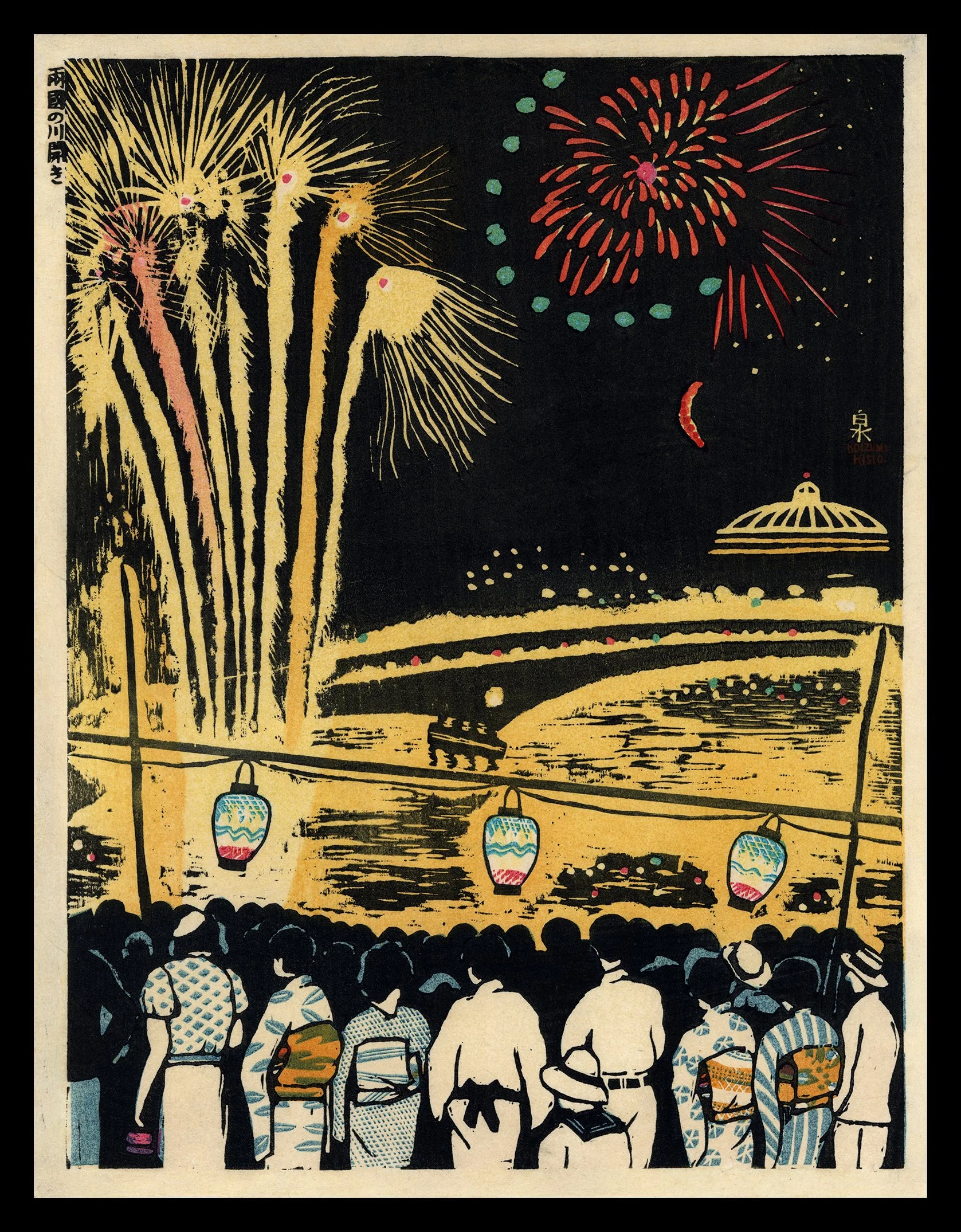
In River Festival at Ryogoku, Kishio Koizumi captures one of Tokyo’s most celebrated summer spectacles with striking graphic immediacy. Beneath an immense black sky, fireworks explode in brilliant bursts of crimson, turquoise, and pale gold above the Sumida River, their reflections shimmering across the water below. The curving bridge and distant illuminated pavilion create a graceful architectural rhythm across the composition, while the crowded foreground is filled with spectators gathered shoulder to shoulder along the embankment. Women in patterned yukata, men in summer attire, and festival-goers carrying fans and lanterns merge into a dense silhouette of urban humanity united by the fleeting spectacle overhead.
The print belongs to Koizumi’s ambitious One Hundred Pictures of Great Tokyo in the Showa Era, a series documenting the evolving identity of Tokyo during a period of extraordinary modernization and social change. Here, Koizumi focuses not on technological progress directly, but on the endurance of communal urban ritual within the modern metropolis. Ryogoku had long been associated with river entertainments, fireworks displays, and seasonal gatherings dating back to the Edo period. By the 1930s, these festivities remained central to Tokyo’s cultural life, though now experienced within a city transformed by electric illumination, modern transportation, and expanding commercial culture. The print beautifully captures this coexistence of continuity and reinvention.
Koizumi’s handling of color and form is especially masterful. The simplified figures, broad areas of flat black, and luminous fireworks reveal the strong influence of modern graphic design while remaining rooted in the traditions of Japanese woodblock printing. The elevated viewpoint allows the viewer to participate directly in the crowd’s collective gaze, transforming the image into both a cityscape and a shared social experience. Lanterns suspended across the foreground introduce a note of intimacy amid the grandeur of the night scene, grounding the spectacle within the rhythms of ordinary summer leisure.
In his 1940 annotated index, Koizumi observed that “the ukiyo-e tradition of depicting fireworks at this site continues uninterrupted.” This awareness of historical continuity quietly permeates the design. Though unmistakably modern in style, the print consciously situates itself within a lineage of artists who for centuries turned to Ryogoku as a symbol of seasonal pleasure and urban vitality.
Connoisseur's Note
River Festival at Ryogoku stands among the most celebrated nocturnal scenes in Koizumi’s series and demonstrates the artist’s exceptional ability to synthesize historical subject matter with distinctly modern visual language. Entirely self-carved and self-printed, the work embodies the ideals of Sosaku Hanga while revealing Koizumi’s sophisticated understanding of composition, rhythm, and emotional atmosphere. His use of stark black space punctuated by brilliant color produces a visual intensity that feels remarkably contemporary even today.
What distinguishes this design within the broader tradition of Japanese festival imagery is its emphasis on collective spectatorship. The fireworks themselves occupy only a portion of the composition; equal importance is given to the assembled crowd whose shared attention defines the event. In this sense, the print becomes a meditation on modern urban community. Public leisure in Tokyo during the early Shōwa era increasingly revolved around mass participation in spectacles—department stores, cafés, cinemas, sporting events, and seasonal festivals—all of which contributed to the formation of new metropolitan identities. Koizumi subtly captures this social transformation through the anonymity and density of the gathered figures.
The print also reveals the enduring relevance of Edo-period cultural memory within modern Tokyo. Ryogoku fireworks had appeared for generations in ukiyo-e by artists such as Hiroshige and Hokusai, yet Koizumi reinterprets the subject through the flattened abstraction and graphic boldness associated with twentieth-century printmaking. The result is neither nostalgic revival nor radical modernist rupture, but rather a carefully balanced dialogue between past and present. This tension gives the work much of its lasting resonance and secures its place among the finest urban night scenes of the Sosaku Hanga movement.
More prints by Kishio Koizumi:
1936
$1,200
Koto Player
Kishio Koizumi (1893-1945)
MEDIUM: Woodblock Print
DATE: 1936
DIMENSIONS: 11 7/8 x 15 1/2 inches
CONDITION: Excellent—no problems to note
$1,200.00
Contact us to purchase