

 Image 1 of 1
Details
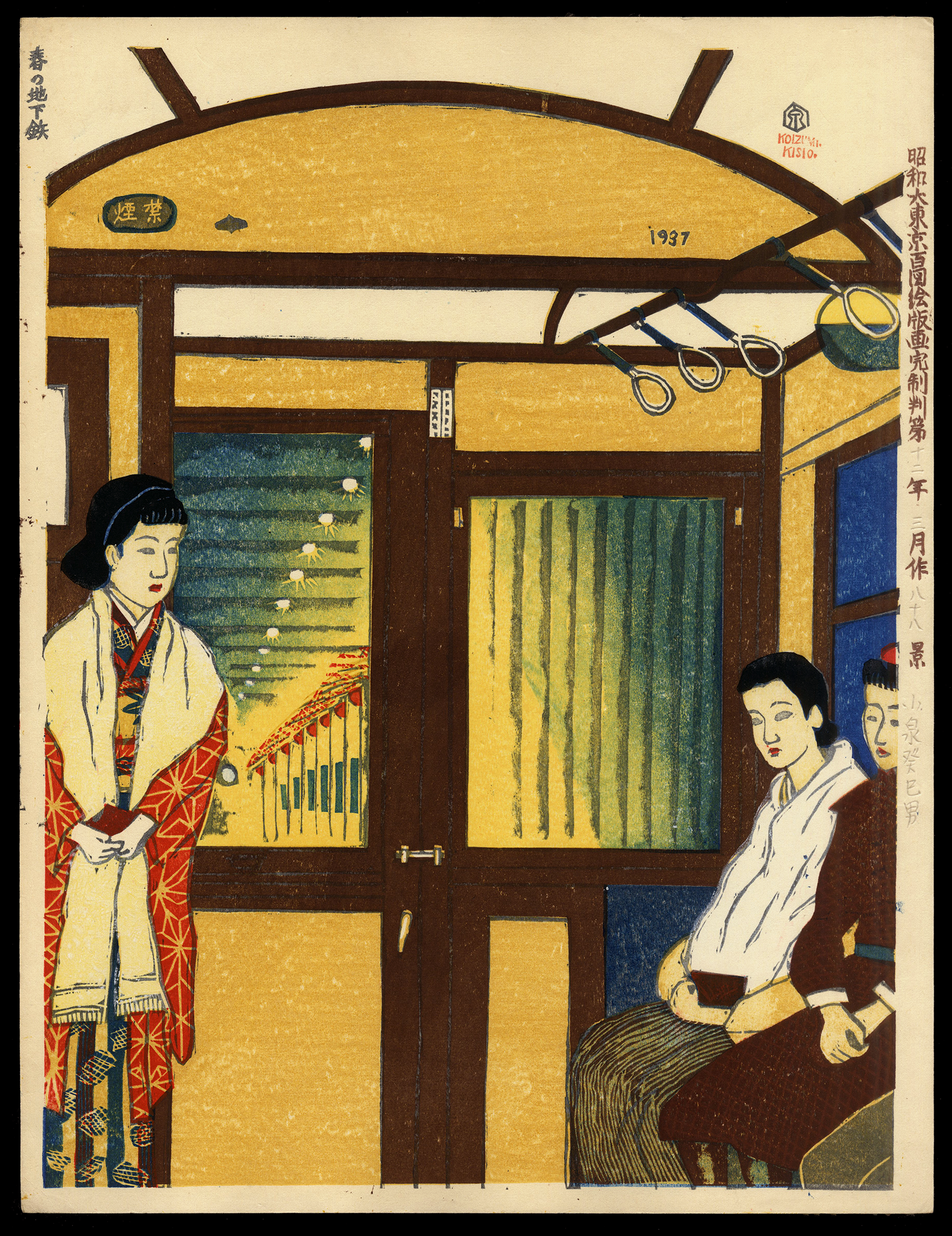
In Subway in Spring, Kishio Koizumi presents one of the clearest visual statements of Tokyo’s transformation into a modern metropolis during the early Shōwa era. Set within the interior of a subway carriage, the composition captures three women quietly suspended within the rhythms of urban transit. The standing figure at left, wrapped in a richly patterned red kimono and pale stole, contrasts strikingly with the seated women at right, whose subdued modern attire and coiffed hairstyles suggest the changing fashions of metropolitan life. Through the subway door window appears a fleeting glimpse of illuminated station architecture and receding electric lights, transforming the train itself into a moving corridor through the expanding city.
The print reflects the rapid modernization of Tokyo’s transportation infrastructure following the opening of the city’s first subway line in 1927, connecting Ueno and Asakusa before gradually extending through districts such as Ginza, Nihonbashi, and Shibuya. Koizumi was deeply attentive to these evolving urban experiences. Here, modernity is not depicted through monumental architecture or machinery alone, but through the subtle choreography of anonymous passengers sharing enclosed public space. The subway carriage becomes a distinctly modern social environment in which traditional and contemporary identities coexist uneasily yet elegantly.
Koizumi’s composition is remarkable for its structural precision. The geometry of the carriage frames, overhead hand straps, and vertical window divisions creates an ordered rhythm that mirrors the mechanized regularity of subway travel itself. Yet against this architectural order, the figures remain introspective and detached, absorbed within private thought despite their physical proximity. The warm ochres and muted greens soften the industrial setting, lending the scene an atmosphere of quiet intimacy rather than mechanical coldness.
The artist later noted in his annotated index that department store stations were decorated with artificial flowers to attract customers, a detail that subtly underscores the increasing interconnection between consumer culture, transportation, and daily urban life. By the late 1930s, the subway had already become more than infrastructure; it was a stage upon which new forms of modern identity and public behavior emerged.
Connoisseur's Note
As one of the later designs in One Hundred Pictures of Great Tokyo in the Showa Era, Subway in Spring demonstrates the full maturity of Koizumi’s artistic vision and technical control. Entirely self-carved and self-printed, the series remains among the defining achievements of Sosaku Hanga, chronicling nearly a decade of Tokyo’s rapid reconstruction and social transformation through the perspective of an artist deeply engaged with the city’s evolving character.
What distinguishes this print within the series is its concentration on interior psychological space rather than exterior spectacle. Koizumi shifts attention away from crowded boulevards and monumental civic architecture toward the quieter emotional textures of metropolitan life. The restrained expressions of the passengers and the stillness of the compartment suggest the subtle alienation accompanying modern urban existence, particularly for women navigating newly expanded freedoms within the city. The subway carriage becomes not simply a mode of transportation, but a symbolic threshold between older social customs and increasingly modern patterns of movement, fashion, and independence.
The print also reveals Koizumi’s sophisticated understanding of contemporary design aesthetics. The flattened forms, carefully balanced asymmetry, and restrained palette align the work with broader international modernist tendencies while remaining firmly rooted in the Japanese woodblock tradition. Particularly striking is the artist’s ability to transform ordinary urban experience into something contemplative and enduring. In this sense, Subway in Spring stands as both a document of modern Tokyo and a nuanced meditation on the changing tempo of everyday life within the modern city.
More prints by Kishio Koizumi:
1936
$1,200
Koto Player
Kishio Koizumi (1893-1945)
MEDIUM: Woodblock Print
DATE: 1936
DIMENSIONS: 11 7/8 x 15 1/2 inches
CONDITION: Excellent—no problems to note
$1,200.00
Contact us to purchase