

 Image 1 of 1
Details
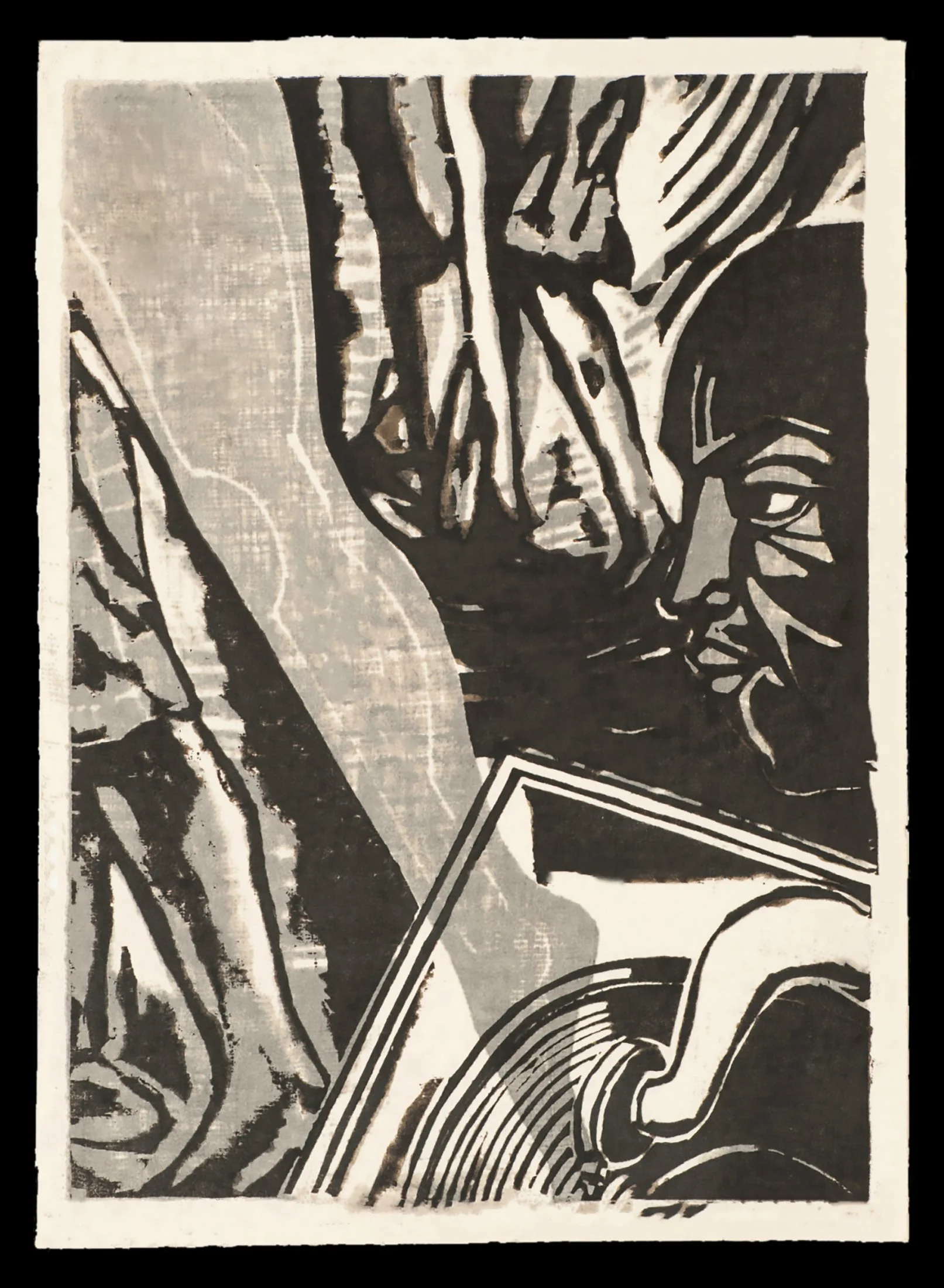
Few artists of the sōsaku hanga movement captured the psychological rhythm of modern urban culture as profoundly as Kōshirō Onchi. In Jazz, the artist abandons conventional figural representation in favor of fractured forms, syncopated lines, and compressed spatial tensions that visually echo the improvisational structure of jazz itself. Rather than depicting musicians or dancers directly, Onchi evokes the sensation of jazz—the vibration of sound, the collision of bodies, and the emotional atmosphere of the modern metropolis.
Angular black forms intersect dramatically across the composition, creating a dense orchestration of visual rhythm. A partially obscured face emerges from the darkness at right, while curving linear passages below suggest the circular movement of a gramophone record. These overlapping elements produce an atmosphere of fragmentation and immediacy characteristic of interwar modernism. The image feels less observed than experienced, as though the viewer has stepped into the sensory turbulence of a smoky café or underground jazz club in Tokyo during the early 1930s.
Within the context of Two Puffs and a Sip: The Moga and the City, the print occupies a particularly important place. Jazz represented one of the defining cultural imports of the modern age, transforming urban nightlife and shaping the identities of the moga and mobo. Dance halls, cafés, cocktail bars, and jazz clubs proliferated in districts such as Ginza and Asakusa, where young Japanese embraced new forms of music, fashion, and social freedom inspired by Europe and America. Onchi’s composition captures this atmosphere not through literal description, but through emotional abstraction and rhythmic visual structure.
The print also reflects the close relationship between literature, printmaking, and avant-garde culture during the period. Created for Muroo Saisei’s novel The Blue Monkey, the image demonstrates how sōsaku hanga artists collaborated with progressive writers and literary circles to forge a distinctly modern visual language. Onchi understood printmaking not simply as illustration, but as a medium capable of conveying psychological depth, urban alienation, and the fragmented tempo of contemporary life.
Stylistically, Jazz reveals Onchi’s mastery of reduction and abstraction. Thick black contours collide with pale tonal passages, while jagged diagonals disrupt any stable reading of space. The resulting composition possesses a raw immediacy that differs markedly from the polished refinement of shin hanga. Instead, the work embraces emotional intensity and expressive distortion, aligning Japanese printmaking with broader international currents of German Expressionism and European modernist design.
Connoisseur's Note
Kōshirō Onchi’s Jazz stands as a compelling exploration of modern urban consciousness. Unlike many Japanese prints of the early Shōwa era that merely depicted fashionable modern life, Onchi sought to convey its psychological and sensory experience. The fractured composition, abrupt contrasts, and compressed forms mirror the emotional dissonance and exhilaration of the rapidly changing metropolis.
Particularly significant is the print’s intimate relationship to literary modernism. Produced for Muroo Saisei’s The Blue Monkey in 1932, the work demonstrates Onchi’s central role within Japan’s avant-garde intellectual circles. Rather than functioning as conventional book illustration, the print operates as a parallel emotional text—an abstract visual counterpart to the novel’s psychological atmosphere. This integration of literature, music, and graphic experimentation reflects the interdisciplinary spirit of Japanese modernism during the interwar years.
This impression is especially important as a rare self-printed work by the hand of the artist. Such impressions possess a distinct vitality absent from later reproductions or workshop editions. Onchi’s direct manipulation of pigment and pressure allows the print surface itself to become expressive, with velvety blacks, uneven tonal passages, and subtle textures contributing to the work’s emotional intensity. The tactile qualities of the ink and paper reinforce the improvisational energy suggested by the title.
The print further reveals Onchi’s remarkable ability to synthesize international modernist aesthetics with Japanese visual sensitivity. While influenced by European Expressionism and abstraction, the composition retains an unmistakably Japanese awareness of interval, asymmetry, and spatial tension. Areas of emptiness function not merely as background, but as active components of rhythm and silence—visual pauses analogous to musical syncopation.
More prints by Koshiro Onchi:
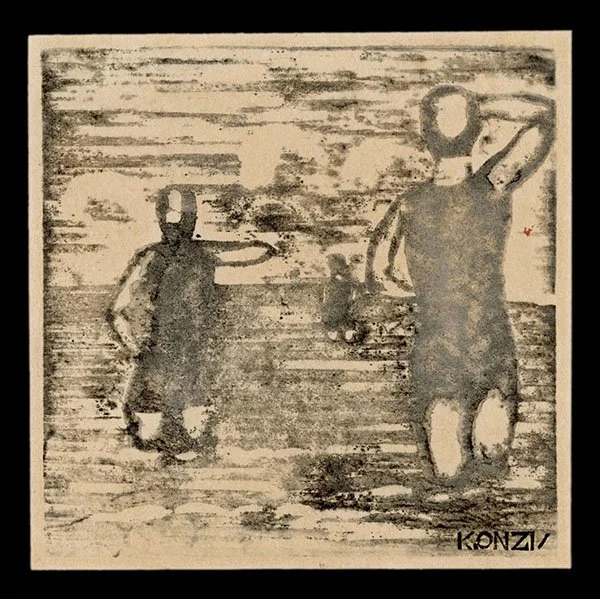
1938
$3,000
Yuigahama Beach, Kamaura
Koshiro Onchi (1891–1955)
SERIES: New 100 Scenic Views of Japan
MEDIUM: Woodblock print
DATE: 1938
DIMENSIONS: 9 x 12 ¼ inches
CONDITION: Excellent, no problems to note
$3,000.00