

 Image 1 of 1
Details
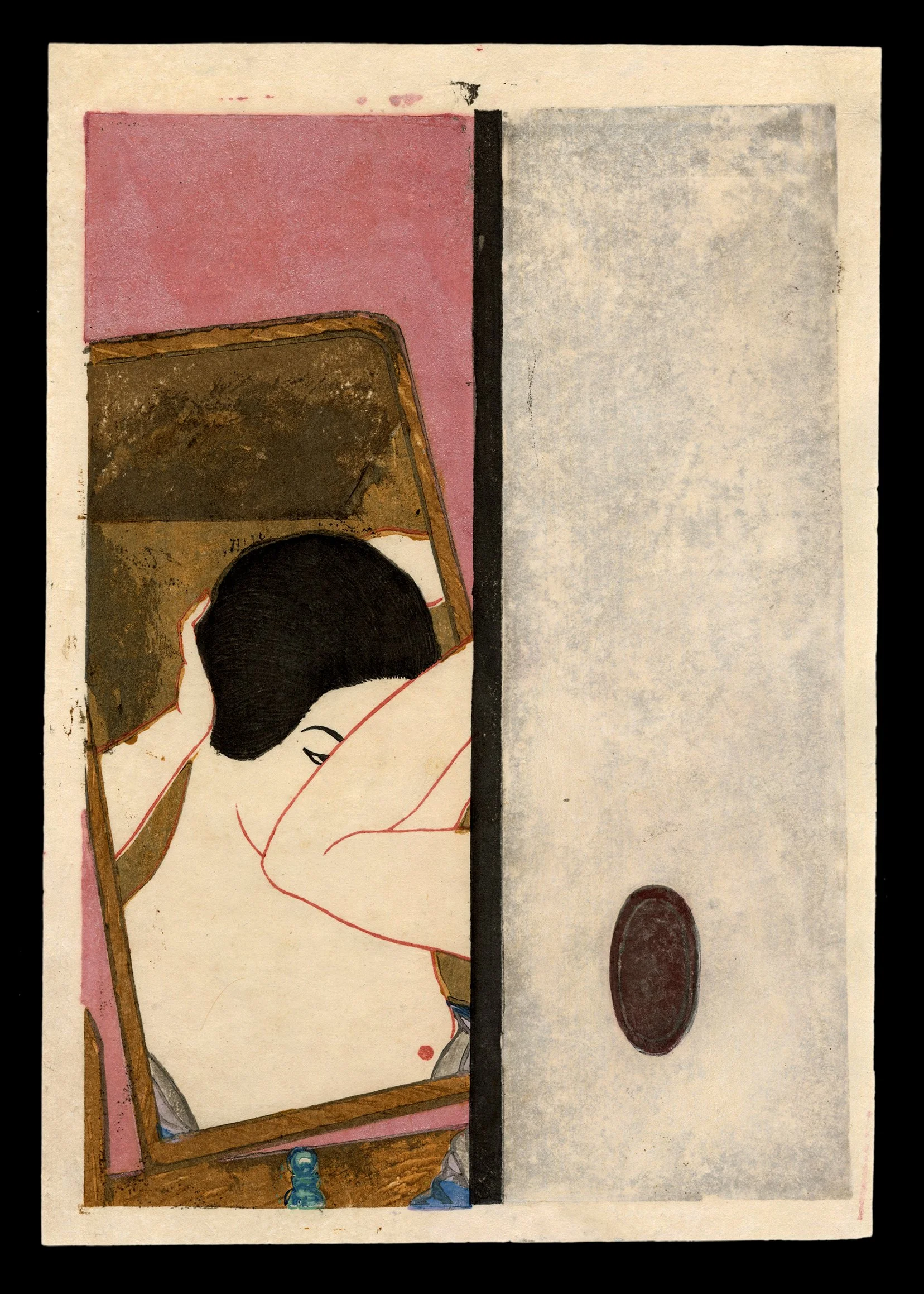
In Mirror, Kōshirō Onchi presents one of the most refined and quietly provocative images of feminine modernity produced within the sōsaku hanga movement. The composition depicts a moga preparing herself before a dressing mirror, yet the artist deliberately withholds the complete figure. Rather than presenting the woman directly, Onchi offers only fragments of her body through reflection and concealment: the curve of a shoulder, the arc of an arm, the dark geometric mass of cropped hair, and the pale surface of exposed skin. This fragmentation transforms the scene into an elegant exercise in suggestion and visual rhythm.
The composition is strikingly playful. A sliding screen partially obscures both the figure and the mirror itself, creating a layered interplay between revelation and concealment. Particularly sophisticated is the visual echo created by the oval handle inset within the screen door, which mirrors the form and placement of the woman’s nipple reflected in the mirror. This subtle repetition introduces an understated erotic wit while maintaining the restraint characteristic of Onchi’s mature sensibility. The humor is quiet, modern, and deeply sophisticated—a fleeting visual joke embedded within an otherwise serene domestic scene.
Within the framework of Two Puffs and a Sip: The Moga and the City, Mirror becomes a powerful image of self-fashioning and urban identity. The modern girl was not merely a social type but an active participant in the construction of modern life through cosmetics, dress, gesture, and appearance. Here, the private act of preparation becomes emblematic of broader cultural transformation. The moga exists between intimacy and performance, between the interior domestic world and the modern city awaiting beyond the screen.
Onchi’s restrained palette heightens the print’s psychological subtlety. Soft pinks, pale grays, and warm ochres create an atmosphere of quiet sensuality, while the large passages of unoccupied space lend the composition an almost abstract clarity. The artist’s mastery lies in what he chooses to omit. The image depends upon partial glimpses and suspended moments, inviting the viewer to complete the scene imaginatively.
Stylistically, Mirror demonstrates Onchi’s extraordinary synthesis of Japanese compositional restraint and international modernist design. The flattened forms, cropped viewpoint, and emphasis on geometry recall aspects of Art Deco and European avant-garde aesthetics, yet the print remains deeply rooted in Japanese sensitivity to interval, balance, and silence. The result is a composition of remarkable elegance and psychological immediacy.
Connoisseur's Note
While many depictions of the moga during the early Shōwa period emphasized spectacle, fashion, or urban nightlife, Onchi instead turns inward, focusing on the quiet private rituals through which modern identity was constructed. The print possesses an unusual intimacy, yet avoids voyeurism through its abstraction, restraint, and compositional intelligence.
This impression is particularly significant as a rare self-printed work by the hand of the artist, preserving the immediacy of Onchi’s spontaneous wet-printing technique. The fluid tonal surfaces, uneven pigment absorption, and softly shifting textures reveal the artist’s direct engagement with paper, moisture, and pressure during the printing process. Such impressions possess a tactile vitality and atmospheric richness often absent from later or commercially printed examples.
Of special importance is the subtle gray tonality added to the otherwise white sliding screen door—an effect absent from other known impressions of the design. This delicate modulation deepens the composition spatially and introduces a remarkable atmospheric softness to the print. The gray wash transforms the screen from a purely graphic element into an active participant within the composition, balancing the warmth of the reflected figure while heightening the work’s sense of quiet interiority.
The print further demonstrates Onchi’s extraordinary command of modern composition. The image is built not through complexity of detail, but through precision of omission. Every line, shape, and interval functions rhythmically, allowing the composition to hover delicately between figuration and abstraction. The partially concealed figure becomes less a portrait than an emotional presence—an evocation of modern femininity filtered through memory, reflection, and atmosphere.
More prints by Koshiro Onchi:
1938
$3,000
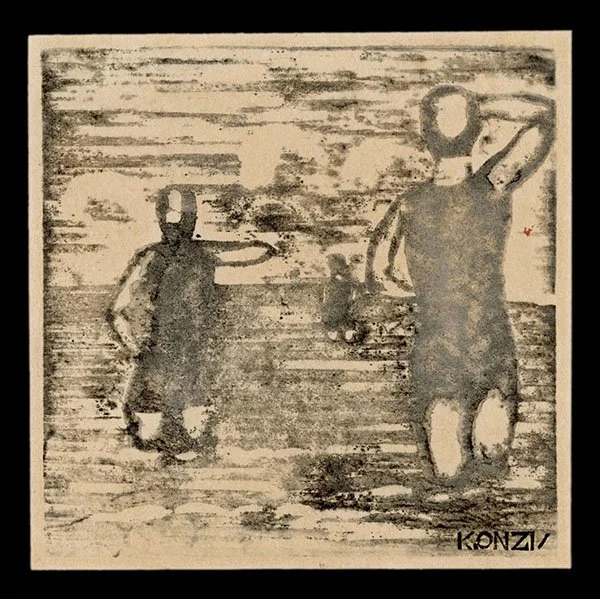
Yuigahama Beach, Kamaura
Koshiro Onchi (1891–1955)
SERIES: New 100 Scenic Views of Japan
MEDIUM: Woodblock print
DATE: 1938
DIMENSIONS: 9 x 12 ¼ inches
CONDITION: Excellent, no problems to note
$3,000.00