

 Image 1 of 1
Details
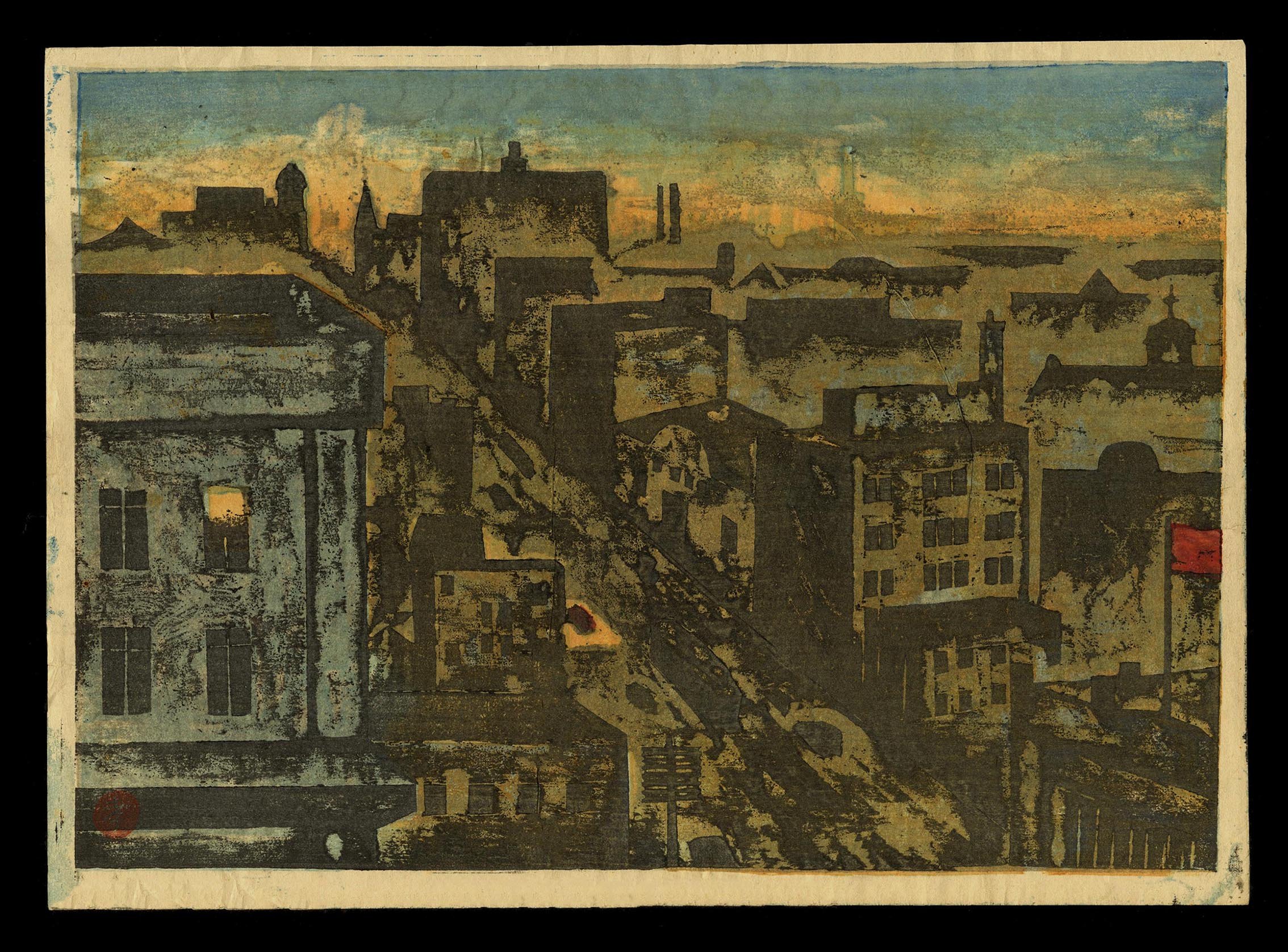
In View from Surugadai, Kōshirō Onchi transforms the modern city into a poetic field of shifting forms, muted silhouettes, and atmospheric texture. Looking out across the rebuilt urban landscape of Tokyo from the elevated district of Surugadai, the composition presents a dense arrangement of buildings dissolving into smoke, haze, and fading light. Streets descend diagonally through the city like channels of movement and memory, while smokestacks, domes, and modern structures emerge rhythmically against the evening sky.
Unlike the polished precision associated with shin hanga, Onchi embraces instability and material immediacy. Pigment appears rubbed, layered, and partially dissolved into the paper surface, creating a vision of Tokyo that feels simultaneously constructed and ephemeral. The city does not stand as a fixed monument, but as a living organism in perpetual transformation. The soft blue sky and warm ochre horizon evoke dusk descending upon the metropolis, while the darkened architectural masses suggest both the promise and uncertainty of modern urban life.
Within the framework of Two Puffs and a Sip: The Moga and the City, the print offers an especially sophisticated meditation on Tokyo as the psychological landscape of modernity. Surugadai, long associated with intellectual and cultural life, became increasingly intertwined with the new urban identity emerging after the earthquake reconstruction projects of the late 1920s. The rebuilt city was no longer the Edo of memory, but a sprawling modern capital shaped by concrete architecture, widened boulevards, industrial infrastructure, cafés, department stores, and cosmopolitan aspirations.
Onchi’s approach differs profoundly from documentary realism. Rather than recording exact architectural detail, he conveys the emotional atmosphere of the city itself—the sensation of observing Tokyo from above as smoke, evening light, and industrial haze soften the boundaries between structures. The resulting image possesses a dreamlike ambiguity that aligns closely with the aesthetic principle of yūgen: the subtle suggestion of forms partially concealed and emotionally resonant beyond direct description.
The composition also reveals Onchi’s deep engagement with international modernism. Fragmented perspectives, compressed spatial relationships, and expressive tonal surfaces recall contemporary European avant-garde printmaking while remaining grounded in Japanese sensitivity to interval and atmosphere. The city becomes both material and psychological space—a modern metropolis filtered through memory, emotion, and abstraction.
Connoisseur's Note
View from Surugadai stands among Onchi’s most compelling urban compositions of the early Shōwa period. While many artists documenting the rebuilt capital emphasized technological triumph and architectural clarity, Onchi instead explored the emotional and sensory dimensions of modern Tokyo. His city is not triumphant in a purely industrial sense; it is introspective, atmospheric, and profoundly human.
Particularly important is the print’s place within the unfinished series One-Hundred New Views of Tokyo. Conceived as a modern counterpart to earlier Japanese landscape traditions, the project sought to redefine the cityscape through the language of sōsaku hanga modernism. Rather than idealized landmarks, Onchi focused on mood, perception, and lived experience. In this regard, the print reflects the broader ambitions of the movement itself: to create prints that were deeply personal, expressive, and modern.
This impression is especially significant as a rare self-printed work by the hand of the artist, revealing Onchi’s celebrated spontaneous wet-printing technique. The uneven application of pigment, softly broken surfaces, and fluid tonal transitions demonstrate the immediacy of the artist’s direct engagement with block and paper. Unlike commercially printed editions, self-printed impressions such as this preserve the subtle variations and experimental textures that define Onchi’s mature aesthetic. The print surface itself becomes alive with atmosphere, carrying traces of gesture, moisture, and timing.
The work further demonstrates Onchi’s extraordinary ability to balance abstraction with architectural suggestion. Buildings dissolve into washes of pigment, yet the city remains unmistakably present. This tension between permanence and dissolution gives the composition its haunting power. The modern metropolis appears simultaneously monumental and fragile—a fleeting vision glimpsed at twilight during a moment of profound national transformation.
More prints by Koshiro Onchi:
1938
$3,000
Yuigahama Beach, Kamaura
Koshiro Onchi (1891–1955)
SERIES: New 100 Scenic Views of Japan
MEDIUM: Woodblock print
DATE: 1938
DIMENSIONS: 9 x 12 ¼ inches
CONDITION: Excellent, no problems to note
$3,000.00