

 Image 1 of 1
Details
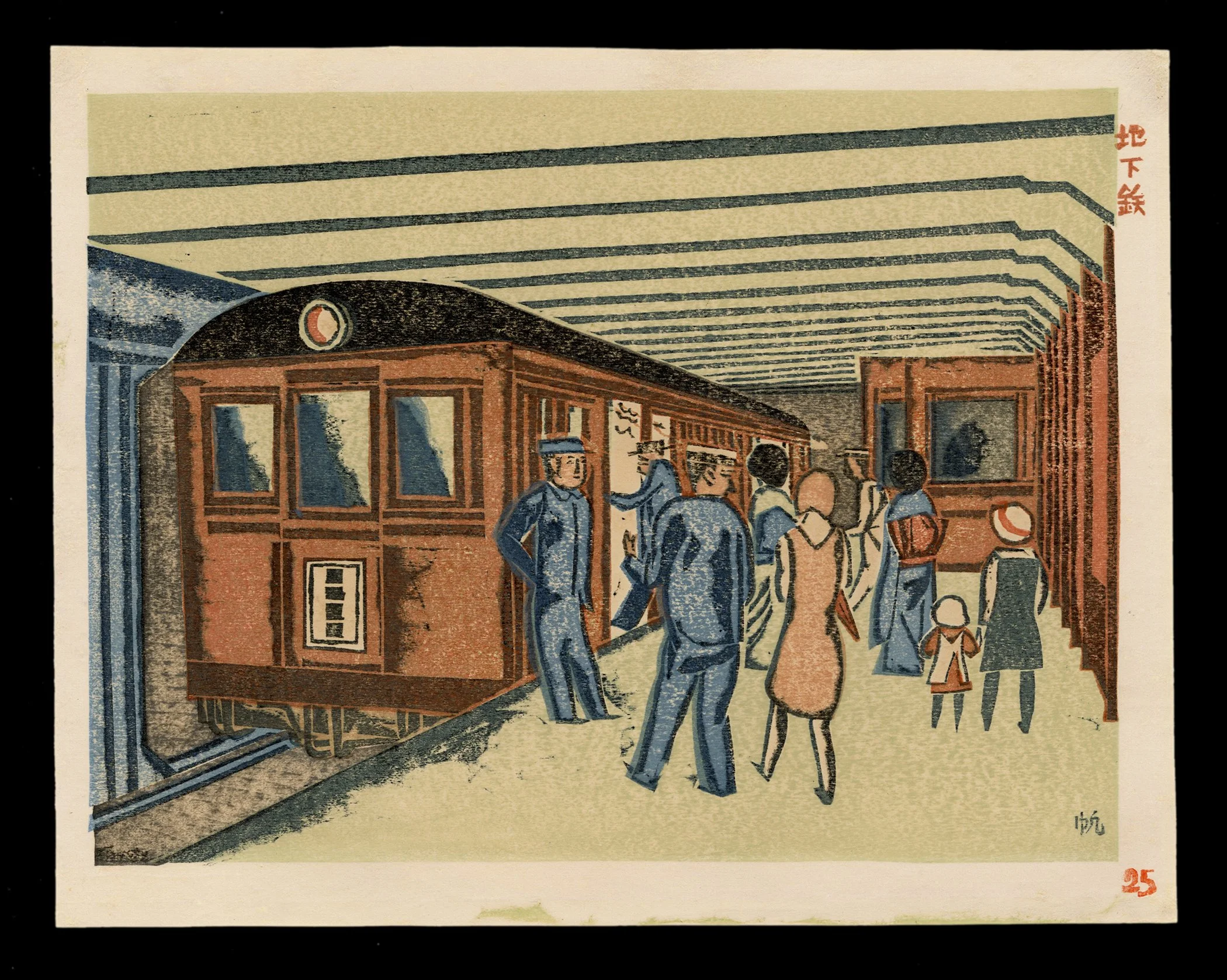
In Subway, Maekawa Senpan captures one of the defining symbols of modern metropolitan life: the underground railway. The composition presents passengers gathering along a subterranean platform as a train arrives beneath a rigid sequence of receding ceiling beams. The geometry of the station creates a powerful sense of depth and movement, guiding the viewer’s eye toward the converging architecture of the tunnel and platform. Rendered in subdued greys, soft browns, and cool blue tones, the print evokes the artificial illumination and enclosed atmosphere of the underground world.
The figures themselves embody the changing rhythms of urban existence. Uniformed railway workers stand beside commuters dressed in both Western and traditional attire, quietly illustrating the coexistence of old and new identities within early Shōwa Tokyo. Women in kimono move alongside modern passengers in coats and hats, while children accompany adults through the station’s ordered flow. The subway, only recently introduced to Tokyo in the late 1920s, represented not merely technological progress but a profound transformation in how the city experienced time, distance, and daily life.Senpan’s restrained design avoids spectacle, instead emphasizing the quiet normalization of modern infrastructure within the everyday routines of the rebuilt capital.
Connoisseur's Note
Maekawa Senpan approached Sosaku Hanga with an unusual sensitivity to ordinary experience. Unlike artists who emphasized dramatic cityscapes or industrial grandeur, Maekawa frequently focused on fleeting moments of common urban life, revealing how modernity reshaped human behavior through subtle social encounters. In this respect, Subway reflects the movement’s broader ambition to document not only the appearance of New Tokyo, but its changing psychology. The underground station becomes a space of disciplined movement, anonymity, and collective rhythm—an environment fundamentally different from the open streets and seasonal landscapes celebrated in earlier ukiyo-e traditions.
The print also reveals the distinctly democratic spirit of the One Hundred Views of New Tokyo project. Rather than privileging monuments or elite spaces, the series elevated modern public life itself into a worthy artistic subject. The subway carried office workers, students, shopgirls, laborers, and families alike, compressing diverse social worlds into shared mechanical space. Within the context of Two Puffs and a Sip: The Moga and the City, the image quietly underscores how the emergence of modern women, consumer culture, and urban mobility depended upon precisely these new infrastructures of circulation. Senpan transforms the underground railway into an emblem of Tokyo’s evolving social fabric, where modern identity was continuously shaped through movement, proximity, and the rituals of the everyday city.
Only fifty impressions of each design in the One Hundred Views of New Tokyo series were produced, making surviving examples increasingly scarce today. The limited production reflects the highly artisanal nature of the project and the independent ethos central to the Sosaku Hanga movement. Prints from the series are now regarded among the most important visual records of Tokyo’s reconstruction during the interwar period.
More prints by Maekawa Senpan:
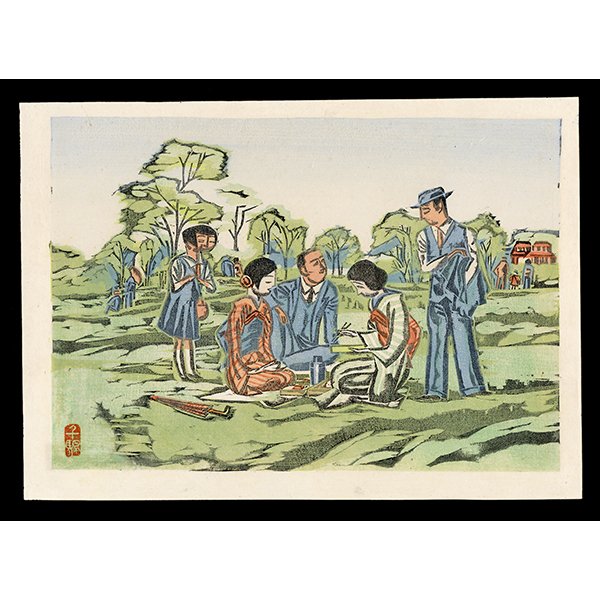

1931
RESERVED
Subway
Maekawa Senpan (1888–1960)
SERIES: One Hundred Views of New Tokyo
MEDIUM: Woodblock print
DATE: 1931
DIMENSIONS: 8 3/8 x 10 5/8 inches
CONDITION: Excellent, no problems to note
$3,000.00 <RESERVED>