

 Image 1 of 1
Details
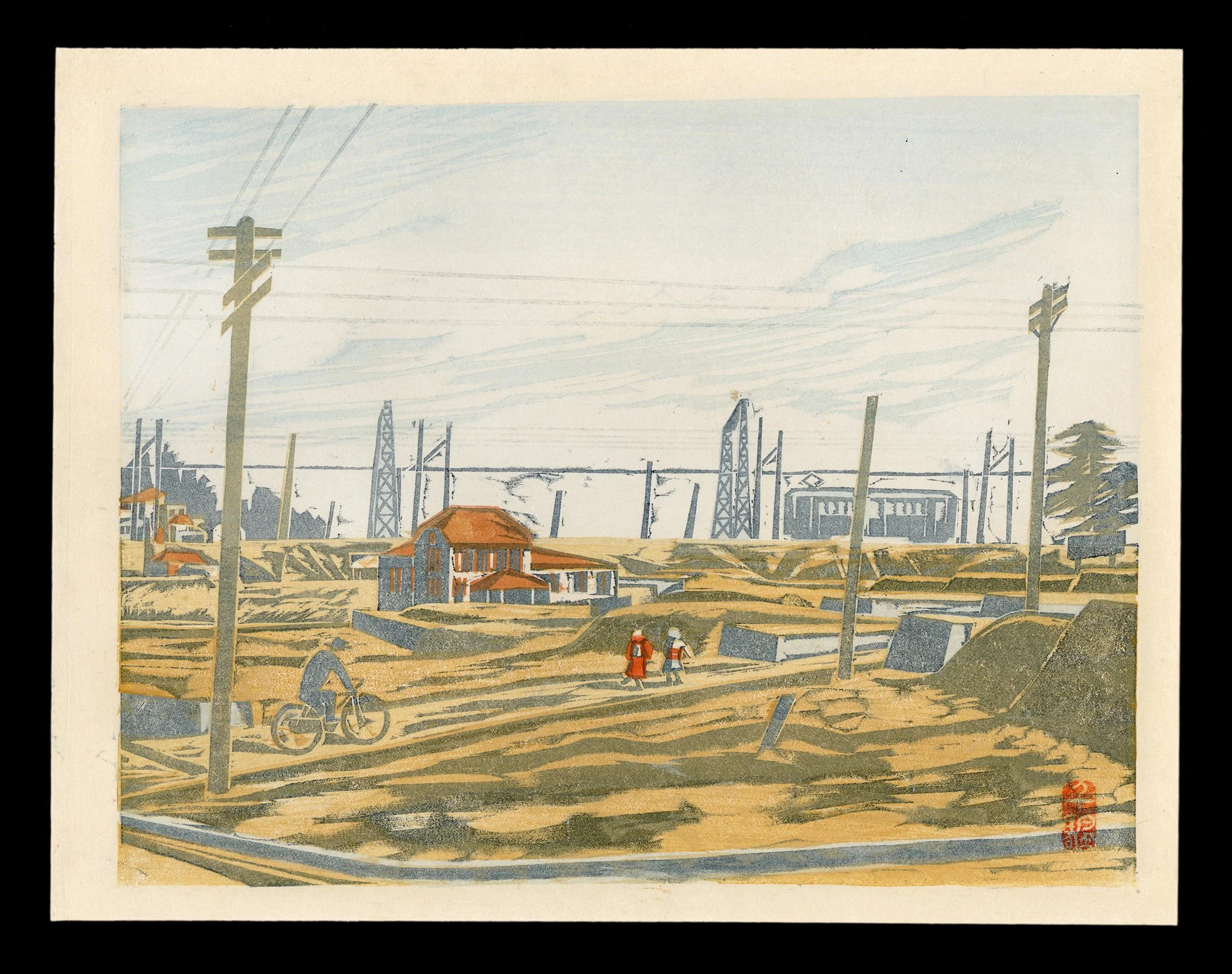
In this understated yet remarkably atmospheric composition, Maekawa Senpan turns his attention toward the transitional outskirts of Tokyo at a moment of profound transformation. A sparse suburban landscape unfolds beneath a pale sky streaked with soft linear clouds. Telephone poles and electrical wires stretch rhythmically across the composition, while distant steel tram structures and industrial frameworks rise above the open terrain. At the center sits a modest red-roofed building surrounded by dirt paths and undeveloped lots, its isolation emphasizing the gradual encroachment of metropolitan expansion into what had only recently been rural countryside.
The composition is notable for its extraordinary restraint. Maekawa avoids visual congestion, instead allowing open space and muted color to communicate a sense of suspended transition. Small figures—a bicyclist, two children in bright red garments, scattered pedestrians—move quietly through the landscape, dwarfed by the emerging infrastructure around them. The tram lines, utility poles, and electrical networks become the true protagonists of the image, subtle markers of technological progress reshaping both geography and daily life. The subdued palette of ochres, pale blues, and soft greys reinforces the impression of a city still in formation, where modernity advances not through spectacle, but through gradual absorption.
Connoisseur's Note
Maekawa Senpan possessed an unusual sensitivity toward peripheral spaces rarely celebrated in traditional Japanese printmaking. While many artists focused upon famous landmarks or bustling entertainment districts, Maekawa frequently explored overlooked environments where the effects of modernization could be observed most quietly and most profoundly. In this print, the suburban fringe becomes a psychological landscape as much as a physical one—a place poised between memory and transformation, where agricultural openness slowly yields to mechanized order.
The work also reflects broader shifts occurring throughout greater Tokyo in the years following the Great Kantō Earthquake. Reconstruction and population growth accelerated outward expansion, bringing transportation systems, utilities, and industrial planning into formerly undeveloped districts. Such areas became laboratories of modern living, where new patterns of commuting, housing, and social life emerged alongside lingering traces of the countryside. Maekawa’s restrained vision captures this historical threshold with exceptional nuance. Rather than dramatizing progress, he reveals its quieter consequences: altered horizons, changing rhythms of movement, and the gradual redefinition of space itself within the expanding modern metropolis.
More prints by Maekawa Senpan:

1931
RESERVED
Subway
Maekawa Senpan (1888–1960)
SERIES: One Hundred Views of New Tokyo
MEDIUM: Woodblock print
DATE: 1931
DIMENSIONS: 8 3/8 x 10 5/8 inches
CONDITION: Excellent, no problems to note
$3,000.00 <RESERVED>