

 Image 1 of 1
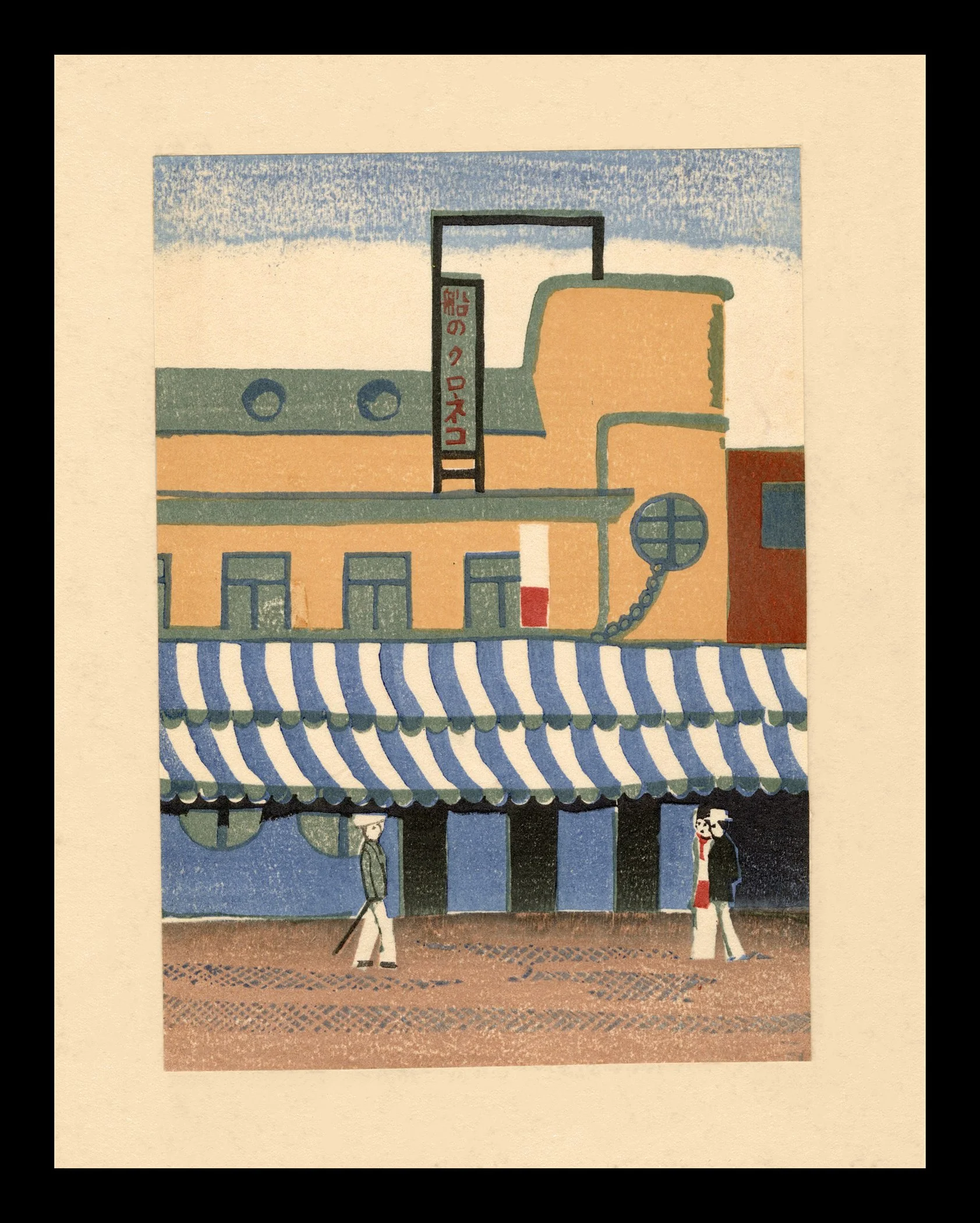
This charming 1930 woodblock print by Matsuki Manji captures a distinctly modern corner of Tokyo’s Ginza district, centered around the fashionable Black Cat Restaurant (Kuroneko). Executed with simplified geometric forms and a restrained pastel palette, the composition evokes the atmosphere of the modern city through elegant economy. Beneath striped awnings, small figures stroll casually along the street while the surrounding architecture rises in softened Art Deco forms, reflecting the increasingly cosmopolitan character of Ginza during the early Shōwa era.
The district depicted here represented the cultural heart of urban modernity in Tokyo. Cafés, restaurants, dance halls, and boutiques transformed Ginza into a gathering place for moga (modern girls), mobo (modern boys), artists, writers, and intellectuals who embraced new fashions and international cultural influences. The Black Cat Restaurant itself belonged to this vibrant café culture shaped by Parisian, German, and American urban aesthetics. In Matsuki’s rendering, however, the scene remains intimate and approachable rather than grandiose. The city appears not as spectacle, but as an everyday lived environment animated by quiet movement and modern social life.
Stylistically, the print reflects the democratic spirit of the sōsaku hanga movement. Rather than pursuing polished illusionism, Matsuki simplifies architecture into flat planes of color and rhythmic shapes, allowing the composition to hover between representation and abstraction. The striped awning becomes almost musical in repetition, while signage and architectural forms create a playful visual cadence across the picture surface. This emphasis on personal expression and direct carving aligns closely with the ideals of sōsaku hanga, in which artists sought creative autonomy through designing, carving, and printing their own works.
Equally important is the print’s publication context. This design appeared in Kitsutsuki Club Magazine Vol. 2, one of the many dōjin (“same-interest”) magazines that sustained the sōsaku hanga movement during its formative decades. These publications allowed artists—many of whom were not full-time professionals—to produce original prints, exchange artistic ideas, and circulate experimental works among fellow artists, collectors, and enthusiasts. Such magazines became essential vehicles for innovation and community, serving as the lifeblood of the sōsaku hanga movement throughout the 1920s and into the mid-1930s.
Connoisseur's Note
Works such as Black Cat Restaurant, Ginza possess historical importance precisely because of their modest scale and original context of distribution. Unlike commercially ambitious print editions, dōjin magazine prints were often produced in relatively small numbers for intimate artistic circles. As a result, surviving examples offer invaluable insight into the experimental networks that shaped modern Japanese printmaking from the ground upward.
Matsuki Manji’s design is particularly compelling for the way it captures the visual language of metropolitan modernity without abandoning the handmade warmth central to sōsaku hanga. The simplified urban architecture, playful signage, and strolling figures evoke the evolving rhythms of Ginza while retaining a sense of personal immediacy. The print does not monumentalize the city; instead, it quietly observes the textures of daily modern life.
The work also reflects a broader transformation occurring within Japanese visual culture during the early Shōwa period. Artists increasingly turned away from nostalgic depictions of historical Japan and embraced the contemporary metropolis as a legitimate artistic subject. Cafés, department stores, electric signs, bridges, cinemas, and modern streets became recurring motifs through which artists explored changing ideas of identity, leisure, and urban experience.
More prints by Matsuki Manji:
1930
$950
Black Cat Restaurant
Matsuki Manji (1906–1971)
MEDIUM: Woodblock print
DATE: 1930
DIMENSIONS: 7x 5 1/8 inches
CONDITION: Excellent, no problems to note
NOTE: Design appeared in the sosaku hanga magazine, Kitsutsuki Club Magazine Vol. 2
LITERATURE: Chiba Museum of Art, Japanese Prints: 1921-1930, pl. 306-2
$950.00 <RESERVED>