

 Image 1 of 1
Details
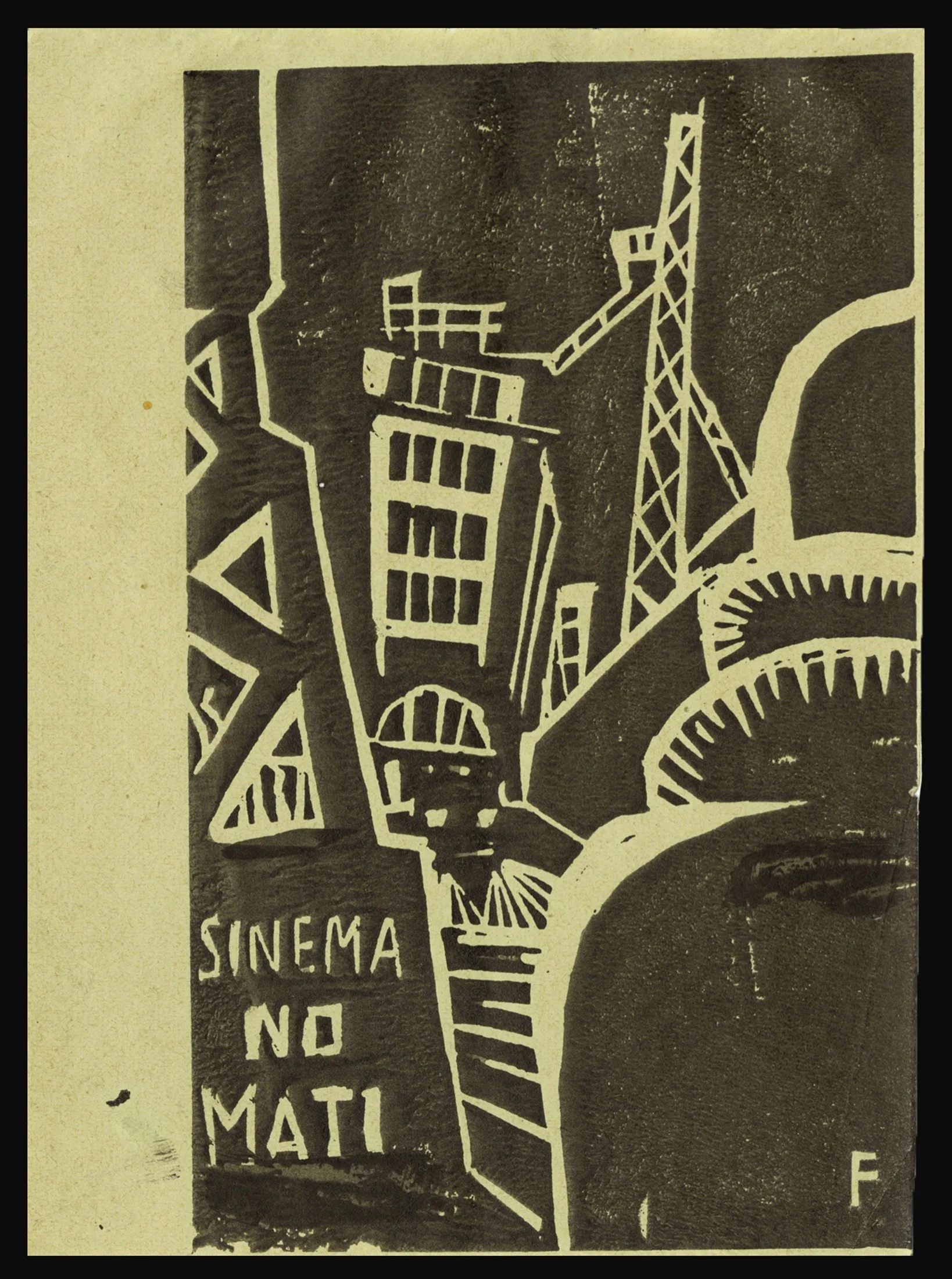
In City of Cinemas, Yoshio Fujimaki transforms the modern city into a fractured landscape of machinery, signage, and theatrical illumination. Executed almost entirely in stark black and white, the composition compresses towers, bridges, industrial forms, and commercial architecture into an angular maze of intersecting diagonals. The bold lettering “SINEMA NO MATI” emerges from the lower left like an illuminated marquee, anchoring the design within the rapidly expanding culture of urban entertainment that reshaped Tokyo during the early 1930s.
Unlike more descriptive city views, Fujimaki’s print does not depict a specific district so much as the psychological sensation of metropolitan modernity itself. Buildings tilt precariously, structures overlap in compressed space, and industrial scaffolding rises like mechanical skeletons against the darkened sky. The city appears restless and unstable, animated by the visual overload of cinema houses, electric signs, and steel construction. This atmosphere reflects the emergence of a new urban culture centered around cafés, dance halls, theaters, and movie palaces—spaces where modern identities were performed, observed, and continuously reinvented.
The cinema occupied a particularly potent role within Tokyo’s modern imagination. By the early Shōwa era, film culture had become inseparable from the rhythms of city life, influencing fashion, language, leisure, and social behavior. Fujimaki’s composition captures that transformation through abstraction rather than narrative. The city becomes a stage of flickering surfaces and fragmented perception, echoing the experience of moving through entertainment districts where neon lights, traffic, advertisements, and crowds dissolved the boundaries between reality and spectacle. The absence of visible figures intensifies this effect; the human presence is implied through architecture and signage, as though the city itself has become the protagonist.
Fujimaki’s bold reduction of form reflects the experimental spirit of Sosaku Hanga, where artists pursued personal expression through self-designed and often self-produced prints. The rough textures and aggressively carved lines preserve the physical energy of the artist’s hand, lending the image a raw immediacy distinct from the polished refinement associated with Shin Hanga landscapes. Here, modern Tokyo is neither romanticized nor condemned. It appears instead as a dynamic and unstable environment shaped by speed, technology, and mass culture.
Connoisseur's Note
Yoshio Fujimaki occupies a singular place within the history of modern Japanese printmaking. Dying at only twenty-four years of age, he nevertheless produced some of the most visually daring urban images of the early Shōwa period. His surviving works reveal an artist deeply engaged with European modernism, cinema culture, industrial design, and the visual fragmentation of the modern metropolis. City of Cinemas stands among his most compelling explorations of the city as a psychological and symbolic space.
The print’s severe black-and-white palette recalls contemporary linocuts, German Expressionist graphics, and avant-garde stage design, yet Fujimaki adapts those influences into a distinctly Japanese urban sensibility. The sharp contrasts create a sensation of artificial illumination cutting through darkness, evoking the experience of wandering entertainment quarters after dusk. Rather than emphasizing atmosphere through color, Fujimaki builds tension through compression, rhythm, and dramatic spatial dislocation. The resulting image feels almost cinematic in itself, unfolding like a montage of urban impressions.
Particularly striking is the manner in which architecture becomes inseparable from commercial spectacle. Theaters, scaffolding, signage, and industrial structures merge into one continuous visual field, suggesting a city defined less by permanence than by consumption and performance. In this respect, the print resonates profoundly with the culture of the modern girl and modern boy, whose identities were shaped through participation in cafés, cinemas, fashion districts, and other spaces of urban display. Fujimaki does not depict these figures directly; instead, he visualizes the environment that produced them.
More prints by Yoshio Fujimaki: