

 Image 1 of 1
Details
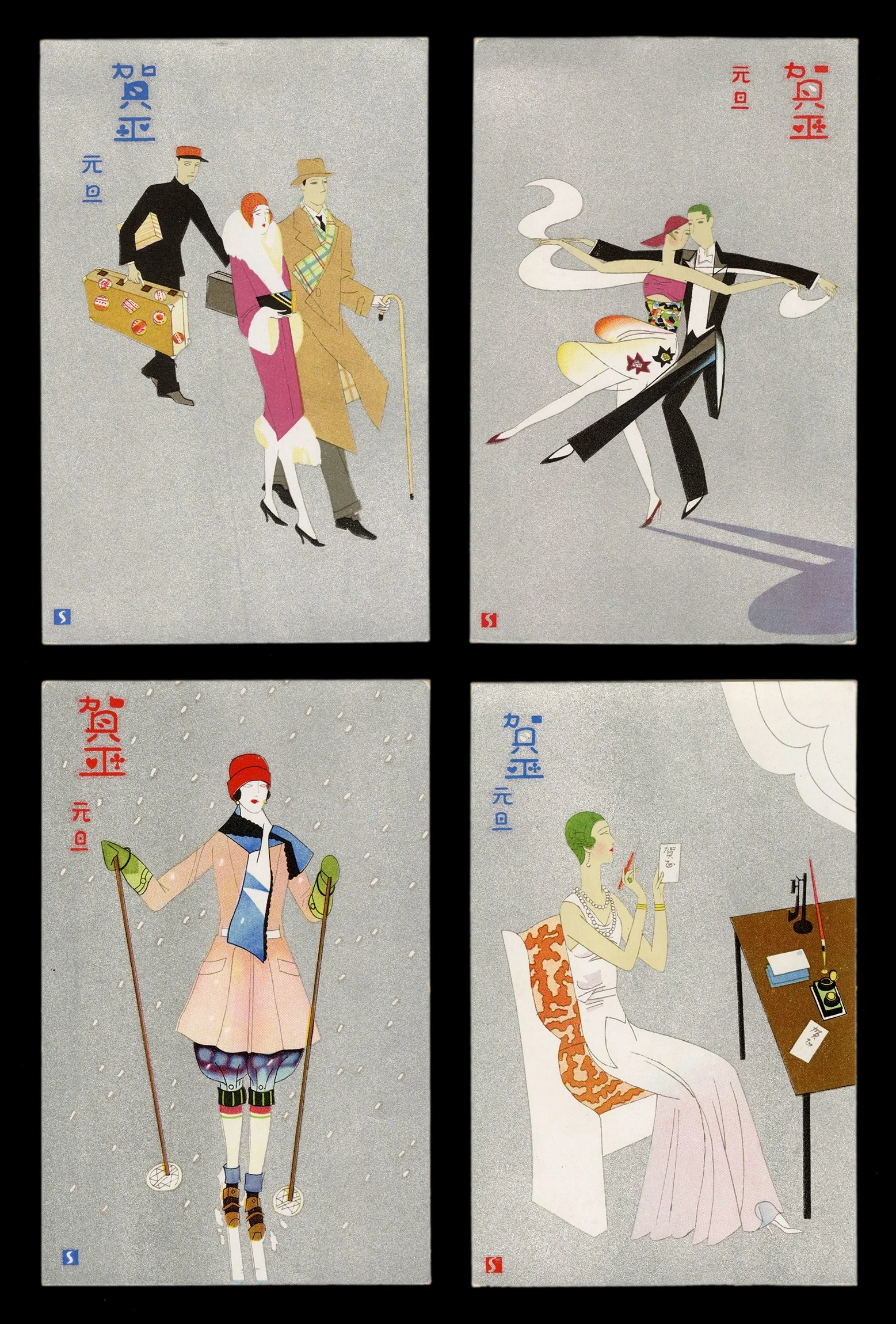
Against shimmering fields of silver mica, Dazai Atsuo presents four vignettes of a new, conspicuously modern Japan. Issued by the Isetan department store, these remarkable woodblock-printed postcards celebrate the fashionable world of the moga and mobo—the “modern girl” and “modern boy” whose clothes, habits, entertainments, and cultivated cosmopolitanism became emblems of urban life in the early Shōwa period.
Each composition isolates its figures against an almost abstract metallic ground, transforming everyday leisure into a kind of modern spectacle. One card depicts a stylish couple accompanied by a porter laden with Western-style luggage, the man impeccably outfitted in overcoat, hat, gloves, and cane: travel itself has become an expression of sophistication. Another captures a dancing couple in exaggerated motion, their elongated limbs and sweeping scarves conveying the speed, syncopation, and theatricality of the modern dance hall. A fashionable young woman on skis embodies the new enthusiasm for Western sport and outdoor recreation, while the final card presents perhaps the quintessential moga: elegantly dressed in an evening gown, seated beside a telephone, cigarette poised in one hand as she reads a note. Fashion, smoking, telecommunications, and the modern interior converge in a single distilled image of metropolitan chic.
Dazai's highly stylized figures are conceived with an economy approaching graphic design. Angular silhouettes, attenuated bodies, flat passages of vivid color, and sharply observed Western fashions suggest the visual vocabulary of contemporary advertising and illustration. The silver mica backgrounds heighten this effect. Rather than describing a particular setting, their cool, glittering surfaces create a luxurious, deliberately artificial space in which the figures appear almost as fashion icons suspended on the page.
Connoisseur’s Note
These four postcards are particularly evocative documents of the intersection between the moga, consumer culture, and the modern department store. Their issuance by Isetan is especially significant: the department store was not merely a place in which the accessories of modern life could be purchased, but one of the principal urban environments through which modern taste was displayed, promoted, and learned.
Dazai's subjects form a miniature catalogue of cosmopolitan aspiration—travel, dancing, skiing, elegant dress, cigarettes, and the telephone. None is presented as exceptional. Instead, modernity appears effortless, pleasurable, and above all stylish. The postcards thus do more than portray mogas and mobos; they participate in the consumer culture that helped create these identities.
The lavish use of silver mica is integral to their effect. Its shimmering surface gives these diminutive prints an unexpected physical presence while reinforcing their atmosphere of luxury and novelty. Against this glittering field, Dazai strips the modern city of its architecture and reduces it to its essential signs: a suitcase, a cane, skis, a telephone, a cigarette, fashionable clothes, and bodies in motion.